New Year’s data dump part 1: Will Ferrell’s gonna Will Ferrell

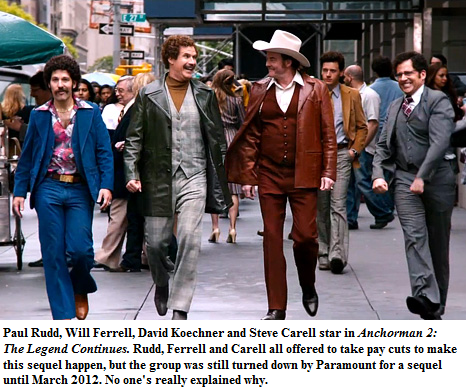
ImageAnchorman 2: The Legend Continues is exactly the movie Anchorman fans have been clamoring for for nine years. For better or worse.

In it, Ron Burgandy (Will Ferrell, who also produces and writes) returns in full salon-quality glory. He’s swiftly fired and separated from wife and co-anchor Veronica Corningstone (Christina Applegate) after she is just as swiftly promoted. Six months later, Burgandy returns to New York to be a part of GNN, the first 24-hour news network.

Anchorman 2 plays like a better, more Anchormany version of Anchorman, with higher highs and lower lows than the 2004 hit.

It’s easy to see that Ferrell and director/writer/producer Adam McKay got their starts on Saturday Night Live. It’s also apparent that Saturday Night Live hasn’t been all that great since before they started middle school. The sketch comedy’s MO is to put a random assortment of weird characters in the same room and then let the sketch run so long it can hardly be called a sketch anymore. As a writing duo, this is all Ferrell and McKay know how to do.

That said, their sketches are more absurd and better tied together than the average SNL romp, even more so in Anchorman 2.

While improving on the raw laugh level, Anchorman 2 also improves on the first movie’s satirical premise. Anchorman, in theory, satirizes chauvinism in the ’70s, but is really just an excuse to be awful toward Applegate. Anchorman 2 is satirizing the 24-hour news paradigm, and it never loses sight of that.

Throughout the movie, Burgandy’s stories degenerate into the optimistic drivel 24-hour news networks have been feeding us for years. In the diagesis, he ends up being credited with the paradigm shift personally. That statement alone makes Anchorman 2 an effective satire — only an anchor as stupid as Ron Burgandy could come up with this view of “news.” As a newsman, it feels like watching a funnier version of Paradise Lost.

This sequel is stronger than the first movie in pretty much every way, and the mass popular demand that drove its production indicates that it’s exactly what people want to see. They pull off  an odd combination of low-brow scene-to-scene humor pasted on a high-brow concept. It’s definitely not something you see every day, and whether or not the style of comedy appeals to individual viewers, this film does have its own unique place.

Joshua Knopp is a formerly professional film critic, licensed massage therapist, journalism and film student at the University of North Texas and a senior staff writer for the NT Daily. You stay classy, 2010s. For questions, rebuttals and further guidance about cinema, you can reach him at reelentropy@gmail.com. At this point, I’d like to remind you that you shouldn’t actually go to movies and form your own opinions. That’s what I’m here for. Keep reading, the data-dump has just begun.

Posted in Entropy | Leave a comment

THE HOBBIT Episode II: Attack of the subplots

The Hobbit: The Desolation of Smaug is an embarrassing kind of stupid, the kind of stupid you can’t help but laugh at.

This is a massive step up from An Unexpected Journey, which is the kind of stupid that makes you feel like your teeth are being pulled out by an old snapping turtle.

The 161-minute film, which covers about 50 pages of source material, follows Thorin (Richard Armitage) and his company of dwarves to Smaug’s (Benedict Cumberbatch, who for some reason also voices Sauron) doorstep, but only for about a third of the runtime.

It also follows Gandalf (Ian McKellan) as he dicks around with villains from another, better movie.

It also follows Bard the Bowman (Luke Evans, who for some reason also plays his character’s ancestor in a flashback) as he… takes care of his family. Or something. He doesn’t really do anything important, but the camera follows him around a lot, so.

It also follows Legolas (Orlando Bloom), who is himself following Tauriel (Evangeline Lilly), a made-up sexual tension elf who is herself following Kili (Aidan Turner) because he was hit by a poison arrow because for some reason there are orcs in this movie.

Ugh.

The first thing to understand about this movie is exactly how transparent of a cash-grab it is. Writer/director/producer Peter Jackson is trying to extract the same amount of footage from a children’s short story as he did from a fantasy epic trilogy. His initial goal, way back in 1995, was for one Hobbit movie followed by two Lord of the Rings movies. After the original trilogy in the early 00’s, these goals became one Hobbit movie followed by a vague mid-quel about the 60-year gap between the two stories. This became two Hobbit movies. In the middle of production, only six months before part one was to be released, this became three Hobbit movies.

This series was, from the start, doomed to be a cluster of thin, barely-there scenes designed more to take up time than tell a story. That was before they put in Azog (Manu Bennett), who’s only real function is to sell toys. That was before the action sequences, which were frightful and to-be-avoided in the book, became highly-stylized amusement park rides. That was before Smaug’s animation was revealed on the side of a commercial airliner, of all places.

An aside- having Smaug as a wyvern instead of a full-bodied dragon, as Tolkien always drew him, because of Game of Thrones’ success? Tisk tisk.

As long as the audience has banished any notion of quality filmmaking from its mind, The Desolation of Smaug is actually fairly enjoyable. It’s stupid, but gleefully so. Sixty years before the original trilogy, Middle-earth apparently didn’t have physics. But the absurd stunts are more likely to put a smile on your face than make you grimace.

This fifth voyage into Jackson’s Middle-earth has, as ever, a huge editing problem, but this is the first film in the set that actually has enough content to match its runtime. It’s padded by storylines that don’t really matter, but still, it’s much rarer in this to feel like nothing is happening in this than in any other Jackson/Tolkien installment.

While the other four have editing problems because they are deliberately and obviously wasting time, The Desolation of Smaug can’t handle all of its extraneous plot threads. At times, viewers will find themselves honestly forgetting about Legolas, Gandalf or even the hobbit himself (Martin Freeman).

It’s not as offensively putrid as An Unexpected Journey, but that’s about all the good that can be said of Desolation of Smaug. There’s still absolutely no reason to watch this instead of the original Lord of the Rings movies.


Image

Joshua Knopp is a formerly professional film critic, licensed massage therapist, journalism and film student at the University of North Texas and a senior staff writer for the NT Daily. Another few months, another semester.  For questions, rebuttals and further guidance about cinema, you can reach him at reelentropy@gmail.com. At this point, I’d like to remind you that you shouldn’t actually go to movies and form your own opinions. That’s what I’m here for. Be sure to come back throughout the rest of the month for reviews of Anchorman 2, The Secret Life of Walter Mitty and various Oscar-bait pictures depending on when they come to the area. 

Posted in Entropy | 1 Comment

It’s always nice when a hit kid’s book series turns out movies that are actually good

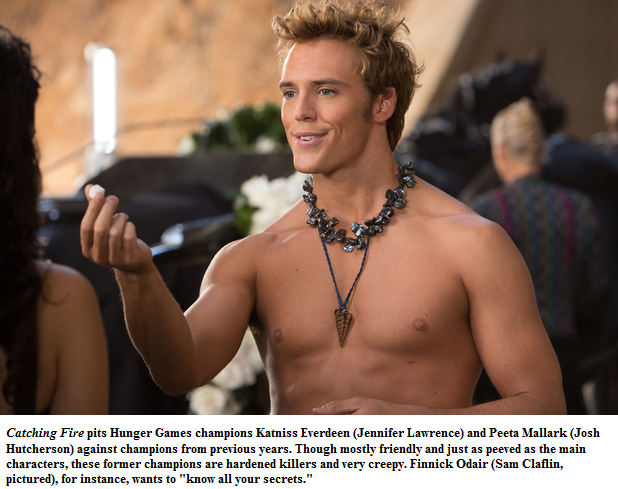
ImageCatching Fire is, for the most part, just as good as The Hunger Games.

While the first movie put Katniss Everdeen (Jennifer Lawrence) into a mess of teenagers trying to kill each other, this film puts her in even less comfortable territory — on a public relations tour for the government that stuck her in the first mess pretending to be in love with Peeta Mallark (Josh Hutcherson). When the facade fails, the government makes some rule changes so they can throw her back into a mess of adults who are also former Hunger Games champions.

Catching Fire features one of the best casts in a long time. Lawrence is the real thing. Her character’s anti-social behavior and paranoid survivalism would make for a potent performance even without the knowledge that she’s a charming, candid interview in real life. The always excellent Philip Seymour Hoffman joins the cast as the new gamemaker. He and Jena Malorne, Jeffrey Wright and Woody Harrelson lead an extraordinary cast of secondary characters.

Fresh director Francis Lawrence doesn’t quite live up to Gary Ross, who everyone thought was coming back after directing The Hunger Games, but his minimalist hand guides the film well. The love triangle that punishes this series with unwarranted comparisons to Twilight is all but left out. The characters’ raw desperation shines through beautifully.

Sadly, the pacing is just barely on the wrong side of perfect, and that can throw off an entire movie. The film seems impatient through its admittedly long first act, and the most interesting part of the movie suffers. We’ve already seen the pagentry and trauma that go into a Hunger Games tournament, and the differences are easy to pick up on. It would have been great to see more detail put into confrontations between Everdeen and President Snow (Donald Sutherland) and Snow and Plutarch Heavensbee (Hoffman).

With a poorly paced beginning and an ending that is horribly reminiscent of The Matrix Reloaded, Catching Fire is far from perfect. But it’s very good, and probably the best thing out this Thanksgiving.

Joshua Knopp is a formerly professional film critic, licensed massage therapist, journalism and film student at the University of North Texas and a senior staff writer for the NT Daily. Happy commercialized harvest festival.  For questions, rebuttals and further guidance about cinema, you can reach him at reelentropy@gmail.com. At this point, I’d like to remind you that you shouldn’t actually go to movies and form your own opinions. That’s what I’m here for. Be sure to come back in a couple of weeks for a review of Inside Llewyn Davis.

Posted in Entropy | Leave a comment

Dark World a half-finished film, has Tom Hiddleston in it

Hey! Marvel’s got a new opening graphic!

ImageIt debuts with Thor: The Dark World. Odin’s (Anthony Hopkins) long, boring narration shows that the dark elves, lead by Malekith (Christopher Eccleston), once tried to destroy all of creation 5,000 years ago when the Nine Realms last aligned around Yggdrasil. And wouldn’t you know it, that’s a quin-millenial occurrence, and right on queue, Malekith wakes up and starts causing trouble again.

The energy he was using, called Aether, infects Jane Foster (Natalie Portman) because the main character has a crush on her, and she starts to get all black swany. Thor (Chris Hemsworth) brings her to Asgard, which is promptly besieged. In order to avenge his home, Thor must free Loki (Tom Hiddleston), who is the entire reason this movie exists.

Thor: The Dark World plays out more like a spoof of an action movie than a real one. In most complete scenes, tropes are played up to be laughed at.

Continue reading →

Posted in Entropy | 1 Comment

12 Years a Slave is fantastic, but you won’t enjoy it

“In time, your children will be forgotten.”

That’s the kind of cheery comfort you can expect heading into 12 Years a Slave.

12 years

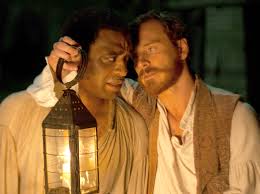
Sadistic, alcoholic plantation owner Edwin Epps (Michael Fassbender) and Solomon Northup (Chiwetel Ejiofor), an enslaved freeman who was taken from his home in New York, have some midnight male bonding time in 12 Years a Slave.

The movie tells the true story of Solomon Northup (Chiwetel Ejiofor), a skilled, black violinist living with his wife and children in New York in 1841. Northup is kidnapped, enslaved and shipped to New Orleans for sale. After 12 years of Jamie Foxx never showing up to kill every white man on screen, Northup finally gets a letter away to his family, who prove his freedom.

12 Years a Slave is going to be required viewing for any film class worth its salt, one of those rare films that will both win and deserve its Oscars, but it’s not perfect.

It’s got that art film stink about it that awards voters love. The cast hinges on a lead nobody’s ever heard of, and he’s surrounded by an all-star team (Michael Fassbender, Benedict Cumberbatch, Paul Giamatti). The score is barely-existent and only ever repeats a few notes. The whole thing is a bit of a transparent pull on liberal sensibilities, although you’d have to be pretty damn conservative to be OK with the abuse Northup endures under the pretense that it was legal at the time.

I’m not Steve McQueen’s biggest fan. His films tend toward a bleak minimalism that make you not want to watch them again, no matter how good they are.

However, it is all these imperfections that loop back and bring out 12 Years A Slave’s harsh beauty. The cast is excellent. The lack of instrumental music allows the constant, vile sounds of physical abuse to take over the background.

This is a film about a culture of rape (literal, figurative and artistic) and enslavement. This is a film about people who are OK with the mortal discomfort of everyone around them. Bleakness is really the only tone you could take. And if you want to watch this movie more than once, there is something fundamentally wrong with you. 12 Yeas a Slave is excellent, but it’s not meant to be enjoyed.

There’s been noise about this being the first slavery film that doesn’t lend any olive branches to whites in the audience, and sadly, that’s not quite true. In the end, it’s a white man (Brad Pitt, the same white man who produces, which can’t be a coincidence) that gets Northup out of his prison. But it’s a lot better than Lincoln and Django.

Last year, the best picture stand featured a sharp dissonance among its ridiculous 10 finalists — both Lincoln and Django Unchained were nominees. Aside from one being mind-numbingly boring and the other being wildly entertaining, Lincoln is yet another movie about old, rich white men talking about how awful slavery is. Django is about the brutality required to keep an entire race of human beings in line.

Quentin Tarantino makes a movie that’s much easier to swallow than 12 Years a Slave, but it’s a huge step up from movies about white politicians saving all the blacks. 12 Years takes that a step further by not having Christoph Waltz hold the lead character’s hand through the film. McQueen has the additional authenticity of being a black person in real life.

Pretty much everyone who thinks slavery was something mild enough that it can be put “in the past” needs to see this movie, and it is truly excellent, but I’d be hard-pressed to recommend it for a majority of audiences. It is very much not for the faint of heart.

Joshua Knopp is a formerly professional film critic, licensed massage therapist, journalism and film student at the University of North Texas and a senior staff writer for the NT Daily. The Counselor wasn’t playing in Denton and I’ve been busy with school and work, bite me.  For questions, rebuttals and further guidance about cinema, you can reach him at reelentropy@gmail.com. At this point, I’d like to remind you that you shouldn’t actually go to movies and form your own opinions. That’s what I’m here for. Be sure to come back next week for a review of Thor: the Dark World.

Posted in Entropy | Leave a comment