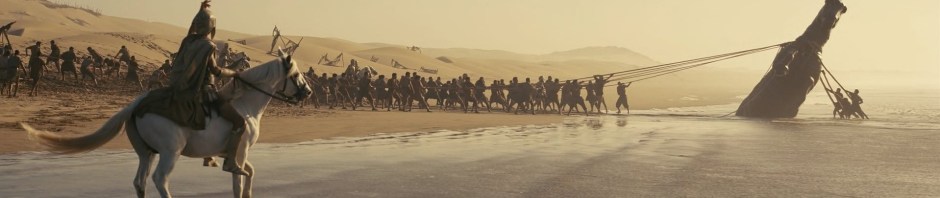

As if a vison from the gods themselves, Christopher Nolan’s The Odyssey has made landfall, a moment in some ways 25 years, in other ways 2,500 years, in the making.
Somewhere in the Mediterranean Sea, 12th Century B.C.- 20 years after leaving for the Trojan War, 10 years after winning that war, Odysseus (Matt Damon), King of Ithaca, cannot get home. His wife and son Penelope and Telemachus (Anne Hathaway and Tom Holland) spend years at the mercy of hundreds of suitors who will not leave their palace, deliberately abusing Greek hospitality customs and wasting his fortune in hopes of forcing Penelope to take one of them in marriage. Lost in a haze under the care of the nymph Calypso (Charlize Theron), Odysseus slowly regains his memory of the war and his doomed voyage home.
Nolan took inspiration primarily from Emily Wilson’s 2017 translation of the poem, which pushes several key concepts to the fore. Most prominent in the final product are the ideas that Odysseus is a liar and his main victories are won through deception – indeed, Roman mythology and poets from Virgil to Dante focus primarily on this aspect of the figure – and, contrarily, the trust and dependence people place on hospitality and honesty in this ancient seafaring world. This is related to another core concept of the gods as present in day-to-day life as peals of thunder or the moods of the Mediterranean.
Wilson also writes about Homer as not being a specific person, but the designated author of oral storytelling traditions that sprang up around the Aegean Sea, traditions that helped spread this understanding of the gods as immediately present – arguing, in a sense, that Homer is the Greek god of poetry, present in every bard, and present now in Nolan. In this understanding of the tradition, there is essentially no difference between interpretation and new source material. There is distinction but not difference between “The Odyssey” and Nolan’s version of The Odyssey.
This is a moment for the history of storytelling, and indeed, the history of the human race. We are a storytelling species. Our instinct to narrativize and anthropomorphize is the bedrock on which we’ve built cultures that have endured across millennia, stories that tell us who we are, that help us identify danger without experience, that keep us alive after we are gone. The Odyssey engages directly with these concepts from its first moments.
It’s fitting that The Odyssey is another window into Nolan’s obsessions, but because this is both one specific story and every story ever told, that window becomes a mirror. We are all familiar with these proclivities – the broken timelines, the hero who creates his own antagonism, the homecoming motifs of Inception and Interstellar, the prelapsarian anguish of The Dark Knight and Oppenheimer.
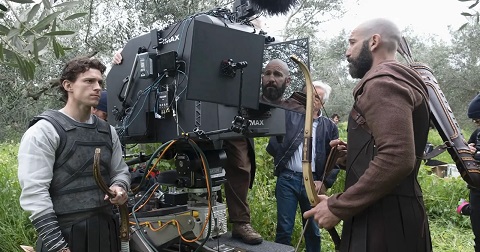
The main selling point of The Odyssey is this is the first movie ever shot completely on IMAX cameras, and that’s another reflection of Nolan personally – they started playing around with IMAX for The Dark Knight, and for The Odyssey, built entirely new cameras housed in soundproof boxes so that they wouldn’t interfere with dialogue scenes, which was the limiting factor before. Behind-the-scenes material shows teams of six cameramen carrying the car-sized beast around like a king on a litter and mirrors attached to the sides so that scene partners could speak to each other from the other side of the thing. You can see some of this reality in the finished product, with a lot of rack focus and not a lot of panning.
Much more important is the brutality of the shoot and commitment to practical effects, as well as practical lighting. Interiors in Ithaca appear to rely on candlelight, giving it a distinct Barry Lyndon vibe. When the sky is grey, the sea is nearly black, and scenes set at night are barely visible. The darkness of the footage often hampers its quality.
Unfortunately, the size of the footage also hampers the film’s quality. IMAX projectors’ platter systems aren’t capable of holding more than three hours of footage, and Nolan said he had to be convinced by IMAX quality officer David Keighley personally that the only solution would involve rebuilding every one of the 25 projectors in the world capable of showing the film at all. The 173-minute runtime tangibly hurts the final product. The scenes in Troy, Hades and the Strait of Messina feel particularly rushed, though most others have room to breathe. If any story deserves a four-hour runtime, it’s this, but there has been no discussion of an extended version, likely because it would immediately undermine the technological marvel that the theatrical cut doesn’t necessarily need to be.
The choice to use these purpose-built but still-impractical cameras, thus tying itself to projectors too impractical to rebuild, is as two-sided as anything else about this project. On the one hand, shooting this on a normal 35mm camera wouldn’t make much of a difference, stipulating that we maintain the same commitment to practical effects and overall craftsmanship, and would have allowed for a more fleshed out cut – really, it only needs five more minutes spread across certain spots, since Nolan’s signature montages already do a great job of compressing the time.

On the other, the scale is the point, matching the greatest story ever told with the largest cameras ever put together.
The Odyssey is looking at a roughly $200 million opening weekend worldwide, though Toy Story 5 and The Super Mario Galaxy Movie’s domestic opening marks are probably out of reach for an R-rated film. Over the past 15 years, filmmaking atrophied as Disney invested in franchise films, offering audiences predictable experiences as a substitute for quality ones, and other studios followed suit. Movies like Oppenheimer and Sinners demonstrate that everyone still knows the difference.
In a very Odyssean sense, and in a very Nolan sense, all of this is both extremely obvious at a surface level while remaining urgent and profound whenever you sit down and take it all in. This Odyssey is just as elemental as every other version of the story, but now taken to the pinnacle of storytelling technology by perhaps its finest craftsman.
This is a moment in human history. Participate in it however you can.
Leopold Knopp is a UNT graduate. If you liked this post, you can donate to Reel Entropy here. Like Reel Entropy on Facebook and reach out to me at reelentropy@gmail.com.

