
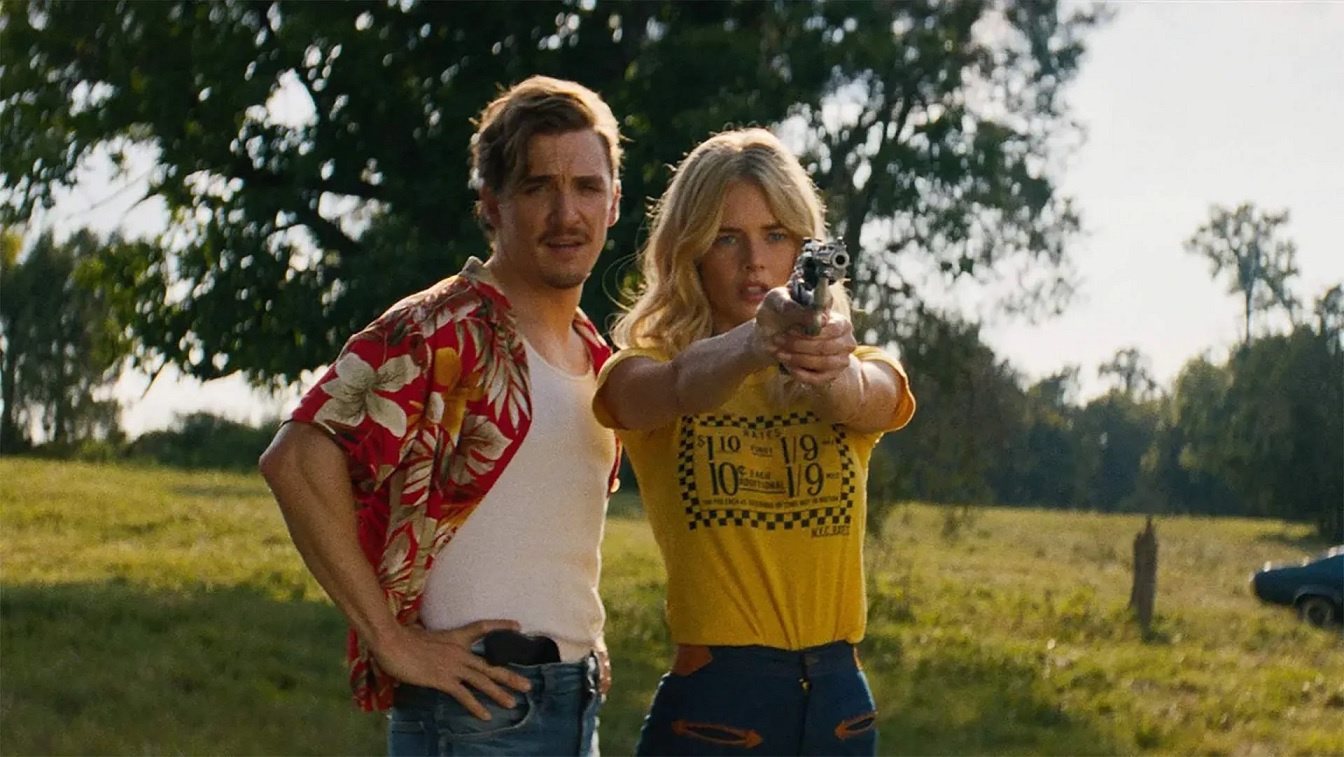
Carolina Caroline, a Southern Gothic erotic crime thriller that’s emerged into the summer dumping grounds of TIFF ’25 onto a very small number of screens, feels ripped from the Classical Hollywood era and re-equipped with modern tools and modern sensibilities as to what can be depicted onscreen. It’s far from what you’d call original, but its execution is transcendent.
Texas – Caroline Daniels (Samara Weaving), stuck working her father’s small-town gas station, is swept off her feet by professional criminal Oliver Anderson (Kyle Gallner). The pair sets off to South Carolina to confront Daniels’ walkout mother, robbing small-town banks as they go.
Carolina Caroline is every good thing you’ve ever heard about a movie. It’s one of the best of the year –or ever of its very specific genre – the steamiest, the most beautiful, the most pulse-pounding, the most emotionally gripping, the deepest Americana, best-written with spectacular lead performances, some of the best sound cues, whatever you want. It’s a technical gem in any applicable category, a great, universally approachable story of leaving home and lost innocence filled with symbolism, which is used to make great shots and tie the fantasy together by elevating the sex and the violence at the same time.
It stands out as a romance by taking viewers deeper into the mindset of someone freshly in love and obsessed with their new partner – every scene is about the couple’s binding to some extent. They get to know each other in the first act, and Daniels’ learning Anderson’s trade in the second is a natural escalation of that process. Releasing into 2026, a moment in history when apps have turned dating into a game of poker in which every player is encouraged to withhold investment for as long as possible so they can fold painlessly at the first sign of trouble, Carolina Caroline takes viewers inside a romance unpoisoned by these things in which both partners go all-in immediately, and we get to spend most of the runtime inside that secure attachment.
The film doesn’t tie itself to a particular time period, though abundant payphones, a thriving cash economy and the state of Anderson’s early ‘70s era Camaro scream late ‘80s. Carolina Caroline’s backwood sprawls across the American South, never filtering into a major city, the kind of network that it feels like doesn’t exist anymore because so much wealth and attention are concentrated at the broadest areas. Like the film itself, Daniels and Anderson stay in a backwood that sprawls across the American South without ever filtering into a major city, the kind of rural, low-budget network that feels like it doesn’t exist anymore. Period detail would be a strength if it were more explicit, but the only real information about the state of Carolina Caroline’s setting is Anderson’s speech about the stock market-based economy, a speech he could have given yesterday. The film becomes all the more universal.
Behind the camera, there’s no insistence on retro technology or filming methods that might make Carolina Caroline stand out as a period piece, either. It’s shot digitally, and carries a lot of common hallmarks like unnecessarily blurry backgrounds and digital color – though this is one of the rare cases where color correction is obvious in a good way. The film is filled with Kentucky’s rich forest greens, complimented by red buildings and nightlife lights, the heightened reds of the lovers’ skin leaving them in a constant state of flushing.

In much of film history, romance is either an afterthought in blockbusters or Oscar films, or even its own genre – the chick flick boom of the ‘90s focused often on couples who spend most of the film yearning or locked in some degree of uncertainty toward each other. In Carolina Caroline, the leads are the most important thing in each other’s lives from start to finish. It’s more honest, more intense and first-person and makes for a better film while narrowing its scope, moving small, intimate dialogue scenes from a money-saving necessity to the main course.
Weaving and Gallner pull us into the relationship with incredible performances of young lovers overwhelmed by new feelings who spend time in a large number of scenes making googly eyes at each other and forgetting how to talk, a decidedly un-cinematic phase of romance that makes it feel so much more intimate than usual. Weaving ups the ante walking a tightrope of uncertainty and excitement in single shots, as well as her solo scenes robbing the banks – Daniels goes in by herself with Anderson waiting in the car, so every robbery has this spectacular shift in energy as Daniels is suddenly on her own in the highest-stress moment.
Carolina Caroline is very much a chick flick, or to put it less derisively, is firmly planted in the female perspective and presents a female fantasy of being swept away by a handsome stranger who fights to realize your dreams and would die to protect you. This fantasy is elevated to a meditation on the meaning of life – if meaning is derived from relationships, which relationships? Daniels searches for what’s missing in her new lover, the parent that stayed and the parent that left, only for these relationships to be overpowered by her new relationship to society, the economy and federal government.
Almost in passing, Carolina Caroline intensely scrutinizes the concept of a “good man,” particularly the different meanings from a lover and an observer. Anderson arrives the classic bad boy, armed, dangerous and obviously a skilled con-man, the things that make him attractive also making him an obviously bad idea. The question of if, when and toward whom Anderson will become violent hangs further and further over the film as it moves along, and sticking tightly to Daniels’ perspective ratchets up this tension – viewers can see her head-over-heels version of events with one eye while recognizing the increasing danger from Anderson with the other.

Roughly 10 years into President Donald Trump’s political career, which has marked a wave of horrifying stories of sexual violence at several levels of power that flow into resentment toward everyday male behavior – obvious reactions to things like the Weinstein scandal or the Access Hollywood tapes somehow transforming into stupid media trends about “man-spreading” or “choosing the bear” – what level of danger do we want from men, exactly? Dangerous enough that they’ll fuck you, but who you know would never hurt you, and still willing to say everything your father wants to hear? Feminist in the streets, abusive in the sheets? This balance isn’t real. It only ever exists in the eye of a lovestruck beholder. Carolina Caroline explores this tension with lust, excitement and ultimately mercy, splitting our heart in two but not stomping on it.
I immediately want to know more about this project and the creative team behind it. This is one of two TIFF features for writer Tom Dean, the other a similar-looking young romance Charlie Harper. Director Adam Carter Rehmeier is in his fifth feature, third in the past six years at about the same high-independent budget range bringing cinematographer Jean-Philippe Bernier and editor Justin Krohn with him from prior projects. He’s known for late-blooming cult hit Dinner in America, also starring Gallner, so the makings of a young auteur with a strong troupe are here.
There’s no great secret behind Carolina Caroline or any of the amazing independent films that are crashing into the spotlight. It’s just a really well-executed movie.
Leopold Knopp is a UNT graduate. If you liked this post, you can donate to Reel Entropy here. Like Reel Entropy on Facebook and reach out to me at reelentropy@gmail.com.

