
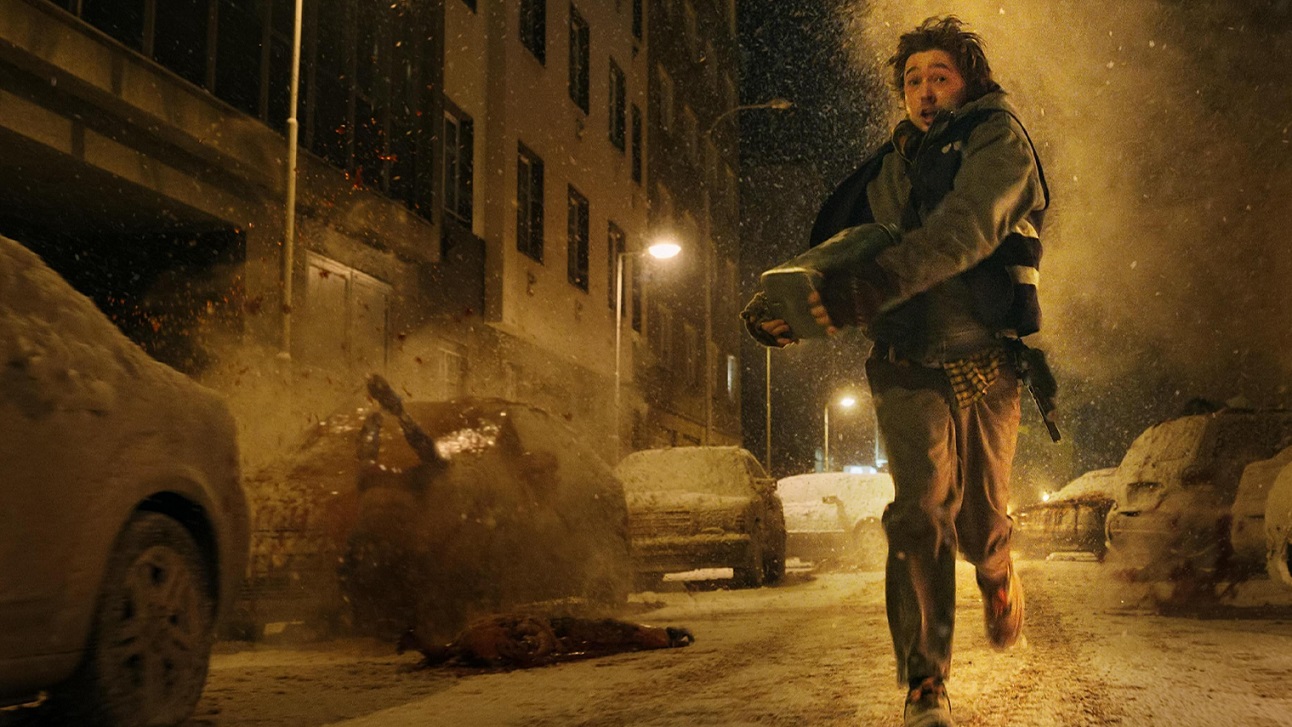
I’m on record for needing more out of writer/director/producer Zach Cregger, and here it is! Resident Evil is the kind of film that silences any doubts about a creator, a straightforward, thoroughly satisfying thriller that demonstrates mastery over not only multiple different genres, but also how to translate ideas into film. We could look back on this in 20 years as a codex for video game adaptation because it makes this translation look so simple.
Raccoon City, winter, contemporary- at the end of a long night, medical courier Bryan (Austin Abrams) is called into the mountains on an urgent delivery to Raccoon City General Hospital. He stumbles on, and must fight his way into the heart of, a burgeoning zombie apocalypse.
Cregger has been almost too eager to clarify that this is a story he already wanted to tell with “Resident Evil” lore and monster designs stacked on top. However much this was written or rewritten around the franchise, what we end up watching is something tailor-made to bridge the gap between film and video game experiences.
Cinema is generally a third-person medium – we watch the protagonist from the outside – whereas video games are generally second-person – we are the protagonist, we make their decisions and directly experience their plights. Resident Evil commits immediately and fully to putting viewers in this second-person perspective as much as it can without making things weird, which the film accomplishes with a healthy dose of over-the-shoulder and point-of-view shots and incisive dialogue choices to keep Bryan’s state of mind clear.
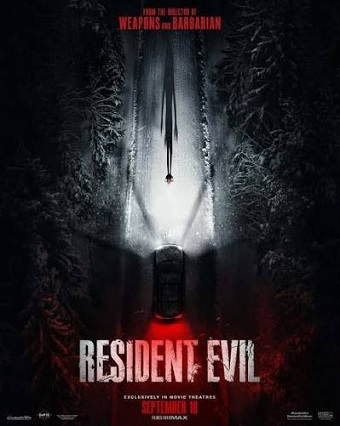
Almost every story decision supports a second-person story as well. Tasks and settings are kept mundane and possible-looking throughout the film, with Bryan doing few things more intensive than running. Many of the horrors he encounters can be easily shot or run from, and the film regularly draws us into his reactions and decision-making process, bolstering the film’s perspective work while giving the horrors room to breathe. His newly pregnant girlfriend Michelle (Sara Paxton), who only appears as a voice on the phone, grounds the film in realistic family strife, but also a realistic, expansive world with a lot more going on – the zombies are the second most important thing Bryan has going on this very evening.
None of this is radical, but it’s thorough, pointed and effective to the point that Resident Evil feels more like a video game than a film, but somehow, in a good way. You feel heroic watching this, like it’s you persevering through Bryan’s night of bad luck.
The shift in perspective is so complete that the entire genre shifts with it – Resident Evil is less of a horror movie and more of an action movie with strong horror elements. There’s lots of bright red blood and lingering gore imagery, but it’s hardly scary, more similar in tone to an openly sarcastic horror film like Evil Dead II, which Cregger specifically referenced as an inspiration.
Cregger’s sketch comedy background also shines through in Resident Evil’s frequent and spectacularly timed punchlines, which grow more consistent as the film moves along, but beyond the laughs, the know-how for structuring sketches and stringing them into a narrative is a huge part of why the film works so well. Cregger has talked about wanting the film to move to different settings at a regular pace like the leveling structure of a video game, and ends up with this spectacular 90-minute thing that feels more like a two-and-a-half hour epic – again, somehow, in a good way. The film feels satisfying and fully fleshed out even at a bottom-end runtime.
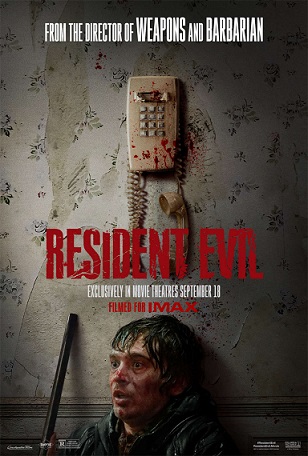
Cregger has been the central marketing draw for Weapons and now Resident Evil, his second and third features, and he’s fully emerged as an own-genre director, with minimalist marketing imagery that reflects the art of his prior films much more than the $75 million budget of a major cross-platform adaptation. That status reflects his current career trajectory, as he says he’s rejecting franchise offers for original content, which is terrific news for him personally and for auteur-driven cinema as a whole. The best periods in cinematic history are always when the artist becomes the driving commercial factor, and between Cregger, Jordan Peele’s and Robert Eggers’ well-established careers and the overnight successes of Obsession and Backrooms, we could be in the throes of a new high-budget movement in American horror.
As for the future of Resident Evil as a film franchise, this effort is so dominated by Cregger’s name that it’s hard to speculate on corporate takeaways. It’s already an object lesson in bringing in top talent, as are entire studios like A24 and Warner Bros, and a lesson in that talent not wanting to marry himself to a franchise. Even the idea of making smaller movies doesn’t really work – you wouldn’t think watching it for the lack of slow motion and fantasy sets, but this is actually the second-most expensive Resident Evil movie adjusted for inflation.
There’s no real way for this movie to be knocked off its unique perch in history, which is all the more reason to see it on the big screen.
Leopold Knopp is a UNT graduate. If you liked this post, you can donate to Reel Entropy here. Like Reel Entropy on Facebook and reach out to me at reelentropy@gmail.com.
 Reel Entropy