It’s always nice when a hit kid’s book series turns out movies that are actually good

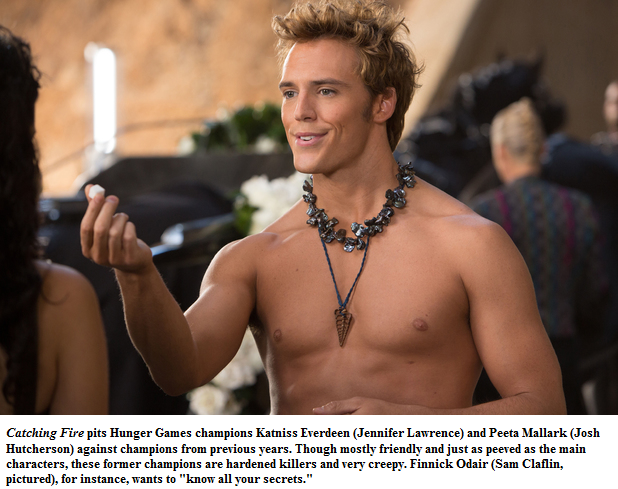
ImageCatching Fire is, for the most part, just as good as The Hunger Games.

While the first movie put Katniss Everdeen (Jennifer Lawrence) into a mess of teenagers trying to kill each other, this film puts her in even less comfortable territory — on a public relations tour for the government that stuck her in the first mess pretending to be in love with Peeta Mallark (Josh Hutcherson). When the facade fails, the government makes some rule changes so they can throw her back into a mess of adults who are also former Hunger Games champions.

Catching Fire features one of the best casts in a long time. Lawrence is the real thing. Her character’s anti-social behavior and paranoid survivalism would make for a potent performance even without the knowledge that she’s a charming, candid interview in real life. The always excellent Philip Seymour Hoffman joins the cast as the new gamemaker. He and Jena Malorne, Jeffrey Wright and Woody Harrelson lead an extraordinary cast of secondary characters.

Fresh director Francis Lawrence doesn’t quite live up to Gary Ross, who everyone thought was coming back after directing The Hunger Games, but his minimalist hand guides the film well. The love triangle that punishes this series with unwarranted comparisons to Twilight is all but left out. The characters’ raw desperation shines through beautifully.

Sadly, the pacing is just barely on the wrong side of perfect, and that can throw off an entire movie. The film seems impatient through its admittedly long first act, and the most interesting part of the movie suffers. We’ve already seen the pagentry and trauma that go into a Hunger Games tournament, and the differences are easy to pick up on. It would have been great to see more detail put into confrontations between Everdeen and President Snow (Donald Sutherland) and Snow and Plutarch Heavensbee (Hoffman).

With a poorly paced beginning and an ending that is horribly reminiscent of The Matrix Reloaded, Catching Fire is far from perfect. But it’s very good, and probably the best thing out this Thanksgiving.

Joshua Knopp is a formerly professional film critic, licensed massage therapist, journalism and film student at the University of North Texas and a senior staff writer for the NT Daily. Happy commercialized harvest festival.  For questions, rebuttals and further guidance about cinema, you can reach him at reelentropy@gmail.com. At this point, I’d like to remind you that you shouldn’t actually go to movies and form your own opinions. That’s what I’m here for. Be sure to come back in a couple of weeks for a review of Inside Llewyn Davis.

Posted in Entropy | Leave a comment

Dark World a half-finished film, has Tom Hiddleston in it

Hey! Marvel’s got a new opening graphic!

ImageIt debuts with Thor: The Dark World. Odin’s (Anthony Hopkins) long, boring narration shows that the dark elves, lead by Malekith (Christopher Eccleston), once tried to destroy all of creation 5,000 years ago when the Nine Realms last aligned around Yggdrasil. And wouldn’t you know it, that’s a quin-millenial occurrence, and right on queue, Malekith wakes up and starts causing trouble again.

The energy he was using, called Aether, infects Jane Foster (Natalie Portman) because the main character has a crush on her, and she starts to get all black swany. Thor (Chris Hemsworth) brings her to Asgard, which is promptly besieged. In order to avenge his home, Thor must free Loki (Tom Hiddleston), who is the entire reason this movie exists.

Thor: The Dark World plays out more like a spoof of an action movie than a real one. In most complete scenes, tropes are played up to be laughed at.

Continue reading

Posted in Entropy | 1 Comment

12 Years a Slave is fantastic, but you won’t enjoy it

“In time, your children will be forgotten.”

That’s the kind of cheery comfort you can expect heading into 12 Years a Slave.

12 years

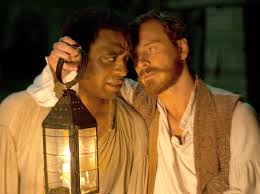
Sadistic, alcoholic plantation owner Edwin Epps (Michael Fassbender) and Solomon Northup (Chiwetel Ejiofor), an enslaved freeman who was taken from his home in New York, have some midnight male bonding time in 12 Years a Slave.

The movie tells the true story of Solomon Northup (Chiwetel Ejiofor), a skilled, black violinist living with his wife and children in New York in 1841. Northup is kidnapped, enslaved and shipped to New Orleans for sale. After 12 years of Jamie Foxx never showing up to kill every white man on screen, Northup finally gets a letter away to his family, who prove his freedom.

12 Years a Slave is going to be required viewing for any film class worth its salt, one of those rare films that will both win and deserve its Oscars, but it’s not perfect.

It’s got that art film stink about it that awards voters love. The cast hinges on a lead nobody’s ever heard of, and he’s surrounded by an all-star team (Michael Fassbender, Benedict Cumberbatch, Paul Giamatti). The score is barely-existent and only ever repeats a few notes. The whole thing is a bit of a transparent pull on liberal sensibilities, although you’d have to be pretty damn conservative to be OK with the abuse Northup endures under the pretense that it was legal at the time.

I’m not Steve McQueen’s biggest fan. His films tend toward a bleak minimalism that make you not want to watch them again, no matter how good they are.

However, it is all these imperfections that loop back and bring out 12 Years A Slave’s harsh beauty. The cast is excellent. The lack of instrumental music allows the constant, vile sounds of physical abuse to take over the background.

This is a film about a culture of rape (literal, figurative and artistic) and enslavement. This is a film about people who are OK with the mortal discomfort of everyone around them. Bleakness is really the only tone you could take. And if you want to watch this movie more than once, there is something fundamentally wrong with you. 12 Yeas a Slave is excellent, but it’s not meant to be enjoyed.

There’s been noise about this being the first slavery film that doesn’t lend any olive branches to whites in the audience, and sadly, that’s not quite true. In the end, it’s a white man (Brad Pitt, the same white man who produces, which can’t be a coincidence) that gets Northup out of his prison. But it’s a lot better than Lincoln and Django.

Last year, the best picture stand featured a sharp dissonance among its ridiculous 10 finalists — both Lincoln and Django Unchained were nominees. Aside from one being mind-numbingly boring and the other being wildly entertaining, Lincoln is yet another movie about old, rich white men talking about how awful slavery is. Django is about the brutality required to keep an entire race of human beings in line.

Quentin Tarantino makes a movie that’s much easier to swallow than 12 Years a Slave, but it’s a huge step up from movies about white politicians saving all the blacks. 12 Years takes that a step further by not having Christoph Waltz hold the lead character’s hand through the film. McQueen has the additional authenticity of being a black person in real life.

Pretty much everyone who thinks slavery was something mild enough that it can be put “in the past” needs to see this movie, and it is truly excellent, but I’d be hard-pressed to recommend it for a majority of audiences. It is very much not for the faint of heart.

Joshua Knopp is a formerly professional film critic, licensed massage therapist, journalism and film student at the University of North Texas and a senior staff writer for the NT Daily. The Counselor wasn’t playing in Denton and I’ve been busy with school and work, bite me.  For questions, rebuttals and further guidance about cinema, you can reach him at reelentropy@gmail.com. At this point, I’d like to remind you that you shouldn’t actually go to movies and form your own opinions. That’s what I’m here for. Be sure to come back next week for a review of Thor: the Dark World.

Posted in Entropy | Leave a comment

Why?

Why?

Why has Misher Films remade Carrie? They can’t have thought it would make money — Sunday afternoon of opening weekend it still needs more than $10 million to break even, even though it’s October and Carrie is the only real horror movie out right now.

So… why?

ImageThe story follows Carrie White (Chloë Grace Moretz), a socially ostracized high school girl who is abused both by her classmates and her Bible-thumping psychopath of a mother (Julianne Moore). Over the course of the film, Carrie develops telekinetic powers, which she eventually uses to avenge herself after being doused in pig blood at her senior prom.

What? “Spoiler alert?” See, no, that isn’t a spoiler. For one thing, this story will be 40 years old in April, and for another, even if you didn’t know exactly how it ended, the commercials spell it out. For whatever reason, this film’s marketing made absolutely sure everyone will know how it ends.

So, everyone knows the ending, it’s not making much money despite being the only horror movie in October… why?

It wasn’t to make a good movie or express any kind of creativity. Misher Films is a small enough production company that it might have just wanted an art film, but this Carrie is a shot-for-shot remake of Brian De Palma’s 1976 classic. There are changes, but they all stand out in a bad way.

Even the faint glimmers of artistic merit that are present seem like accidents. The film opens with Carrie’s mother hemorrhaging vaginally and in immense pain, echoing the sequence in which Carrie has her first period and freaks out because she doesn’t know what it is. But this turns into a completely needless birth scene. The only purpose is to check off “ominous origin sequence” on the movie’s trope list.

Carrie seems to constantly have a menstrual cramp, which could be an interesting motif because of the same scene, but that’s probably just Moretz over-acting her character’s awkwardness.

There’s no artistic merit, everybody knows the story, it might make a few million dollars in the end but nothing significant… why?

Was it to put Carrie in a modern context? Because the mere presence of cell phones and a Tim Tebow reference doesn’t accomplish that. You could put cell phones in Shakespeare, but if it’s still in iambic pentameter you’re never going to surprise your audience.

Was it to make a higher quality movie? Because they did the exact opposite of that. The dialogue is atrocious, particularly between Carrie and her mother. Scenes that are supposed to be highly traumatic don’t have any teeth.

Director Kimberly Peirce has found a magical zone of remake badness. It’s a shot-for-shot reproduction, almost literally, of the 1976 version. But, somehow, the changes are all minor or cosmetic, but at the same time they make a huge difference for the worse.

The movie successfully adds in modern, annoying tropes, and that’s the only thing it does successfully. The intense awkwardness of the oddly-physically-mature high school kids is in full effect. Moretz and Ansel Elgort are the only main cast members under 24. It’s a little jarring when 25-year-olds who are probably just getting their start after years of modeling start building up to a threesome and then cut it off for a conversation about how much detention would suck.

There are better telekinesis effects, but in my own mind this actually works against the movie. Carrie is a story about the pain of being female and attempts to rebel against chastising peer groups, abusive parenting and an oppressive religious culture. All of those themes are understated in this version, but boy do those telekinesis effects look sharp!

Why? The only answer is to bring the horror classic into the modern era of filmmaking. That’s a bad thing, because this generation of horror movies is filled to the brim with laughably terrible films that have been manufactured to have the same aesthetic, the same basic story and the same absolute lack of artistic merit.  Someday, maybe soon, something will break the industry out of its mire. Carrie isn’t that something.

Joshua Knopp is a formerly professional film critic, licensed massage therapist, journalism and film student at the University of North Texas and a staff writer for the NT Daily. Why? FOR THE GLORY OF SATAN, OF COURSE! For questions, rebuttals and further guidance about cinema, you can reach him at reelentropy@gmail.com. At this point, I’d like to remind you that you shouldn’t actually go to movies and form your own opinions. That’s what I’m here for. Be sure to come back next week for a review of The Counselor.

Posted in Entropy | Leave a comment

Machete Kills it, but only halfway

ImageIn Machete Kills, Robert Rodriguez has created a perfect B-Movie.

Well, the first 45 minutes of one, at least.

The movie starts with Machete (Danny Trejo) losing a missile to unidentified assailants. President Rathcock (Carlos Estévez) then asks him to go to Mexico and track it down. Machete learns that the revolutionary who stole it, Mendez (Demián Bichir), has pointed the missile straight at Washington D.C. and wired the launch sequence to his heartbeat. Machete has 24 hours to get Mendez to America, where the bomb can be defused.

Machete Kills is wonderfully ridiculous. There is a ton of action, and all of it has gone through a few extra silly cycles. This is a movie in which helicopters can explode when their propellers are hit. This is a movie in which only a handful of people conduct electricity. This is a movie in which Charlie Sheen plays the president of the U.F.S. It’s filled with gleeful laughter and unrepentant, goofy violence.

Unfortunately, the shock of awesomeness wears off, and what was a romp of unbridled joy becomes a shamble through an overcomplicated plot that is suddenly important. Without their counterweight, the movie’s myriad flaws pop right to the surface.

There actually is a right and a wrong way to do a B-movie. Take Monty Python and the Holy Grail, probably the most recognizable B-movie. It’s actually a fundamentally sound film that was made to maximize abject absurdity. Watch it again and think. If someone cleaned up all the silly bits, the film would actually hold your attention.

Holy Grail is also constantly pushing the envelope. From the limbless Black Knight to the killer rabbit, the film never stops being stupid.

Machete Kills, on the other hand, gets lost in the weeds and starts to drag on. After the first few action sequences it starts to decelerate, and once Machete gets to America it comes to a screeching halt as a boring plot and poorly-developed recurring characters become more prominent.

After that, there’s nothing to compensate for the film’s blatant political agenda and extremely poor treatment of women. Machete fights against the Mexican Cartel and American corruption that allows them to exist, and the movie operates on the assumption that all violence in Mexico is directly tied back to that corruption. Anyone uncomfortable with these political implications will have difficulty enjoying this film.

Another difficulty that most decent human beings will have is with the movie’s female roles. Machete Kills is an exploitation film, and I get that. It’s supposed to be pulpy and exploitative and not to be taken seriously. And if there were one or two bubble-headed bleach blonds in there, it’d work. But there aren’t.

Basically, Rodriguez wrote a gender neutral script, then took every character that wasn’t Machete, made them female and subjugated them. Madame Desdemona (Sofía Vergara) and her prostitutes serve no purpose other than weaponized T and A. Miss San Antonio (Amber Heard) and Shé (Michelle Rodriguez) actually do have function, but they’re sexualized to the point that all other characteristics are trivial. There’s too much sexism here, even for Machete Kills’ outrageous context.

When Machete Kills sits down, shuts up and shows us the blood-spattered goods, there’s a lot to like about it. Machete, Mendez and El Chameleón (Walton Goggins, Cuba Gooding Jr., Lady Gaga, Antonio Banderas) are hilarious even in dialogue much of the time. It’s easy to enjoy the film for what’s right with it, but it could have been much better.

Joshua Knopp is a formerly professional film critic, licensed massage therapist, journalism and film student at the University of North Texas and a staff writer for the NT Daily. Oh dear God, the U.S. government is still shut down. For questions, rebuttals and further guidance about cinema, you can reach him at reelentropy@gmail.com. At this point, I’d like to remind you that you shouldn’t actually go to movies and form your own opinions. That’s what I’m here for. Be sure to come back next week for a review of Carrie.

Posted in Entropy | Leave a comment