Everything you have heard about Gravity is completely true

Image

Gravity’s opening crawl is enough to tighten every sphincter in the audience, and for the next 90 minutes, there will be no relief.

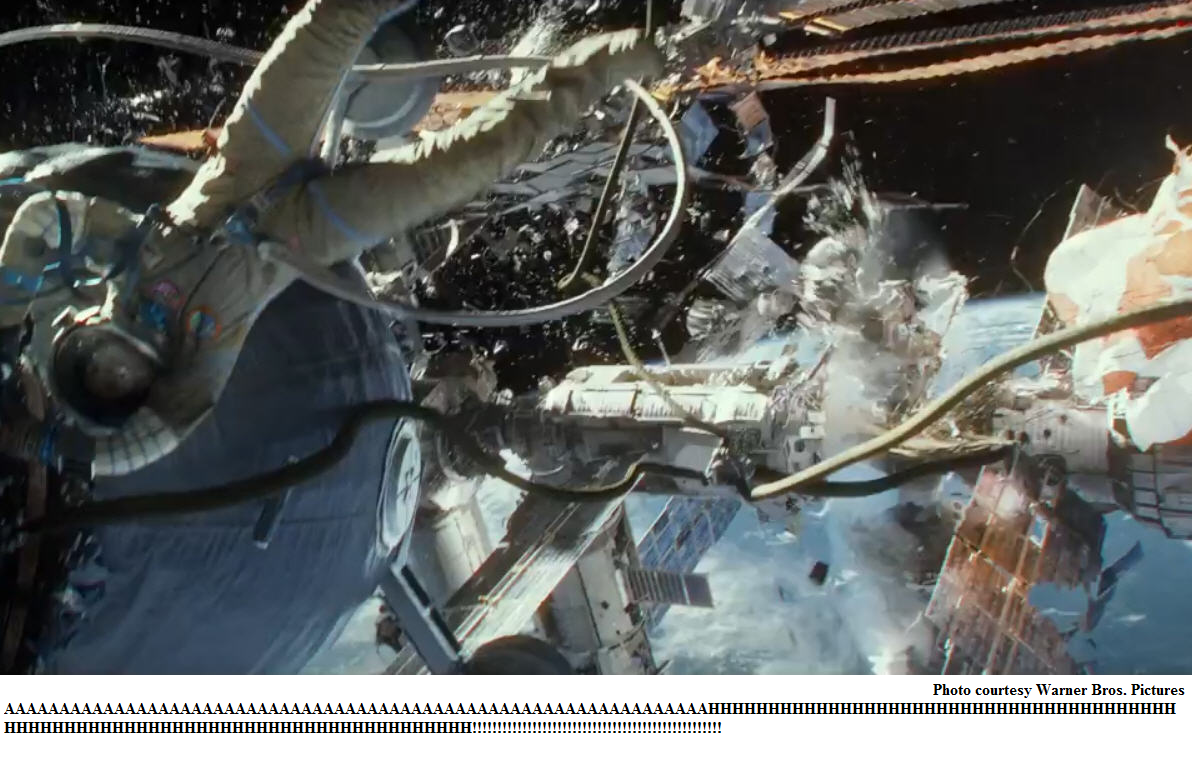
The movie follows mission specialist Ryan Stone (Sandra Bullock) through a disastrous spacewalk. While she’s servicing the Hubble Space Telescope, Russia shoots down one of its inactive satellites and hurls a shower of debris toward her at a few hundred miles per hour. After a scene of complete chaos when it hits, Stone is sent careening into space.

Gravity is equal parts breathtaking and terrifying. The movie does a great job of stressing both the horrible fate its characters face and their difficulty avoiding it. With no matter to push off of, every thrust Stone gets could be her last, sending her endlessly in that direction to asphyxiate thousands of kilometers away from the nearest living thing.

The film is beautiful to behold, though most of it is green screen. An $80 million budget isn’t enough to bring a camera into space, and for a large majority of the movie, Bullock’s face is the only real thing on the screen.

CGI-based films are normally a turnoff, but Gravity does two key things right. First, it has the goods. Visuals are both unbelievably gorgeous and completely believably accurate.

Second, it doesn’t use the CGI in vain. This is a story that would be impossible to tell with a real camera. So many movies waste time and money getting computer images when they could have had the real thing, but Gravity actually takes its audience thousands of miles above anywhere we will ever go.

For all its visual splendor, Gravity would be nothing more than smoke and mirrors without a powerful, human story at its heart. This film is the most emotionally intense cinema experience since the Breaking Bad finale. Writer/director/producer Alfonso Cuarón knocks the script out of the park as much as anything else.

The story is remarkably well-written and well-constructed. Structurally, it’s a horror movie — but in place of a slasher, Stone is stalked by the ever-present danger of where she is. Stone has all the marks of a Final Girl, and Gravity is a fantastic introduction to the concept.

Because it is character driven and because of the difficulties in acting against a green wall, Bullock and George Clooney are the real engines that drive Gravity. Universal went through Angelina Jolie, Marion Cotillard, Scarlet Johansson, Blake Lively and Natalie Portman before interviewing Bullock and Robert Downey, Jr. backed out before Clooney was hired. Gravity is very much a character driven film, but it only has two characters. Settling for second and sixth choices in those roles could have crippled the film, but the duo carries the action wonderfully.

There is every reason to see this movie in theaters. There’s even an argument to be made to see it in 3D. But there’s just as much reason to see it on a tiny analogue screen through a shop window. It’s a masterpiece.

Joshua Knopp is a formerly professional film critic, licensed massage therapist, journalism and film student at the University of North Texas and a staff writer for the NT Daily. The U.S. government is seriously still shut down. For questions, rebuttals and further guidance about cinema, you can reach him at reelentropy@gmail.com. At this point, I’d like to remind you that you shouldn’t actually go to movies and form your own opinions. That’s what I’m here for. Be sure to come back next week for a review of Machete Kills.
Posted in Entropy | Leave a comment

Rush doesn’t back up the hype

ImageRush is very, well, rushed.

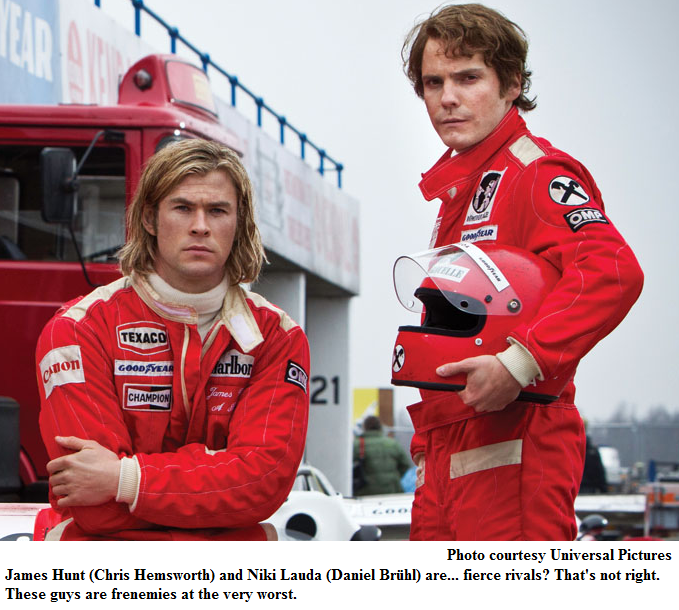
Headlined by director Ron Howard, the movie tells the story of the 1976 Formula 1 racing season and the legendary rivalry between James Hunt (Chris Hemsworth) and Niki Lauda (Daniel Brühl). Lauda, the defending world champion at the time, pulls out a large lead on Hunt while Hunt has car difficulties, which Hunt then makes up after Lauda has a near-fatal accident.

How this developed into an intense rivalry with one driver or the other incapacitated during the vast majority of the season is beyond me.

In its best form, Rush would be an intense scrutinization of the German Grand Prix that year. The heart of Hunt’s and Lauda’s rivalry was their contrasting natures. Hunt is courageous and reckless and Lauda is clever, cold and calculated. This was the race in which that conflict came to a head.

While the crew tried to focus on it, making the race a part of the prologue and the first half of the film a flashback, but that trick lost significance when it became fashionable.

Instead, Rush  is a giant — two very long hours — blow-by-blow breakdown of the principal characters’ lives. The producers wanted to get everything in there but didn’t want it to be too long, and it led to some sloppy writing.

Take the storyline with Hunt’s failed marriage. This kind of story constitutes the entirety of some very good movies (Blue Valentine springs to mind). But in Rush, they only have a couple of scenes — the first time Hunt meets Suzy Miller (Olivia Wilde) and then their last fight before divorcing.

The lack of screen time leads to weak, self-aware dialogue because that’s the only way to make sure the audience gets all the context. Real people don’t talk like Hunt and Miller do in these scenes. Real Formula 1 announcers don’t cater their play-by-play to people who don’t watch Formula 1, and it’s a safe bet the real Lauda never waxed poetic about how much fun having a rival is. It’s tough to tell whether Brühl is supposed to really hate Hunt’s guts and fails to express that through the say-exactly-what-you-want-the-film-audience-to-think dialogue or if his character is actually that self-aware.

Howard and writer Peter Morgan simply don’t communicate the soul of their story well here. A lot happens in Rush, but it just happens. There’s nothing to put the audience on the edge of it’s seat and make us want to keep watching.

Since it aspires to be a talkie, the weak dialogue gives most of this sense, but it’s everywhere. The race scenes are thrilling, but too short. Emotional scenes are also rushed.

I guess the movie was very well-titled, but that’s about all that can be said for it. Rush is just barely entertaining throughout, but not worth the two hour investment it demands.

Joshua Knopp is a formerly professional film critic, licensed massage therapist, journalism and film student at the University of North Texas and a staff writer for the NT Daily. He gets all the Major Arcana. For questions, rebuttals and further guidance about cinema, you can reach him at reelentropy@gmail.com. At this point, I’d like to remind you that you shouldn’t actually go to movies and form your own opinions. That’s what I’m here for. Be sure to come back later in the week for a review of Gravity.

Posted in Entropy | Leave a comment

Romantic comedy about how movie relationships are fake presents fake movie relationships as realistic

I have to imagine the first meeting on the set of Joseph Gordon-Levitt’s new movie, Don Jon, went something like this- http://www.youtube.com/watch?v=u33dL7MVdoY

Gordon-Levitt writes, directs and stars as Jon Martello, a playboy who falls in love at first sight with Barbara Sugarland (Scarlett Johansson). Martello and Sugarland have a lot of sex because that’s the type of thing you get to do when you’re the director. But Sugarland must compete for Martello’s attention with his porn addiction.

Image

The best microcosm of this film is a scene when Martello and Sugarland are first dating. Sugarman refuses to let him into her apartment for sex, but brings him to orgasm by dry humping him outside the door.

Continue reading

Posted in Entropy | Leave a comment

Film puts audience in a worse prison than its characters

ImagePrisoners wants to be an intense examination about the lengths a man would go to to get his child back, but really it’s just boring.

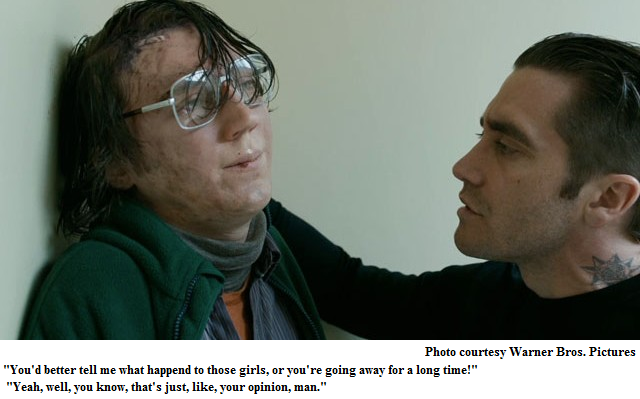
The audience is supposed to get behind Keller Dover (Hugh Jackman), a Christian, carpenter and hunter who thinks the national anthem is a pretty song and not just something you sing before sports events. While celebrating Thanksgiving with the Birchs (Terrance Howard, Viola Davis), both families’ young daughters disappear. Dover fixates on the primary suspect (Paul Dano) after the suspect is released because he’s too stupid to have committed the crime.

The movie pits Dover against his own better nature as he tries to figure out where the girls were taken. In one storyline, he kidnaps and tortures the invalid. This seems to be the film’s main advertised storyline.

In a completely different storyline, Detective Loki (Jake Gyllenhaal) leads an investigation into the girls’ disappearance. In another completely different storyline, Dover’s wife (Maria Bello) lays at home and cries.

To say this movie stops and smells the roses is putting it mildly. Its various plots are all lightly connected – it’s all got something to do with the prisons the characters put themselves in. Dover is caught in his violent fixation on Dano’s character, Dano and the missing children are literally imprisoned, Dover’s wife can’t get out of bed, etcetera.

But, in theory, a film can do that without taking the audience through every detail of two or three lives over six days. If Prisoners had picked a main character and stuck with him, it wouldn’t be so long, it wouldn’t have had so many dull bits and it still would have been able to express the “prisons” theme well enough.

What really should have happened, though, would be a rewrite into a comedy. All the characters are there – a die-hard conservative, a passive liberal, a straight detective and a man-child with the IQ of a 10-year-old all fumble around two kidnappings in a convoluted plot that doesn’t really matter in the end. Sounds just like The Big Lebowski, doesn’t it? This plot would have worked well in a similar, genre-mash aesthetic.

As it is, Prisoners is deeply flawed and there isn’t really any point to watching it. Director Denis Villeneuvre doesn’t create an atmosphere intense enough to be a reward in its own right. The plot twists are telegraphed and ineffective. There are better, shorter movies available through just about every avenue.

Joshua Knopp is a formerly professional film critic, licensed massage therapist, journalism and film student at the University of North Texas and a staff writer for the NT Daily. If you strike him down, he will be come more powerful than you can possibly imagine. For questions, rebuttals and further guidance about cinema, you can reach him at reelentropy@gmail.com. At this point, I’d like to remind you that you shouldn’t actually go to movies and form your own opinions. That’s what I’m here for. Be sure to come back later in the week for reviews of Don Jon and Rush.

Posted in Entropy | Leave a comment

Insidious continues bland horror trends

A lot of modern horror is garbage, but Insidious: Chapter 2’s soul-crushing monotony stands apart.

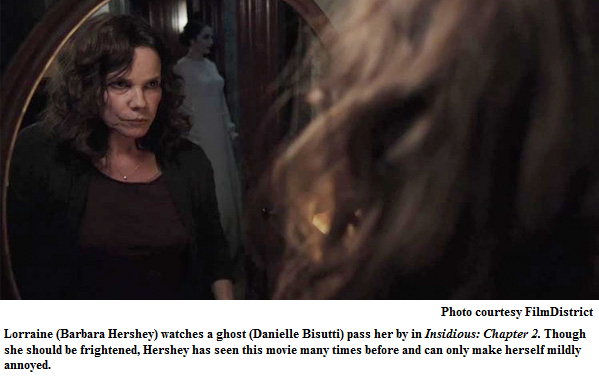
The film picks up right after its predecessor, with Josh (Patrick Wilson) possessed by a vicious ghost. Josh becomes a nexus for interaction between the physical and the astral. Spooky antics ensue.

Image

Insidious: Chapter 2 is extremely dull. All scares have a set formula: someone says something mildly creepy, then there’s a smash cut with sudden music. It happens once every five minutes and it gets old before the previews are over. The entire production falls flat under this boring, archaic paradigm.

And that’s really sad. Whannell wrote himself into a corner in the first movie. After 75 minutes of genuinely creepy nonsense, he didn’t know how to end the story and so the main characters called the Ghostbusters. The film suffered the rest of the way.

In Chapter 2, Whannell wrote himself out of that corner, managing to reestablish the haunted house problem that was supposedly solved and adding depth to the ghost possessing Josh. Delving into (well, scraping) child abuse and serial murder, the backstory’s implied crimes provide the only real thrills in the movie.

The movie is a perfect epitome of the spiral its principle creative minds have been in for some time now. Wan and Whannell broke into the horror scene with 2000’s Saw, and neither of them have worked on anything special since.

Recently, Wan’s films have become reliant on the same combination of paranormal experts, jump scares and stolen scenes from the classics I’d rather be watching. Whannell tried his had at children’s book adaptation in 2010’s God-awful Legend of the Guardians, but has mostly stuck to the same horror titles Wan has — horror titles that are made bland by their repeated use of the same tropes played the same ways.

The Insidious series also adheres to producer Jason Blum’s fallback cache of tropes, with the arrogant patriarch ignoring the problem for most of the movie and an overflow of subplots giving the film an odd soap-opera feel.

Blum has produced nine horror films since 2010 after producing 2007’s smash hit Paranormal Activity, a movie that should have changed American horror movies irrevocably. But a run through of the titles — Insidious, Dark Skies, Sinister — tells us that everything he’s done has followed a strict formula that’s not conducive at all to horror.

For all of them, Insidious: Chapter 2 is just something to stick at the end of a conga line of dull and near-identical horror movies. The saddest thing, and the real root of the problem, is that these three are hailed as leading lights for their initial success and because of that everything they touch is supposedly innovative and daring. As much as the genre could benefit from the minds that made some of the true horror classics of the ’00s, it’s clear these three just aren’t up for actual creativity anymore.

Joshua Knopp is a formerly professional film critic, licensed massage therapist, journalism and film student at the University of North Texas and a senior staff writer for the NT Daily. He may be a genius, but he is not an architect.  For questions, rebuttals and further guidance about cinema, you can reach him at reelentropy@gmail.com. At this point, I’d like to remind you that you shouldn’t actually go to movies and form your own opinions. That’s what I’m here for. Be sure to come back later in the week for a review of Prisoners.

Posted in Entropy | Leave a comment