
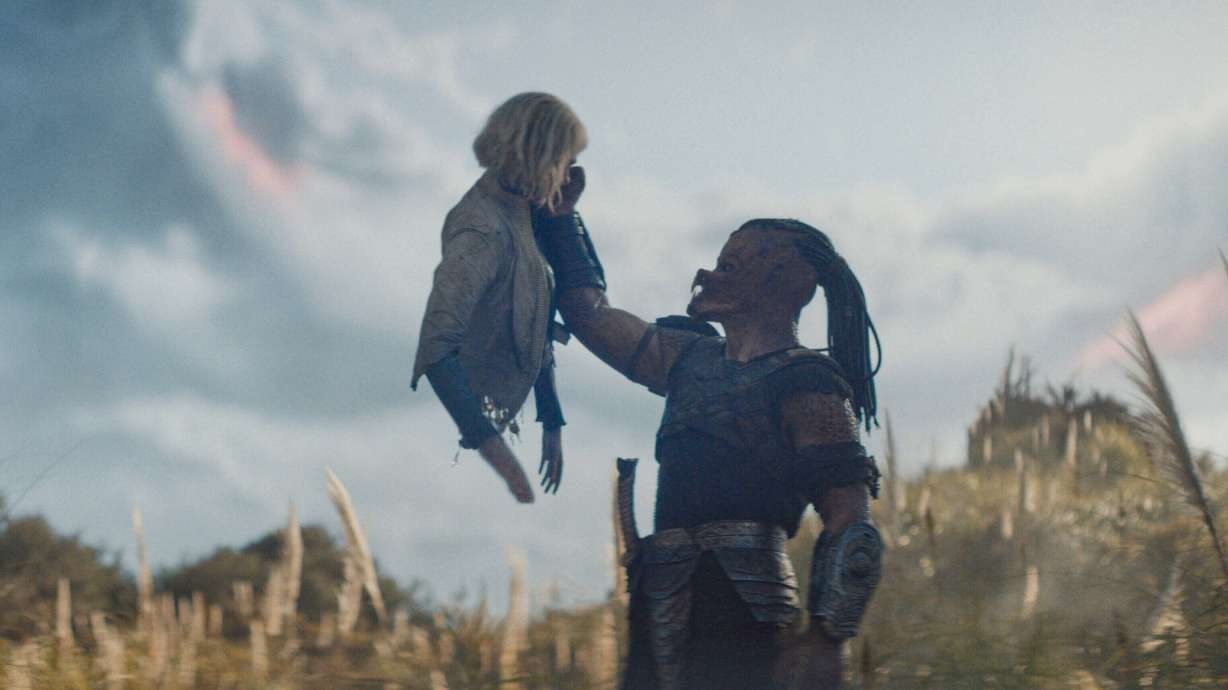
Predator: Badlands is a movie, a real one, the kind you grew up hearing about. It’s got everything – constant action, adventure to far-away lands, coming of age, complex relationships between technology and nature, rugged individualism weighed against a communal survival strategy and all the implications that has for the future of the human race, capitalism grinding against human connection and even some romance, if you really want to read that into it.
Genna- Dek (Dimitrius Schuster-Koloamatangi), a young Yautja viewed as physically inadequate by his clan, has come to the most dangerous planet in the universe to hunt the Kalisk, an apex predator reputed to be unkillable, to prove himself. As he navigates the profoundly hostile environment, he brings along Thia (Elle Fanning), an android from the neighboring Alien franchise who’s had her legs removed by the beast, for advice and guidance.
Disney is trying to structure all of its franchises like they’ve structured the MCU, with a single executive who loves the property overseeing everything – obviously, it’s been hit-or-miss – and seems to have handed the keys to the Predator kingdom to director/producer Dan Trachtenberg. Two live-action films in, it’s been an astonishingly good choice. Predator: Badlands is a direct, big-budget upgrade over Prey, the Trachtenberg-directed Hulu original that quietly resurrected the franchise in 2022. They’re extremely similar films that use Predator lore to wrestle with toxic masculinity, which the creatures were specifically designed to mock. Screenwriter Patrick Aison, cinematographer Jeff Cutter, composer Sarah Schachner and producer John Davis all join Trachtenberg from film to film.
The original Predator is sort of an anti-muscle movie, pitting Schwarzenegger and other comparably built ‘80s action heroes against this thing in the trees that they can’t even see, let alone outgun or outmuscle. The movie goes out of its way to establish a rigid code of honor for its central creature that doesn’t make any sense – it will freeze immediately when faced with an unarmed opponent, but is perfectly willing to bring invisibility cloaks, heat scanners and automatically targeted energy weapons to a gun fight. Badlands, the first ever film with a Yautja protagonist, delves face-first into a paternalistic culture that is similarly rigid and confused.
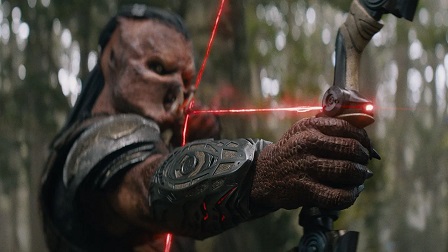
In the film, Dek struggles directly with the contradictions of his upbringing without seeming to realize it, most of it wrapped up in the central relationship with Thia. The android has been programmed with high sympathy to better understand the creatures she’s assigned to study and tries to befriend her new protector, but Dek, unwilling to accept help on his hunt, only employs her when he realizes that she is an android. He repeatedly shouts at her that she is a tool for his use whenever she gets off-topic.
The fantasy setting and lack of sexuality does nothing to hide the gender dynamics of this relationship, but they are also wrapped up in Dek’s confused relationship with technology. He will not accept help, but he doesn’t consider anyone who’s built or supplied his array of weapons as “helping.” Thia’s existence as a conscious tool directly confronts him with this contradiction, though he’s too focused on getting his trophy to notice.
Both films also heavily focus on the natural environment – Prey, set in 1719 and shot at the eastern foot of the Alberta Rockies, portrays realistic Earth nature, but Badlands, in which New Zealand has a hostile alien world drawn onto it, spends its energy on its fantasy. One of the best things about the film is how hard it works to sell Genna, the “death planet.” Here, cacti fire poisonous barbs at you, the grass is sharp enough to shave with and caterpillars self-destruct with the force of a hand grenade. The first thing that happens to Dek when he crash-lands is he gets attacked by the trees.
Eventually, Dek mixes things up even more when he starts using nature as a substitute for technology, funneling his conflicts with technology, nature, his internal conflict of individualism against a more communal survival strategy, conflicts with Yautja society and religion and the android detachment into one giant mess of antagonism – this is what makes Badlands such a rich story. It’s navigating so many different layers of conflict.
Driving the film through this thicket of complex conflict is Dek, who is having absolutely none of this. He is not here to think about his converging relationships with nature and technology, he is here for that Kalisk’s skull. No matter how awful he is toward Thia, you still love him because his eyes are always on the prize.
The film manages to have all these conflicts on its mind by showing us all these conflicts. Badlands’ action is constant and, though not always perfect, always swinging for the fences.
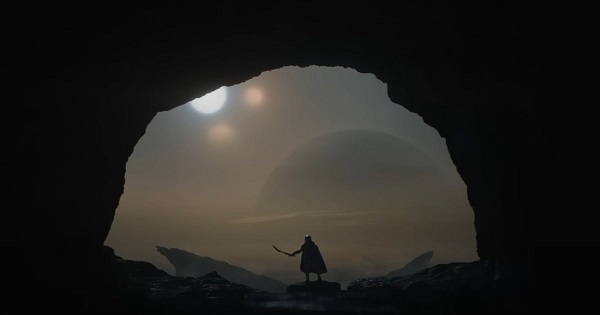
What really keeps Badlands interesting at the surface level is its perfect ‘20s cyberpunk aesthetic, which has exploded into adult cinema in recent years after films like Blade Runner 2049 and – well, Blade Runner 2049 and imitators, which Predator: Badlands counts among. This has emerged as a fusion of a couple of subgenres, with the joyous neon synth of more accessible ‘80s nostalgia giving way to this brutal bass and retro-futurism perfect for revisiting long-running ‘80s series like this. The anxieties that bore films-turned-franchises from this time period like Blade Runner, The Terminator and Alien, films that are all heavily focused on capitalism-driven technological advancement and environmental decay, are also ripe for updating today as large-scale computing threatens human existence in more and more ways.
The real coup de grace for Predator: Badlands’ aesthetic is its use of language – this is another similarity to Prey, the first ever Comanche-language film. They brought in the guys who developed the Na’vi language for Avatar to write a new language for the Yautja, usually portrayed as not speaking, which Schuster-Koloamatangi worked in for the film, and Dek holds full conversations with Thia speaking in English. Ever since we met Han Solo in that Mos Eisley dive, arranging conversations like these across alien languages has been the ultimate utopian ideal of science fiction cinema, and I have no idea why they’re still so rare.
That’s Predator: Badlands. It gives you everything you could want from a night at the movies, and makes it all look easy.
Leopold Knopp is a UNT graduate. If you liked this post, you can donate to Reel Entropy here. Like Reel Entropy on Facebook and reach out to me at reelentropy@gmail.com.

