New Year’s data dump part 4: He makes almost a million dollars a week, but he roots for the New York Islanders

ImageIt starts with a shot of Leonardo DiCaprio snorting cocaine out of a hooker’s anus. For anyone over the age of 20, subtitles meant to be read in Ray Liota’s voice flash across the screen, reading, “As far back as I can remember, I always wanted to be a gangster.”

It never slows down.

The Wolf of Wall Street is the true story of noted New York Islanders fan Jordan Belfort (DiCaprio, who also produces), a stock broker who started a billion-dollar company that pumped and dumped stocks — basically, they acquire stock for worthless companies, then sell them to clients who don’t know any better for a profit. Though he was indicted in 1998, this is the same tactic that was made famous after the 2008 economic collapse. The script, written by Terence Winter, is adapted from memoirs he wrote in prison.

Director Martin Scorsese, who also produces, has used his own history as a filmmaker to equate Wall Street greed with the cocaine-running films of yesteryear. The Wolf of Wall Street is really a remake of Goodfellas. It’s Scarface for the 2010s. Whether or not that’s a good thing is up to the viewer.

The film brilliantly uses flavor narration and all kinds of montage sequences to tie its meanings together. Early in the film, Belmont equates money to drugs. Montages of many brokers learning and plying their craft gives the scheme a grand scale. Belmont and his minions pause for a scene to abuse dwarves in a heavy-handed display of what they really think of the little people. In a broad sense, the entire three hour experience is a thesis-worthy montage fetishizing gluttony.

It’s cut from the same cloth as traditional crime epics, and it has the same problems. The dirty secret about this kind of movie is it’s not perfect. It’s way too long. It dances with misogyny — all though The Wolf of Wall Street never holds sexism as something the viewer should aspire to and never out right says women are worthless, it features a lot of sexism from its main characters and a lot of women who are only there for sex. No one should idolize Belfort, but then again, no one should idolize Henry Hill. People will see his wealth and prosperity onscreen and idolize him, despite the obvious fact that he’s a terrible person.

These movies never do a good job of making clear that large-scale crime has large-scale consequences. In Scarface, for instance, we see Tony Montoya grow into a powerful drug lord but we rarely see the violence and destitution involved in drug smuggling. I still don’t know why the feds were after Michael Corleone. The Wolf of Wall Street is no different. Belfort is a real person who took real people’s life savings for nothing, and still owes hundreds of thousands of dollars to more than 1,500 victims as of last October. But all we see is all the sex he had.

The Wolf of Wall Street is cinema at its finest and a tour de force by DiCaprio, who is a keystone like no other. Sometimes grotesque, sometimes thoughtful and sometimes side-splittingly funny, the film is everything right and everything wrong with American moviemaking wrapped into a gigantic, topical package.

Joshua Knopp is a formerly professional film critic, licensed massage therapist, journalism and film student at the University of North Texas and a senior staff writer for the NT Daily. Seriously, the Islanders in the mid-90′? The Mark Messier guarantee, and you pull for the Islanders? Really?  For questions, rebuttals and further guidance about cinema, you can reach him at reelentropy@gmail.com. At this point, I’d like to remind you that you shouldn’t actually go to movies and form your own opinions. That’s what I’m here for. Be sure to come back here for reviews of Paranormal Activity: The Marked Ones and various oscar-bait morsels as they come to Denton.
Posted in Entropy | Leave a comment

New Year’s data dump part 3: At eHarmony, we deliver more than just dates

If Ben Stiller and assorted executives got less than half of The Secret Life of Walter Mitty’s $90 million budget from eHarmony, they should probably take a few years off from filmmaking and re-think some life choices.

Stiller stars (and also produces and directs) as Mitty, Life Magazine’s photo manager. Mitty has humongous daydreams, but starts out to scared to send a wink on the movie’s patron dating site.

In the film, Life is shifting to online-only and downsizing. Renowned photographer Sean O’Connell (Sean Penn) has sent in a photo that he wants to be the magazine’s last cover, but Mitty can’t find it. Despite working with him for 16 years, Mitty has no way of contacting O’Connell other than tracking him down in person. Spurred on by his cheerful and always helpful eHarmony customer service representative (Patton Oswalt) and his very creepy crush on coworker Cheryl Melhoff (Kristen Wiig), Mitty crosses the globe tracking O’Connell.

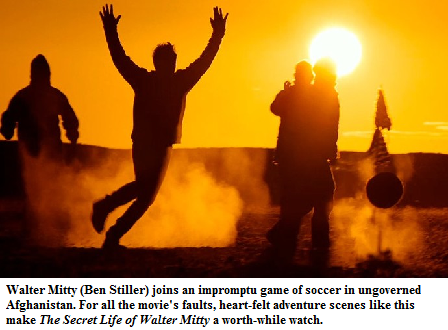
Image

The Secret Life of Walter Mitty is a confused, tangled mess of scenes, though almost all of them are delightful and heart-felt.

It’s easy to split the film into three distinct categories: scenes where Mitty is fanaticizing, scenes where he’s acting out his fantasies and scenes where nothing much is happening. One of these scenes is wonderful and the reason to watch this movie. One of them is empowering, but still carries a tinge of cartoonish wish-fulfillment that dilutes the effect. In the other, not much is happening.

The movie is frustrating and inconstant. Parts of it feel like the whole thing should have been made a short story, and other parts of it feel like pieces of a movie that needed to be split in two. But this can’t be born of inconsistency, because the feeling it gives is remarkably consistent — at the end, it feels like you watched a fluffy rom-com out of one eye and a sprawling adventure epic out of the other. The experience is unique, though not entirely pleasant.

Secret Life runs into its biggest problem when trying to figure out its target audience. It is clearly a kids movie, with a PG rating, a kid-friendly star and a refusal to look into its themes in any real detail. Mitty is driven far out of his comfort zone trying to impress a woman he barely knows who is half a world away most of the film. Attaching that level of significance to a crush isn’t unheard of, but this instance is creepy and unhealthy and the film seems to condone it.

The movie is a coming of age party for a man in his late 40s, but it doesn’t explore the regret inherent with going through that process so late in life. Like so many kids movies, The Secret Life of Walter Mitty only dances around the darker emotions and is too scared to dive into them.

It is also a functional eHarmony commercial, so someone had to expect an audience of people over 40. Maybe the key demographic for this Christmas Day release is single parents?

The film is mostly delightful and appropriate for any of its potential demographics, but I have to wonder if a given audience member wouldn’t be better served by a more tailored film.

Joshua Knopp is a formerly professional film critic, licensed massage therapist, journalism and film student at the University of North Texas and a senior staff writer for the NT Daily. All kidding aside, it’s a travesty that Neil Clark Warren doesn’t have a producer credit on this thing.  For questions, rebuttals and further guidance about cinema, you can reach him at reelentropy@gmail.com. At this point, I’d like to remind you that you shouldn’t actually go to movies and form your own opinions. That’s what I’m here for. Keep reading, the data-dump isn’t over yet.

Posted in Entropy | Leave a comment

New Year’s data dump part 2: So much 70s

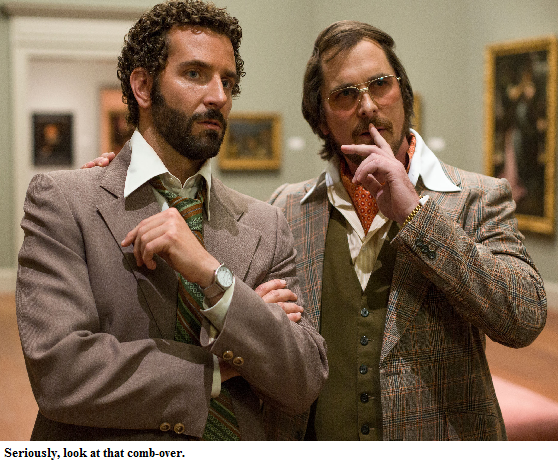
ImageAmerican Hustle is all about terrible haircuts, but that doesn’t matter. The movie is hilarious and everyone should go see it.

The movie is based on the Abscam FBI sting which took place over the late ’70s and early ’80s. To get out of a confidence scam indictment, Irving Rosenfeld (Christian Bale) and Sydney Prosser (Amy Adams) set up a deal with agent Richie DiMaso (Bradley Cooper) to help him convict other con artists. The scam escalates quickly. Though they initially go after small-time con artists, the objective soon becomes entrapping local politicians and, eventually, organized crime heads with an Arab sheik (Michael Peña) that doesn’t exist.

American Hustle is, more than anything else, magnificently, outrageously funny. As the sting grows more complicated and DiMaso gets more out of control, an absurd tension mounts in each audience member. There’s no telling when, how often or how hard, but you will laugh and something in this movie.

The hilarity is equal parts writing and acting. Original writer Eric Warren Singer’s script was one of Hollywood’s 10 best that weren’t produced in 2010, and director David O. Russell added a great shine when he took the project. The two share writing credit.

American Hustle’s all-star cast performs like one. Bale, Cooper and Jeremy Renner have great fun in their roles. Adams gives her subtlest, nastiest, sexiest performance to date. Jennifer Lawrence takes her oddball character to dimensions only she can. It seems like every year she does even more to separate herself from the rest of Hollywood.

The movie backs itself up with rich identity themes, which are tacked onto characters’ hair of all things. The opening sequence is three minutes of silence as Rosenberg applies a sloppy comb-over, which is promptly removed. He and Prosser introduce themselves and each other as people who become what they need to in order to survive, and spend much of that introductory sequence dealing with clothing and appearances.

Make-up and costume becomes both a running gag and a way to express the movie’s themes. American Hustle is constantly talking about the disguises we wear, and it backs that up by having its actors in the most elaborate disguises they’ve worn in a long time.

Oscar season is usually boring and filled with pretentious, calculated efforts, but American Hustle starts 2014’s off with a very funny bang. It deserves at least best actress for Adams and best costuming, and isn’t unworthy for best picture.

Joshua Knopp is a formerly professional film critic, licensed massage therapist, journalism and film student at the University of North Texas and a senior staff writer for the NT Daily. There need to be more JFK assassination exhibits that are on the first few floors of buildings, instead of up high where he was shot from.  For questions, rebuttals and further guidance about cinema, you can reach him at reelentropy@gmail.com. At this point, I’d like to remind you that you shouldn’t actually go to movies and form your own opinions. That’s what I’m here for. Keep reading, the data-dump isn’t over yet.

Posted in Entropy | Leave a comment

New Year’s data dump part 1: Will Ferrell’s gonna Will Ferrell

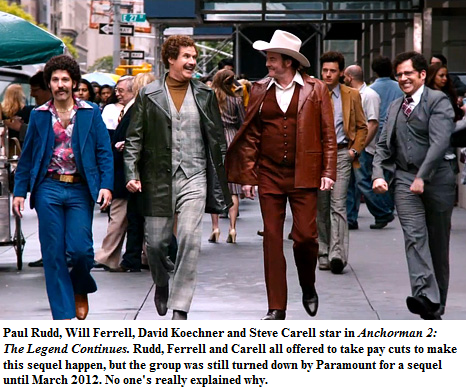
ImageAnchorman 2: The Legend Continues is exactly the movie Anchorman fans have been clamoring for for nine years. For better or worse.

In it, Ron Burgandy (Will Ferrell, who also produces and writes) returns in full salon-quality glory. He’s swiftly fired and separated from wife and co-anchor Veronica Corningstone (Christina Applegate) after she is just as swiftly promoted. Six months later, Burgandy returns to New York to be a part of GNN, the first 24-hour news network.

Anchorman 2 plays like a better, more Anchormany version of Anchorman, with higher highs and lower lows than the 2004 hit.

It’s easy to see that Ferrell and director/writer/producer Adam McKay got their starts on Saturday Night Live. It’s also apparent that Saturday Night Live hasn’t been all that great since before they started middle school. The sketch comedy’s MO is to put a random assortment of weird characters in the same room and then let the sketch run so long it can hardly be called a sketch anymore. As a writing duo, this is all Ferrell and McKay know how to do.

That said, their sketches are more absurd and better tied together than the average SNL romp, even more so in Anchorman 2.

While improving on the raw laugh level, Anchorman 2 also improves on the first movie’s satirical premise. Anchorman, in theory, satirizes chauvinism in the ’70s, but is really just an excuse to be awful toward Applegate. Anchorman 2 is satirizing the 24-hour news paradigm, and it never loses sight of that.

Throughout the movie, Burgandy’s stories degenerate into the optimistic drivel 24-hour news networks have been feeding us for years. In the diagesis, he ends up being credited with the paradigm shift personally. That statement alone makes Anchorman 2 an effective satire — only an anchor as stupid as Ron Burgandy could come up with this view of “news.” As a newsman, it feels like watching a funnier version of Paradise Lost.

This sequel is stronger than the first movie in pretty much every way, and the mass popular demand that drove its production indicates that it’s exactly what people want to see. They pull off  an odd combination of low-brow scene-to-scene humor pasted on a high-brow concept. It’s definitely not something you see every day, and whether or not the style of comedy appeals to individual viewers, this film does have its own unique place.

Joshua Knopp is a formerly professional film critic, licensed massage therapist, journalism and film student at the University of North Texas and a senior staff writer for the NT Daily. You stay classy, 2010s. For questions, rebuttals and further guidance about cinema, you can reach him at reelentropy@gmail.com. At this point, I’d like to remind you that you shouldn’t actually go to movies and form your own opinions. That’s what I’m here for. Keep reading, the data-dump has just begun.

Posted in Entropy | Leave a comment

THE HOBBIT Episode II: Attack of the subplots

The Hobbit: The Desolation of Smaug is an embarrassing kind of stupid, the kind of stupid you can’t help but laugh at.

This is a massive step up from An Unexpected Journey, which is the kind of stupid that makes you feel like your teeth are being pulled out by an old snapping turtle.

The 161-minute film, which covers about 50 pages of source material, follows Thorin (Richard Armitage) and his company of dwarves to Smaug’s (Benedict Cumberbatch, who for some reason also voices Sauron) doorstep, but only for about a third of the runtime.

It also follows Gandalf (Ian McKellan) as he dicks around with villains from another, better movie.

It also follows Bard the Bowman (Luke Evans, who for some reason also plays his character’s ancestor in a flashback) as he… takes care of his family. Or something. He doesn’t really do anything important, but the camera follows him around a lot, so.

It also follows Legolas (Orlando Bloom), who is himself following Tauriel (Evangeline Lilly), a made-up sexual tension elf who is herself following Kili (Aidan Turner) because he was hit by a poison arrow because for some reason there are orcs in this movie.

Ugh.

The first thing to understand about this movie is exactly how transparent of a cash-grab it is. Writer/director/producer Peter Jackson is trying to extract the same amount of footage from a children’s short story as he did from a fantasy epic trilogy. His initial goal, way back in 1995, was for one Hobbit movie followed by two Lord of the Rings movies. After the original trilogy in the early 00’s, these goals became one Hobbit movie followed by a vague mid-quel about the 60-year gap between the two stories. This became two Hobbit movies. In the middle of production, only six months before part one was to be released, this became three Hobbit movies.

This series was, from the start, doomed to be a cluster of thin, barely-there scenes designed more to take up time than tell a story. That was before they put in Azog (Manu Bennett), who’s only real function is to sell toys. That was before the action sequences, which were frightful and to-be-avoided in the book, became highly-stylized amusement park rides. That was before Smaug’s animation was revealed on the side of a commercial airliner, of all places.

An aside- having Smaug as a wyvern instead of a full-bodied dragon, as Tolkien always drew him, because of Game of Thrones’ success? Tisk tisk.

As long as the audience has banished any notion of quality filmmaking from its mind, The Desolation of Smaug is actually fairly enjoyable. It’s stupid, but gleefully so. Sixty years before the original trilogy, Middle-earth apparently didn’t have physics. But the absurd stunts are more likely to put a smile on your face than make you grimace.

This fifth voyage into Jackson’s Middle-earth has, as ever, a huge editing problem, but this is the first film in the set that actually has enough content to match its runtime. It’s padded by storylines that don’t really matter, but still, it’s much rarer in this to feel like nothing is happening in this than in any other Jackson/Tolkien installment.

While the other four have editing problems because they are deliberately and obviously wasting time, The Desolation of Smaug can’t handle all of its extraneous plot threads. At times, viewers will find themselves honestly forgetting about Legolas, Gandalf or even the hobbit himself (Martin Freeman).

It’s not as offensively putrid as An Unexpected Journey, but that’s about all the good that can be said of Desolation of Smaug. There’s still absolutely no reason to watch this instead of the original Lord of the Rings movies.


Image

Joshua Knopp is a formerly professional film critic, licensed massage therapist, journalism and film student at the University of North Texas and a senior staff writer for the NT Daily. Another few months, another semester.  For questions, rebuttals and further guidance about cinema, you can reach him at reelentropy@gmail.com. At this point, I’d like to remind you that you shouldn’t actually go to movies and form your own opinions. That’s what I’m here for. Be sure to come back throughout the rest of the month for reviews of Anchorman 2, The Secret Life of Walter Mitty and various Oscar-bait pictures depending on when they come to the area. 

Posted in Entropy | 1 Comment