The OK-but-doesn’t-even-try-to-be-better-than-the-book Gatsby

ImageAfter his run as Spiderman, hasn’t everyone learned Tobey Maguire can’t really narrate?

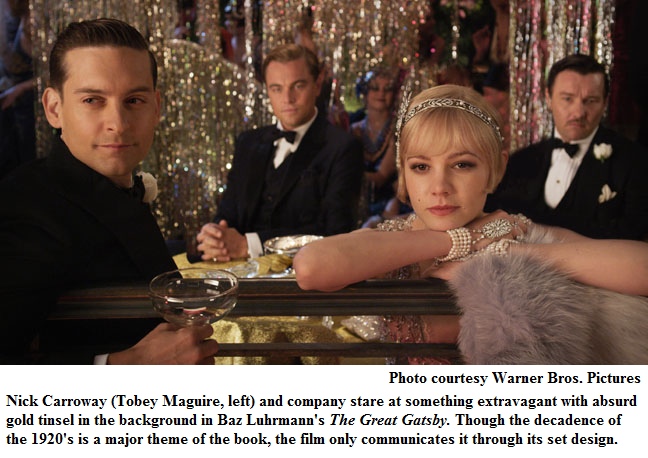
As Nick Carroway in Baz Luhrmann’s The Great Gatsby, that’s basically all he does. Carroway chronicles his summer in New York with the titular Jay Gatsby (Leonardo DiCaprio). Gatsby throws giant parties all the time, which would lead to a fun summer were it not for his obsession with Carroway’s married cousin, Daisy Buchanan (Carey Mulligan).

Gatsby falls deeply into a common trap for adaptations in that it tries to celebrate its source material rather than recreate and adapt it. The resultant product always has the same problem — it doesn’t do a very good job of actually telling the story. Audiences who know the story will likely love it, but those who don’t will leave the arena scratching their heads.

The Great Gatsby actually presents a big headache for prospective adaptors. With less than 200 pages, the book says a great deal without much bulk. It’s what makes great writing, but the best writing often doesn’t translate to screenplays at all.

In this film, it’s obvious when Carroway’s lines are being stretched to include iconic quotes that were only narrated in the book, when dialogue that the book glossed over is being recreated word-for-word without being fleshed out and when important moments are being stretched out because Luhrmann wanted to add pop music over them.

The stretching is another big pitfall the film trips over. It pulls 143 minutes out of a 182-page book, which is kind of ridiculous even without the knowledge that the book is narration-heavy. This movie is long, and it feels long.

The movie isn’t without artistic merit. The soundtrack is melodic and haunting, and the set designs are wonderful. They both go a long way in creating an aesthetic that fits the story like a glove. Audiences who come just for Luhrmann’s reputation in these aspects won’t be disappointed.

But with a focus on these elements, the overall film suffers. There are multiple points in which the movie grinds to a complete halt while the audience is invited to simply admire the sets for a few minutes. When a movie literally tries to move its background into the foreground, something’s gone wrong.

Joshua Knopp is a formerly professional film critic, licensed massage therapist, journalism and film student at the University of North Texas and a staff writer for the NT Daily. He was previously unaware of the concept of “preemptive amputations,” but is pretty sure they have more to do with cowardice than courage . For questions, rebuttals and further guidance about cinema, you can reach him at reelentropy@gmail.com. At this point, I’d like to remind you that you shouldn’t actually go to movies and form your own opinions. That’s what I’m here for. Be sure to come back next week for a review of Star Trek Into Darkness.

Posted in Entropy | Leave a comment

Iron Man fun, meaningless

Iron Man 3 is really fun and awesome, but can’t escape its own lack of importance.

The movie picks up with Tony Stark (Robert Downey Jr.) where The Avengers dropped him off — suffering acute anxiety attacks after a near-life experience. Stark is called to action after The Mandarin (Ben Kingsley) takes responsibility for a series of explosions, one of which catches Stark’s old bodyguard, Happy Hogan (Jon Favreau). In other news, Maya Hansen (Rebecca Hall) and Aldrich Killian (Guy Pearce) develop the extremis virus, and after a radical plot twist this becomes important.

This plot twist is the first thing that jumps out about Iron Man 3 — the violent plot twists. It’s difficult to examine them without spoiling them entirely, but suffice it to say the antagonists aren’t as advertised, even if you’re familiar with the Extremis storyline on which the film is based.

Continue reading

Posted in Entropy | 1 Comment

Pain & Gain shows, doesn’t condone violence

ImagePain & Gain has the words “Michael Bay” in the opening credits, but after those words fade out, the film becomes unlike anything Bay’s ever directed.

Based on a true story, the movie follows Daniel Lugo (Mark Wahlberg) and the Sun Gym Gang, a real-life group of gym trainers who kidnapped, mutilated and extorted wealthy members of their Miami community in the mid ’90s. In the film, he recruits Adrian Doorbal (Anthony Mackie) and Paul Doyle (Dwayne Johnson) to help him kidnap Victor Kershaw (Tony Shalhoub) and force him to sign over all his assets. Lugo and Doorbal are real-life criminals who currently sit on death row for this and much more, while Doyle is a composite of three other gang members. Kershaw is fictionalized and has his name changed.

Pain & Gain has taken some heat for making real-life criminals into sympathetic characters, but that’s actually the exact opposite of what the film does.

Pain & Gain is a rebuttal on gangster movies of the ’70s and ’80s, which do romanticize violent crime. Lugo mentions Michael Corleone and Tony Montana (Main characters of The Godfather and Scarface) as his inspiration — people who took what was theirs, regardless of the legality. Lugo argues this is the essence of some perverted version of the American Dream — he’s worked hard, therefore he deserves Shalhoub’s money.

He further rationalizes that Shalhoub, who owns a Schlotzkey’s and made his fortune through business exchanges, is a jerk and therefore doesn’t deserve what he’s earned.

The hypocrisy makes the film. Lugo, like the movies he’s mimicking, confuses being a man and living the American Dream with beating other people up and taking their things, despite the fact that it is Shalhoub who has realized the dream.

Pain & Gain is bathed in American themes and perverse movie references, the latter of which are usually used to justify something horrible. The flag noticeably hovers over Lugo as he asks for a second chance early in the movie. Acutely typical motivational speaker Johnny Wu (Ken Jeong) helps set Lugo on his journey. The bodybuilding surroundings and steroid use highlight a perverse focus on muscle mass as a measure of masculinity. Detective Ed DuBois (Ed Harris) expressly dismisses Lugo’s actions as “un-American.”

The script, penned by Christopher Markus and Stephen McFeely, further alienates the gang members with a strange, multiple narration structure. The audience hears directly from all parties, which makes it even clearer the film doesn’t want the gang seen as role models.

Bay abandons splatter-gore horror and explosion-based action for a more thoughtful movie than he’s ever made. His dull token female is, regrettably, still there, but so is his ability to make movies fun, if nothing else. His next movie, The Purge, looks to continue the thoughtful streak.

Joshua Knopp is a formerly professional film critic, licensed massage therapist, journalism and film student at the University of North Texas and a staff writer for the NT Daily. He totally doesn’t have a problem with the gangster movies of the 70’s and 80’s. For questions, rebuttals and further guidance about cinema, you can reach him at reelentropy@gmail.com. At this point, I’d like to remind you that you shouldn’t actually go to movies and form your own opinions. That’s what I’m here for. Be sure to come back next week for a review of Iron Man 3.

Posted in Entropy | Leave a comment

Oblivion is OK, not really worth the effort

ImageTechnically, Oblivion is a well-done film. Technically.

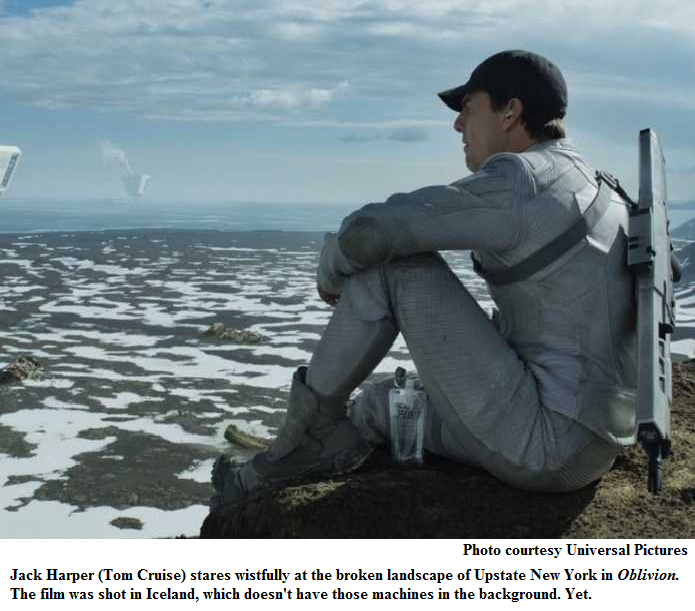
The movie follows Jack Harper (Tom Cruise) as he repairs drones on an Earth that has been lost in an alien war. According to Harper, the planet was rendered uninhabitable after the aliens destroyed the moon, which caused catastrophes due to the sudden shift in gravity. The nuclear arsenal was also deployed. Harper later finds that this is all a bold-faced lie.

Oblivion is one of those movies that is executed well, but doesn’t have much soul to speak of. The villains are sinister, the scenery is beautiful and the action is actiony, but the things that are wrong with it stand out so much further than the things that are right.

There are too many annoying, lazy tropes that encroach on the film’s potential. Morgan Freeman, despite second billing, has two whole scenes and is much less significant than Andrea Riseborough and Olga Kurylenko. The film leads with an extremely weak narration sequence that takes twice as long to set up the plot as the commercials did, and all the information is rehashed anyway. The invasion as it was described doesn’t make any sense, and even though it’s all a lie that’s bothersome.

The film makes a point of glossing over nuclear disarmament, despite it being a hot-button issue. Maybe that’s the moral writer/director/producer Joseph Kosinski (who also wrote the graphic novel on which it is based) was trying to establish — that nuclear disarmament is a bad thing. Or that it’s a good thing. I don’t know. Oblivion seems to have a message about nukes, but that message is unclear.

That’s not fair. This isn’t a bad movie, really, it isn’t. It’s shot beautifully, with Iceland’s odd majesty standing in beautifully for a buried New York City. Cruise, Kurylenko and Riseborough all do well, and at this point no one should expect more than a few scenes per movie out of Freeman.

There’s just something off about the whole thing. It’s one of the better things in theaters right now, but still isn’t worth going out for. Whether its the feel of being a mash-up between other, better films, or the fact that it feels about twice as long as it really is, or that still-so-annoying nonsense with physics, Oblivion just doesn’t have the goods.

Joshua Knopp is a formerly professional film critic, licensed massage therapist, journalism and film student at the University of North Texas and a staff writer for the NT Daily. He would like to remind you to never trust strangers in parking lots.  For questions, rebuttals and further guidance about cinema, you can reach him at reelentropy@gmail.com. At this point, I’d like to remind you that you shouldn’t actually go to movies and form your own opinions. That’s what I’m here for. Be sure to come back next week for a review of Pain & Gain.

Posted in Entropy | 2 Comments

42 straight of the 1940’s

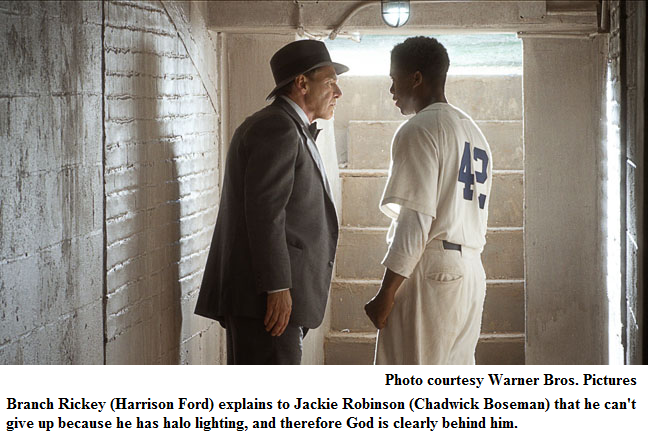
Image42 sets itself up as a bio-pic, but it takes its cues more from World War II-era propaganda films.

The movie follows baseball icon Jackie Robinson (Chadwick Boseman) through his first year with the Brooklyn Dodgers in 1947. The first black player in Major League Baseball, Robinson takes a lot of abuse throughout the year.

42 shoots its message at the audience with gaudy dialogue and lighting. Most of it is religious. Early in the film, manager Branch Rickey (Harrison Ford) makes Robinson into a Jesus analogue, and he never stops talking about God from there. Halo lighting is used exorbitantly to make sure the audience knows how Godly and glorious everything is.

The racial aspect of the story is focused on tightly. To a degree this should be expected, but the fact that Robinson was actually very good at baseball is only vaguely referenced, and that’s kind of a problem.

The film is more about sassy commentary from Robinson, Rickey and Red Barber (John C. McGinley). It’s basic wish-fulfillment — it gives the audience the pleasure of having the actions to drown out the bad guys’ words. It lets us root for the team we know is going to win.

But I can’t figure out the point of this larger-than-life bio-pic when the facts of Robinson’s career are staggering. This sensationalized fiction doesn’t live up to the reality.

In real life, Robinson is one of the most dynamic offensive players in Major League history. In the 1947 season, he lead the league in both sacrifice bunts and, somewhat counter intuitively, in stolen bases. He had 175 hits and 12 home runs, helping lead the Dodgers to the pennant where they would lose to the Yankees.

This is important, because Robinson wasn’t just notable because he was black — he was notable because he was a damn fine baseball player. 42 doesn’t mention any of his on-field accomplishments other than playing while black, and in doing so reduces him to the color of his skin. It’s pretty racist, really.

Joshua Knopp is a formerly professional film critic, licensed massage therapist, journalism and film student at the University of North Texas and a staff writer for the NT Daily. He extends his deepest condolences to citizens of Boston and West, Texas . For questions, rebuttals and further guidance about cinema, you can reach him at reelentropy@gmail.com. At this point, I’d like to remind you that you shouldn’t actually go to movies and form your own opinions. That’s what I’m here for. Be sure to come back next week for a review of Oblivion.

Posted in Entropy | Leave a comment