Evil Dead was better in the ’80s

The latest remake of a beloved horror classic is out. Yawn.

Evil Dead follows a similar plot to 1981’s The Evil Dead — five teenagers go to an isolated cabin and find the Necronomicon. A character says something about demonic possession, and then the director breaks out the fire hydrants of fake blood and turns them all on at once. The minutia doesn’t really matter.

Evil Dead’s big, glaring issue is it’s boring. The series has always been much more about gore than suspense, but basically every scary scene is preceded by 10-15 seconds of tension-building despite the fact that anyone who’s even vaguely genre savvy knows what’s about to happen. This movie is a highway to splatter-gore, and it was never going to surprise anyone along the way. Attempts to do so only amount to wasted time.

There really isn’t a scene where this atmosphere of feaux-tension is present, and that’s kind of sad because the plot was good and deserved attention. Instead of a group of college kids headed to a cabin just because the plot required it, this film is about Mia’s (Jane Levy) heroine withdrawal. She’s there with her friends (Lou Taylor Pucci, Jessica Lucas), brother (Shiloh Fernandez) and brother’s girlfriend (Elizabeth Blackmore) to quit cold turkey, and no one is allowed to leave until she’s better. So, when she starts doing her best Exorcist impression, everyone thinks it’s the withdrawal.

Evil Dead  sets itself up to add new meaning to the classic tale by making it a fantasy about the trials of withdrawal instead of just a scary movie. However, it’s kind of a red herring. The film starts with this thread, abandons it for the main body of the film and then picks it up for the closing act. It’s not done completely, but it’s more enjoyable and touching if you can think about it as about withdrawal.

It’s hard to see why Sam Raimi, Bruce Campbell and Robert G. Tapert signed on to produce this. The fact that the writer/director, star and producer of the classic series were involved was a source of excitement and speculation that this might not be just another remake, but the fact of the matter is that’s all Evil Dead is.

There’s a half-hazard withdrawal storyline and it’s a little prettier, but I can’t see a reason for this to be here when the original is still so culturally relevant.

Joshua Knopp is a formerly professional film critic, licensed massage therapist, journalism and film student at the University of North Texas and a staff writer for the NT Daily. He has a paralytic phobia of ducks. For questions, rebuttals and further guidance about cinema, you can reach him at reelentropy@gmail.com. At this point, I’d like to remind you that you shouldn’t actually go to movies and form your own opinions. That’s what I’m here for. Be sure to come back next week for a review of 42.
Posted in Entropy | Leave a comment

G.I. Joe is just useless

G.I. Joe: Retaliation’s opening credits are pretty epic until the word “Hasbro” flashes on the screen.

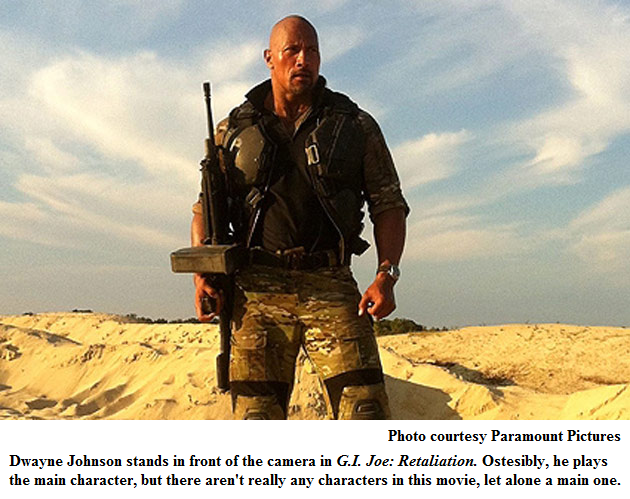
The film is a sequel to 2009’s Rise of Cobra in name only. Retaliation features an entirely new set of writers, a new director and an entirely new cast — Ray Park and Lee Byung-hun return as those two ninjas (Byung-hun’s character died in the first one, but whatever) and Channing Tatum returns as Duke, but he dies five minutes in. Dwayne Johnson, Bruce Willis, Ray Stevenson and Luke Bracey come in as the principal characters, but their characters don’t require any acting. Jonathan Bryce returns as the president/that one bad guy who can disguise himself really well, and he actually has dialogue so that’s neat.

ImageThe thing to understand here is G.I. Joe: Retaliation does share two of it’s predecessor’s three producers. In that context, it is bafflingly, hilariously mishandled, even for the music video action movie it is.

Stephen Sommers, who only works on toy-selling movies, was canned as director in favor of Jon M. Chu, who lists a couple of Step Up movies and Justin Bieber concert movies to his credit. The film was pushed from a June 2012 release to a March 2013 one, despite having already committed to a Super Bowl commercial and a ton of merchandise. As mentioned above, Byung-hun’s character was impaled and dropped into the Arctic Ocean in the first movie, but he’s alive and well in this. Cobra Commander was re-cast from Joseph Gordon-Levitt to Bracey (that might not have been the producers’ decision).

This is a drawing the illustrator never cared about, and it shows. There are a lot of cool things in this movie, from the exploding fireflies to Johnson’s melt hands. Bryce, Stevenson and Walton Goggins turn in quality performances, Bryce in a major part. His character has the best nuclear disarmament plan ever.

But it’s impossible to focus on these when most of the movie is as poorly thought-out as it is. For every cool set piece, there’s a sequence where bullets don’t seem to work properly. Cobra Commander answers every good performance with lines like “Destro, you’re out of the band,” or “I need him for the war I’m about to start.” Adrienne Palicki’s role as a piece of meat is another mark against the cast’s ability to enhance the movie. After Zartan achieves nuclear zero with what is, again, the most glorious nuclear disarmament plan ever conceptualized, he destroys London.

No one seems to care about this movie, from the producers to the creative team to the actors all the way to the audience. It’s a speck of dust, a go-through-the-motions affair of ridiculous, tenuously connected action sequences. It’s industrial cinema at its worst.

Joshua Knopp is a formerly professional film critic, licensed massage therapist, journalism and film student at the University of North Texas and a staff writer for the NT Daily. He constantly wonders why the U.S. doesn’t take North Korea more seriously. For questions, rebuttals and further guidance about cinema, you can reach him at reelentropy@gmail.com. At this point, I’d like to remind you that you shouldn’t actually go to movies and form your own opinions. That’s what I’m here for. Be sure to come back next week for a review of Evil Dead.

Posted in Entropy | Leave a comment

The Host not salvageable by cinema

ImageWhen writer/director Andrew Niccol took on adapting The Host, Stephanie Meyer’s other book about supernatural love triangles, I was intrigued.

My mistake.

The melodrama follows Wanderer, a body-snatcher alien whose race has taken over the planet, from the point it takes over Melanie Stryder (Saoirse Roman) onward. Wanderer can’t control Stryder’s emotions, and is soon driven to the desert to look for Stryder’s loved ones. Once it finds them among a large colony of free humans, Wanderer lives in the colony and they all learn to trust each other and live in peace and harmony and extremely poor dialogue.

What Meyer has done here is she’s taken the plot from Animorphs and taken out everything that made it cool. Instead of pre-pubescent middle schoolers thrust into a situation they can’t possibly control, The Host features saucy post-pubescent teens who blow most of their time in an underground farm with nothing better to do. Instead of perseverance against all odds, the story stresses dependence and rewards indecision. Thought speech is in, shape shifting powers are out.

The Host tries to key in on the internal dissonance between Wanderer and Stryder. Unfortunately, it does this with a poorly-developed love triangle, because that is literally the only plot device Meyer understands. Ian (Jake Abel) forges a relationship with Wanderer, but the alien is held back by Stryder’s already established relationship with Jared (Max Irons). Somehow, it devolves into yet another story about a weak female lead surrounded by strong men who want to have sex with her. The dynamic could have been interesting this time, but with Stryder’s constant stream of thought-dialogue, it actually gets kind of rapey.

The audience’s ability to hear Stryder’s thoughts is The Host’s key problem. It externalizes an internal struggle,  turning what should have been a source of tension and unpredictability into a reality TV-style argument about who to sleep with.

It’s hard to tell why Niccol signed on here. Normally a writer of thoughtful science fiction, he was unable to adapt the stupid out of The Host. His directorial fingerprints are there, but the story itself is too overwhelmingly lame for anything to save it.

This film places absolutely no trust in the audience to understand or care about its characters without help. Its body is eviscerated by terrible dialogue and an extremely botched car roll, and its ending is absolutely nonsensical. There is no conceivable reason to spend time or money here.

Joshua Knopp is a formerly professional film critic, licensed massage therapist, journalism and film student at the University of North Texas and a staff writer for the NT Daily. He has long been an avid fan of K.A. Applegate’s Animorphs book series. For questions, rebuttals and further guidance about cinema, you can reach him at reelentropy@gmail.com. At this point, I’d like to remind you that you shouldn’t actually go to movies and form your own opinions. That’s what I’m here for. Be sure to come back tomorrow  for a review of G.I. Joe: Retaliation.

Posted in Entropy | Leave a comment

SATIRE: New Die Hard OK, not really necessary

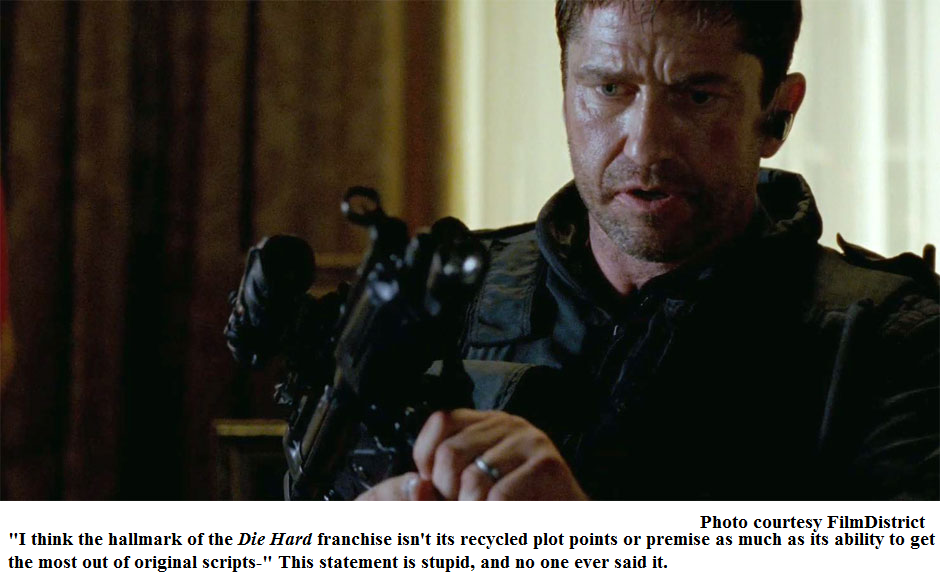
ImageDie Hard: Olympus has Fallen is a very mild movie, but it’s all just too much.

In his astonishing sixth time around the block, John McClane (Gerard Butler), action movie garbage man, must save the president (Aaron Eckhart) from a Korean terrorist (Rick Yune) who wants to force America to allow the Korean War to resume.

McClane is retroactively painted as a former secret service member who allowed the first lady (Ashley Judd) to die in an accident and was kicked off the force. Part of his motivation is guilt over this incident, but they don’t really do very much with that storyline so whatever.

In Olympus has Fallen, the Die Hard series returns to a simpler chapter. Instead of saving the entire East Coast, McClane is again only responsible for one building with a hostage situation. But, because that building is the White House and the hostage situation threatens the reignite the Korean War, it seems bigger.

The action stays small, though. Outside of an early sequence in which the terrorist team all-too-easily captures Washington D.C., the action is limited to small arms fire with a handful of explosives. The film keeps a nice mix of fire fights and martial arts, and further, it keeps the fire fights interesting and manages to minimize Asian martial arts stereotypes.

It is unclear why Butler replaced Bruce Willis as McClane. He’s a good candidate, but there wasn’t any reason for Willis to step down. Shooting for Olympus has Fallen overlapped with its predecessor, A Good Day to Die Hard, but there’s no reason they couldn’t have delayed production and allowed Willis to maintain his role. Butler does a good enough job, but couldn’t he shave his head or something? For continuity, I mean?

The biggest problem with Olympus has Fallen is the context it places itself in. Die Hard has a sterling history going back to the 1988 classic of being able to convert action scripts into profitable-if-cheesy movies that have Bruce Willis’ name attached. If your story idea has a lot of explosions but isn’t getting traction, call the folks at Die Hard! They’ll squeeze it out!

But now, with Die Hard: Olympus has Fallen (and A Good Day to Die Hard), producers seem to be using Die Hard as a go-to option. Unlike the previous movies in the series, both are original scripts that were always intended to be Die Hard movies.

Why? Who would take a perfectly good recycling factory and jam new material into it? They’re doing it so fast now that, as mentioned earlier, the production schedules overlapped.

If Die Hard continues down this road of using scripts written from scratch, it’s bad news for crummy screenwriters everywhere.

On its own, Die Hard: Olympus has Fallen is an OK movie, but there are just too many Die Hards now. The day of the completely disposable action movie is long gone.

Joshua Knopp is a formerly professional film critic, licensed massage therapist, journalism and film student at the University of North Texas and a staff writer for the NT Daily. He is unbelievably tired of hearing about how good those boys were at football. For questions, rebuttals and further guidance about cinema, you can reach him at reelentropy@gmail.com. At this point, I’d like to remind you that you shouldn’t actually go to movies and form your own opinions. That’s what I’m here for. Be sure to come back next week for a reviews of The Host and G.I. Joe: Retaliation.

Posted in Entropy | Leave a comment

Oz, the sexist and terrible

Image

Oz the Great and Powerful is so bad… so bad…

The film keys on Oz (James Franco), a ladies’ man circus magician who aspires to “greatness” and is thrust into the fantastic, incredible, 100 percent CGI world of Oz. There, he meets Theodora (Mila Kunis) and Evanora (Rachel Weisz), who send him to kill the wicked witch, Glinda (Michelle Williams). Upon her death, all his wildest dreams will come true.

Oz the Great and Powerful is viscerally bad. The scenery, which seems to be the key drawing point of the film, is on par with a nice screen saver. All of the main cast members, Kunis in particular, turn in willfully bad performances that point to director Sam Raimi as a root problem. When visual effects are asked to do more than just liven up the background, they fail spectacularly. This is most notable in the completely unnecessary visual enhancements to the Wicked Witch of the West, who is the most awkward thing in cinema so far this year.

Despite being a children’s film, Oz sets a disturbingly poor example for children. The main character is a slime ball with no redeeming qualities, yet the story makes him into a messianic figure.

The weakness of the female characters would have L. Frank Baum spinning in his grave. A firm feminist, the majority of Baum’s Oz books featured strong female leads. This film features three pathetic female supporting characters, all of whom exist as a function of the wizard. The film goes so far as to paint The Wicked Witch of the West, one of the most iconic film villains of all time, as a product of heartbreak from the wizard’s schmoozing.

But this isn’t just a bad movie. If it were just a bad movie, it could go off in a corner and be bad without drawing attention to itself. No, this is the prequel to The Wizard of Oz, one of the most enduring, beloved movies ever made.

By tying itself to a piece of American iconography, Oz gains instant market credibility and guarantees itself a good opening weekend, despite being garbage. This kind of piggybacking is painfully common and seems more and more pronounced as time goes on. It can come in the form of categorically worse remakes (The Amazing Spider-Man), a never-ending stream of sequels (Ice Age, Madagascar) or prequel trilogies that advertise the same creative team as their predecessors, but manage to invalidate them anyway (The Hobbit). All of these were top-10 at the box office in 2012.

The baffling part is Disney put the effort in to make a new, lame story for this simple end. If they’d re-made The Wizard of Oz to be closer to the book, it would have done the same thing but been more interesting. If they’d adapted Wicked, which is based on the 1939 film version, it would have done the same thing but been much more interesting. Writer Mitchel Kapner has said that they wanted a male lead character and went on to imply that there weren’t enough of those already.

Oz the Great and Powerful is bad and its editorial decisions make no sense. It claims famous source material that it spurns at every turn, usually for something stupider or more far-fetched. It is a soulless cog in a soulless machine, not suitable for viewers of any age group.

Joshua Knopp is a formerly professional film critic, journalism and film student at the University of North Texas and a staff writer for the NT Daily. He also holds a BFA in political theory  from Shiz University.  For questions, rebuttals and further guidance about cinema, you can reach him at reelentropy@gmail.com. At this point, I’d like to remind you that you shouldn’t actually go to movies and form your own opinions. That’s what I’m here for. Be sure to come back next week for a review of Olympus has Fallen.

Posted in Entropy | Leave a comment