
Production a Great War for new zombie flick

Brad Pitt’s new zombie blockbuster, World War Z,  is much more about what happened off the screen than on it.

Pitt, who also produces, plays Gerry Lane, a retired United Nations employee who is recruited to help the U.N. again after a global breakout of “rabies.” After a brief jaunt through a chaotic New England, Lane is sent up and down Asia hunting for the pandemic’s patient zero.Image
World War Z is OK. The film’s biggest crime is not being accurate to or as good as the book on which it’s based, and that’s not fair criticism.

Given the problems with production, it’s a miracle the film is as coherent as it is. Writer Michael Straczynski (uncredited) wrote a script that author Max Brooks was thrilled with and “Ain’t it Cool News” thought could be best picture worthy, but director Marc Forster had Matthew Carnahan rewrite it to focus more on action and drop the first-person retrospective that makes the book so memorable.

Production started before the third act was fully written and was faced with myriad silly, stupid problems. At one point in Israel, shooting was delayed for several hours because they didn’t order enough food for all the extras. They got into trouble with the Hungarian anti-terrorism division because their 85 prop assault rifles may or may not have been functional weapons.

By the end of re-shooting, which encompassed the entire third act, Pitt and Forster weren’t on speaking terms. After loving the first script, Brooks was upset with and distanced himself from the final product.

The zany production brings the movie’s strangest flaw into relief. In the third act, the movie’s subject abruptly changes from a search for patient zero to a half-hazard attempt at developing a vaccine. It very much feels like one movie’s head got placed on another one’s body.

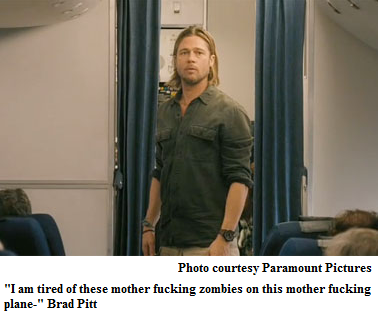
World War Z is at least mildly entertaining. We get to see zombie hordes on an unprecedented scale and a world going to a confused, panicky Hell. Large-scale scenes, like zombies on a plane, haven’t really been done before, and they capture the global feel the movie is going for.

It’s a serviceable zombie/disaster movie, but subtract some extreme arrogance from all levels of the production and it could have been a great one. Un-invested viewers will enjoy it well enough. Audiences who put more thought into their movie watching will have a little more trouble. And fans of the book will inevitably be left wanting, wondering what could have been. The book is nigh-impossible to translate into a script, but apparently the first one was a doozy. If they’d run with it, who knows how the final product would have ended up?

Plan B Productions seems to view World War Z as a long-term action franchise, so it’ll probably get worse as time goes on. The franchise about zombies will, ironically enough, die and twist into an off-screen zombie, requiring more and more life support and yielding less and less milk with each passing installment. We’ve seen it before, but normally we get at least one stellar movie out of it.

Joshua Knopp is a formerly professional film critic, licensed massage therapist, journalism and film student at the University of North Texas and a staff writer for the NT Daily. He stands with Wendy Davis. For questions, rebuttals and further guidance about cinema, you can reach him at reelentropy@gmail.com. At this point, I’d like to remind you that you shouldn’t actually go to movies and form your own opinions. That’s what I’m here for. Be sure to come back tomorrow for a review of Monsters University.

Posted in Entropy | 2 Comments

Superman defies gravity, why can’t his movies?

DC’s attempt to compete with Marvel on the big screen begins with Man of Steel, quite possibly the most disappointing superhero movie ever made.

The film starts with Kal-El (Henry Cavil) being born, because this origin story goes all the way to the beginning. After a 20 minute prologue in which his father, Jor-El (Russell Crowe), and General Zod (Michael Shannon) quarrel over the fate of a dying planet, Kal-El is sent to Earth where he fast-forwards 30 years and becomes Superman. He is then called to defend Earth from Zod, who wants to turn it into a new Krypton.

David S. Goyer’s script is a humongous problem, rife with structural flaws, poor dialogue and extreme stupidity.Image

In terms of structure, the prologue has the movie’s emotional climax, but is set before anyone cares or understands what’s happening. It picks up and sets down Man of Steel’s primary theme of trying to link Krypton’s death to social issues that are causing Earth to die.

Had they put more thought into this sequence it might have been meaningful, but there’s a difference between social commentary and heavy-handed attempts at resonating with headlines. The film doesn’t delve into its chosen social issues as much as it shouts out at them in an attempt to be hip. They even add a shot at the ultra-current American domestic scandal at the end.

The movie’s bi-global scale is also an issue. While the focus is supposed to be on Superman, too much hay is made of what’s going on in the world — both of them. DC is trying to create a Christopher Nolan flavor with its movie franchises, but if  all that means is imitating tricks that worked in The Dark Knight but haven’t worked elsewhere (Inception, The Dark Knight Rises, this movie), we’re in for a long decade of poor filmmaking.

Ironically, Man of Steel could have solved its bigger structural problem by taking cues from one of Nolan’s earliest film, Memento.

Poor dialogue permeates the movie. A few lines obtrude awkwardly from the film, taking the audience out of it simply because it’s too hard to believe a person would talk like that. Of the cast, only Shannon is able to overpower the inherent badness of his lines.

The third head of the three-headed monster the script creates is stupidity, and oh, is there a lot of it.

Man of Steel features one of the stupidest on-screen militaries in cinematic history. Many soldiers die in the film because they keep firing at Kryptonians no matter how many bullets bounce off them and never make any attempt to defend themselves. Later in the film, someone thinks its a bright idea to fire missiles at a gravity-warping device.

Speaking of gravity-warping, Superman and the military’s plan to save Earth features them creating a black hole on the planet’s surface.

Seriously.

While the script does address some of the sillier parts of the Superman mythos, such as Lois Lane never recognizing Clark Kent and pieces of Superman’s home world being somehow damaging to him, they accentuate the stupidest — why doesn’t anyone else leave Krypton? They did take the trouble to preserve a toddler and a maniac who’d just been sentenced to 300 years for high treason, but everyone else stays and dies with the planet. An Ark doesn’t seem like it would be a difficult concept for these people.

Director Zack Snyder puts together one nice action sequence, but is incapable of truly elevating the movie. The visuals largely attack viewers instead of communicating with them. It doesn’t help that the dialogue is shot in shaky-cam as well. The last fight between Superman and Zod is an unfortunate homage to Matrix Revolutions, where the characters just fly at each other butt heads.

Frankly, with Snyder, that’s what you pay for. He’s proven time and time again that he can deliver stunning visuals but will do absolutely nothing to mend a damaged script.

There’s no telling how Goyer went from something as elegant as The Dark Knight to something this hair-brained in five short years. If DC doesn’t stop trying to recreate the 2008 hit, even the most avid fans will start getting bored with them.

Joshua Knopp is a formerly professional film critic, licensed massage therapist, journalism and film student at the University of North Texas and a staff writer for the NT Daily. He has long held the belief that friends don’t let friends go to for-profit colleges. For questions, rebuttals and further guidance about cinema, you can reach him at reelentropy@gmail.com. At this point, I’d like to remind you that you shouldn’t actually go to movies and form your own opinions. That’s what I’m here for. Be sure to come back next week for reviews of Monsters University and World War Z.

Posted in Entropy | 5 Comments

Purge is a mixed bag

The Purge has elicited mixed reactions from critics, who either love it or hate it, and that’s because there are a lot of reasons to do both.

The film is set 10 years in the future. The U.S. has begun holding an annual purge, a 12-hour period during which emergency services and criminal law are suspended. Anything goes, even murder. Everyone in the film makes sure to include that phrase, “even murder,” when explaining this, because murder is all anyone seems to do. It stands to reason that if the purge is about letting out aggression, there would be much more sadism than that. Don’t get me wrong, it’s not like I like torture and rape sequences — we’ll get to the clusterbomb of conceptual problems in a minute.

The movie itself follows the Sandin family through one of these purges. James (Ethan Hawke) is in home security, an industry that has boomed since the purge became law. He lives with his wife (Lena Headey) and children (Max Burkholder, Adelaide Kane) in a wealthy, suburban neighborhood. The Sandins were sitting pretty until Charlie (Burkholder) drops security to let in a fleeing, bloodied stranger (Edwin Hodge), and the house comes under siege by the pack of college students that was after him.

Image

The Purge is a thoroughly mixed bag. Writer/director James DeMonaco’s script has a clever enough concept, but is filled with laughable dialogue. The cast, with the exception of Rhys Whitfield, who plays the murderous pack’s polite leader, is tilting at windmills trying to perform these lines well. The plot has the same issue — most of it is just fine, but every now and then Zoey (Kane) will vanish for no apparent reason. The film’s pacing will seem like it’s a problem sometimes and be pitch perfect at others.

The good and bad aspects of these basic factors mix with the good and bad aspects of the film’s concept to produce twisting layers of good and bad cinema. Outside of a few really bad lines, The Purge is never really one or the other at any point. It’s always both.

Its social commentary is heavy-handed, and that’s both good and bad. Multiple talking heads suggest the post-purge economic boom (crime and unemployment rates are at an all-time low) is simply because all the poor people get killed off during the purge. If we kill everyone who doesn’t have a job once a year, of course unemployment will drop. The film equates the American homeless’ plight with murder. The leader’s constant vomit of elitism and the stranger’s dog tags and race add great depth here.

The film’s other primary theme is that complacency is just as harmful as active participation. Throughout the film, the Sandins repeatedly attempt to hide themselves and ignore the purge, and they are repeatedly forced to face it head-on. The problem is, literally and figuratively, at their doorstep, pulling down the expensive steel walls that make looking the other way an option for the family. For a film as preachy as The Purge is, it has a very rich subtext. Hitchcockian house level mechanics are used to superb effect, also.

Unfortunately, while rejecting the premise is a cardinal sin, this movie is just too hard to keep up with. The economic boom is attributed solely to the purge’s introduction, suggesting that all of society’s problems (and specifically all crime) is simply due to pent-up aggression.

The fact that murder is all that goes on raises some questions. What happened to our rape epidemic? If humans are so sadistic that we need a purge to keep us in line, why is this most sadistic and already common crime completely absent during said purge? Why aren’t any banks robbed? If they are, why is the economy so stable? What happened to the drug trade? Was that whole thing just due to pent-up aggression? How come nobody can hear anything, even gunfire, that happens in another room?

Ultimately, the poor dialogue, plot holes and gaping conceptual flaws win out for me, but The Purge is still a poignant and enjoyable movie.

Crazy fan theory– if you’ve seen it and are having trouble, pretend that Zoey died in a previous purge and is a ghost, and that’s why she keeps vanishing for no reason. The filmmakers probably didn’t intend this, but it makes the movie a lot better.

Joshua Knopp is a formerly professional film critic, licensed massage therapist, journalism and film student at the University of North Texas and a staff writer for the NT Daily. He thinks Thomas Hobbes is an absolute tool. For questions, rebuttals and further guidance about cinema, you can reach him at reelentropy@gmail.com. At this point, I’d like to remind you that you shouldn’t actually go to movies and form your own opinions. That’s what I’m here for. Be sure to come back next week for a review of Man of Steel.

Posted in Entropy | 3 Comments

Questionable origins doesn’t hurt After Earth

ImageAfter Earth is taking a lot of crap for being made by M. Night Shyamalan and the Scientologist church, but when the baggage is laid down, the movie is fantastic.

The film stars Will and Jaden Smith as Cypher and Kitai Raige. Cypher is a high-ranking general in a neo-military organization that Kitai has just failed to join because, despite book smarts, he collapses in the field. At their wife/mother’s (Sophie Okonedo) insistence, the emotionally distant duo go on vacation, but crash land on Earth, now a poisoned wreck of a planet. Cypher’s legs are broken, and to get rescue, Kitai must journey through 100 kilometers of wilderness and overcome his fear of active duty.

Complicating matters is the ship’s third survivor — an ursa, a blind, arachnoid behemoth that was genetically engineered by an alien race to kill humans. Ursas track their prey by pheromones produced in fear. The primary defense against them is to completely purge oneself of fear, a technique Cypher invented, but Kitai cannot master.

After Earth  is a thematic triumph. Fear and guilt are thoroughly examined through the main characters’ experiences, and the simplistic directing and powerful performances allow the audience to sympathize completely. As a character examination, After Earth couldn’t aspire to be anything more.

The Smiths are fantastic, with Jaden turning in the most subtle performance of his career. The stilted, awkward aesthetic between son and distant father makes dialogue a non-option for expressing emotions, but at no point does Jaden have trouble expressing the posttraumatic anxiety that defines his character.

Writer/director M. Night Shyamalan validates the marketing tactic of not mentioning him ever by taking himself out of the film. His stylistic quirks are minimized, to the point that he doesn’t have a cameo or a twist ending.

The film isn’t perfect. It needs more ambition. Because Kitai and Cypher don’t communicate, their back story is primarily told through flashbacks, and more flashbacks would have been better.

I would have really liked to see Kitai collapsing in his field training. While the informed trait is supported by his difficulties in the main body of the movie, it would help to see how bad his panic attacks were in a controlled environment.

There’s also a bit of a bait-and-switch going on. While guilt takes a big role, the green aesop the commercials promised lacks bite, particularly because of the biggest monster not being from Earth at all. The film would have been better and cleaner had it abandoned Earth as a setting.

A lot of noise has been made about Scientology themes in the film, with its main message coming straight from L. Ron Hubbard’s teachings and its climactic setting, a volcano, being important to the religion. If an audience goes in expecting to see propaganda, confirmation bias could easily ruin the movie. It happens, but in this case, it’s really sad. After Earth is strong in all the ways it needs to be, and a few motifs to an alternative religion shouldn’t change that.

I have to wonder though — what happened to firearms?

Joshua Knopp is a formerly professional film critic, licensed massage therapist, journalism and film student at the University of North Texas and a staff writer for the NT Daily. He is going to be 21 forever, baby. For questions, rebuttals and further guidance about cinema, you can reach him at reelentropy@gmail.com. At this point, I’d like to remind you that you shouldn’t actually go to movies and form your own opinions. That’s what I’m here for. Be sure to come back next week for a review of The Purge.

Posted in Entropy | 2 Comments

Star Trek Into Darkness: What is the line between a loving tribute and a conceited remake

ImageJ.J. Abrams crushed it with his first Star Trek movie, but a big reason why was the fact that he didn’t remake a story that had already been told. However, in Star Trek Into Darkness, he___ ______________ ______________ ______.

New Jim Kirk (Chris Pine) returns to defend the Earth (still not boldly going anywhere just yet) and Starfleet against John Harrison (Benedict Cumberbatch), who is blowing things up because director/producer Abrams wanted to allude to real-world terrorism. The rest of the New cast returns as young, sexy versions of the original Star Trek cast along with Alice Eve as New Carol Marcus.

The first 20 minutes of the film are just awful, but it picks up quickly from there. A cold opening featuring the Enterprise saving a primitive civilization from a volcano that would apparently destroy their entire planet gets Kirk demoted and Spock (Zachary Quinto) reassigned, but before either of them report to their new assignments they are reunited as captain and first officer on the Enterprise and sent after a terrorist hiding on the Klingon homeworld, Kronos. These sequences are boring and serve only to lengthen the film and add constant, masturbatory references to Star Trek and Wrath of Khan.

It also sets a context into the film of Kirk growing into a leadership role, which is redundant because that’s exactly what the previous movie was about. Into Darkness attempts to recapture its predecessors’ brilliance by recreating plotlines, and that’s very much the wrong way to go about it.

Continue reading

Posted in Entropy | 3 Comments