
Film puts audience in a worse prison than its characters

ImagePrisoners wants to be an intense examination about the lengths a man would go to to get his child back, but really it’s just boring.

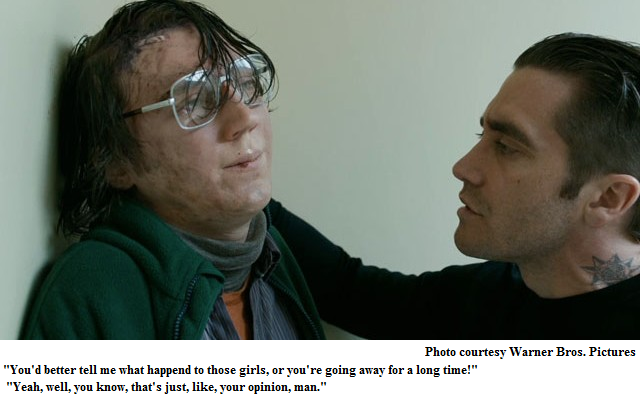
The audience is supposed to get behind Keller Dover (Hugh Jackman), a Christian, carpenter and hunter who thinks the national anthem is a pretty song and not just something you sing before sports events. While celebrating Thanksgiving with the Birchs (Terrance Howard, Viola Davis), both families’ young daughters disappear. Dover fixates on the primary suspect (Paul Dano) after the suspect is released because he’s too stupid to have committed the crime.

The movie pits Dover against his own better nature as he tries to figure out where the girls were taken. In one storyline, he kidnaps and tortures the invalid. This seems to be the film’s main advertised storyline.

In a completely different storyline, Detective Loki (Jake Gyllenhaal) leads an investigation into the girls’ disappearance. In another completely different storyline, Dover’s wife (Maria Bello) lays at home and cries.

To say this movie stops and smells the roses is putting it mildly. Its various plots are all lightly connected – it’s all got something to do with the prisons the characters put themselves in. Dover is caught in his violent fixation on Dano’s character, Dano and the missing children are literally imprisoned, Dover’s wife can’t get out of bed, etcetera.

But, in theory, a film can do that without taking the audience through every detail of two or three lives over six days. If Prisoners had picked a main character and stuck with him, it wouldn’t be so long, it wouldn’t have had so many dull bits and it still would have been able to express the “prisons” theme well enough.

What really should have happened, though, would be a rewrite into a comedy. All the characters are there – a die-hard conservative, a passive liberal, a straight detective and a man-child with the IQ of a 10-year-old all fumble around two kidnappings in a convoluted plot that doesn’t really matter in the end. Sounds just like The Big Lebowski, doesn’t it? This plot would have worked well in a similar, genre-mash aesthetic.

As it is, Prisoners is deeply flawed and there isn’t really any point to watching it. Director Denis Villeneuvre doesn’t create an atmosphere intense enough to be a reward in its own right. The plot twists are telegraphed and ineffective. There are better, shorter movies available through just about every avenue.

Joshua Knopp is a formerly professional film critic, licensed massage therapist, journalism and film student at the University of North Texas and a staff writer for the NT Daily. If you strike him down, he will be come more powerful than you can possibly imagine. For questions, rebuttals and further guidance about cinema, you can reach him at reelentropy@gmail.com. At this point, I’d like to remind you that you shouldn’t actually go to movies and form your own opinions. That’s what I’m here for. Be sure to come back later in the week for reviews of Don Jon and Rush.
Posted in Entropy | Leave a comment

Insidious continues bland horror trends

A lot of modern horror is garbage, but Insidious: Chapter 2’s soul-crushing monotony stands apart.

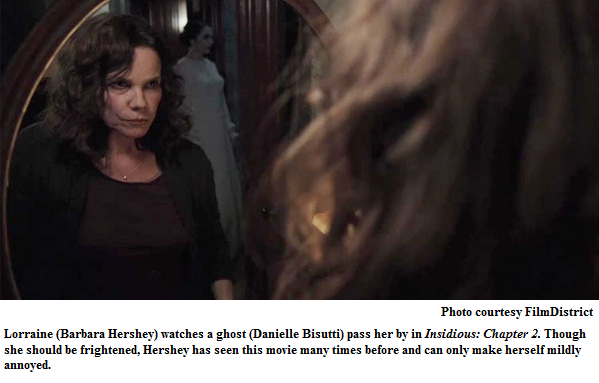
The film picks up right after its predecessor, with Josh (Patrick Wilson) possessed by a vicious ghost. Josh becomes a nexus for interaction between the physical and the astral. Spooky antics ensue.

Image

Insidious: Chapter 2 is extremely dull. All scares have a set formula: someone says something mildly creepy, then there’s a smash cut with sudden music. It happens once every five minutes and it gets old before the previews are over. The entire production falls flat under this boring, archaic paradigm.

And that’s really sad. Whannell wrote himself into a corner in the first movie. After 75 minutes of genuinely creepy nonsense, he didn’t know how to end the story and so the main characters called the Ghostbusters. The film suffered the rest of the way.

In Chapter 2, Whannell wrote himself out of that corner, managing to reestablish the haunted house problem that was supposedly solved and adding depth to the ghost possessing Josh. Delving into (well, scraping) child abuse and serial murder, the backstory’s implied crimes provide the only real thrills in the movie.

The movie is a perfect epitome of the spiral its principle creative minds have been in for some time now. Wan and Whannell broke into the horror scene with 2000’s Saw, and neither of them have worked on anything special since.

Recently, Wan’s films have become reliant on the same combination of paranormal experts, jump scares and stolen scenes from the classics I’d rather be watching. Whannell tried his had at children’s book adaptation in 2010’s God-awful Legend of the Guardians, but has mostly stuck to the same horror titles Wan has — horror titles that are made bland by their repeated use of the same tropes played the same ways.

The Insidious series also adheres to producer Jason Blum’s fallback cache of tropes, with the arrogant patriarch ignoring the problem for most of the movie and an overflow of subplots giving the film an odd soap-opera feel.

Blum has produced nine horror films since 2010 after producing 2007’s smash hit Paranormal Activity, a movie that should have changed American horror movies irrevocably. But a run through of the titles — Insidious, Dark Skies, Sinister — tells us that everything he’s done has followed a strict formula that’s not conducive at all to horror.

For all of them, Insidious: Chapter 2 is just something to stick at the end of a conga line of dull and near-identical horror movies. The saddest thing, and the real root of the problem, is that these three are hailed as leading lights for their initial success and because of that everything they touch is supposedly innovative and daring. As much as the genre could benefit from the minds that made some of the true horror classics of the ’00s, it’s clear these three just aren’t up for actual creativity anymore.

Joshua Knopp is a formerly professional film critic, licensed massage therapist, journalism and film student at the University of North Texas and a senior staff writer for the NT Daily. He may be a genius, but he is not an architect.  For questions, rebuttals and further guidance about cinema, you can reach him at reelentropy@gmail.com. At this point, I’d like to remind you that you shouldn’t actually go to movies and form your own opinions. That’s what I’m here for. Be sure to come back later in the week for a review of Prisoners.

Posted in Entropy | Leave a comment

Home invasion pic darkly satires… something or other

Well, if a body count is what you want, You’re Next delivers.

The film follows four siblings and their significant others through a dinner celebrating their parents’… something or other. After 20 minutes of boring pipe-laying establishing Imagefamily turmoil that’s supposed to be representative of… something or other, a group of masked men start killing them all, finally giving the audience reason to pay attention.

The most outstanding feature of You’re Next has been the critical response. Before wide release, it was a darling on Rotten Tomatoes. After real people began to watch it, it fell precipitously to 73 percent, where it stands as of this writing.

That tells you all you need to know. You’re Next is a movie made for well-schooled horror fans. It’s a medley of tropes that are both played straight in some parts of the movie but subverted in others, which allows the genre-savvy to see anything they want.

What does this film offer the average moviegoer? Not much.

The plot is solid, but razor-thin. The acting is largely terrible, except for Sharni Vinson’s main character. Experienced horror director Adam Wingard is a quiet pilot who doesn’t do anything too jarring with the camerawork.

There are 16 gore-filled, squelchy kills in this movie, and that’s pretty much it. There’s a purity about it that’s very attractive, and the action is fake enough for the faint of heart and intense enough for real thrill-seekers.

Maybe, just maybe, the poor acting and barely-there plot is the director’s method of overtly making the to-be-killed characters unsympathetic and making the plot unimportant, satirizing common horror films that pay just enough attention to humanizing the cannon fodder and fleshing out the story that it becomes a problem. It’s his way of saying… something or other about the state of horror movies today.

Or maybe this is just another sub-par slasher movie.

Joshua Knopp is a formerly professional film critic, licensed massage therapist, journalism and film student at the University of North Texas and a senior staff writer for the NT Daily. He is still laughing about Ben Affleck.  For questions, rebuttals and further guidance about cinema, you can reach him at reelentropy@gmail.com. At this point, I’d like to remind you that you shouldn’t actually go to movies and form your own opinions. That’s what I’m here for. Be sure to come back in a couple of weeks for a review of Insidious: Chapter 2.

Posted in Entropy | Leave a comment

Jim Carrey might have had a point

ImageSince Hollywood really started ramping up sequel production, there have been some legendary dropoffs in quality from first film to second. Freddy Kruger, The Matrix and even Star Wars are tainted by the blatant cash-grabs that came after them. While once in a blue moon the same creative team is retained and they actually understand what made their first movie successful, bad sequels have become a fact of life in American cinema.

I knew all of that going in, but Kick-Ass 2 broke my heart.

The sequel to the 2010 hit picks up where its predecessor left off, with Hit-Girl (Chloë Grace Moretz) training Kick-Ass (Aaron Taylor-Johnson) to be a more competent hero while Red Mist (Christopher Mitz-Plasse), now calling himself the Motherfucker after devising a new costume from his mother’s bondage gear, lurks in the background.

Then the plot takes an immediate left turn for no particular reason and focuses on Hit-Girl trying to adjust to normal life and a dejected Kick-Ass joining a group of costumed vigilantes lead by Captain Stars and Stripes (Jim Carrey. Jim Carrey does not support the violence in this film). Then it takes another left turn and becomes a pretty standard hero vs. mass murderer movie.

While the first Kick-Ass was about as much fun as it’s possible to have at the movies, Kick-Ass 2 is the opposite of that. This isn’t just a bad sequel. This film is a corruption.

Instead of music that is either hand-picked for its cultural significance or beautifully composed for a specific, important sequence, Kick-Ass 2 frequently features one build-up riff that was used in the first movie and never plays the payoff. Instead of subtly exploring themes of heroism, bravery against stupidity, young sexuality and parental relationships, Kick-Ass 2 breaks out a gong labeled “identity theme” and bangs it for a couple of hours.

Worst of all, while both feature high school aged main characters, Kick-Ass was all about breaking out of the meandering inconsequentiality that looms over that stage of American life and making a real, if fantastic, difference. Kick-Ass 2, the main body of it at least, is about Hit-Girl trying to get a date.

Even on a character-by-character basis, this movie doesn’t miss the point of its predecessor as much as it actively runs in the opposite direction. Motherfucker combines his Superbad-style awkwardness with mass murder, a combination that isn’t as fun as it sounds. Hit-Girl, the supremely confident assassin, learns that she should be unconfident when faced with more trendy fashions. Nicolas Cage’s extended cameo gives way to Jim Carrey’s (Jim Carrey does not support the violence in this film).

All that, and the movie retains the ultra-violence (Jim Carrey does not support the violence in this film) and strange objectification of minors that made the original controversial.

As easy as it is to make fun of Carrey for his about-face and point out that everyone knows it’s not real, he does have a point. The first Kick-Ass was about teenage angst matched up against the drug trade. The story was told through violence, but at least the story was told. In Kick-Ass 2, the violence comes in more of a meaningless barrage that audiences are supposed to laugh at.

It may seem like these criticisms are too relative, but Kick-Ass was everything a movie can and should be. Other, similar films need to do something to stand out, but this one could have built directly on its predecessor’s success and no one would have batted an eye. It doesn’t.

Joshua Knopp is a formerly professional film critic, licensed massage therapist, journalism and film student at the University of North Texas and a senior staff writer for the NT Daily. After a brief hiatus spurred entirely by how awful Kick-Ass 2 is, he’s back! For questions, rebuttals and further guidance about cinema, you can reach him at reelentropy@gmail.com. At this point, I’d like to remind you that you shouldn’t actually go to movies and form your own opinions. That’s what I’m here for. Be sure to come back tomorrow  for a review of You’re Next.

Posted in Entropy | 1 Comment

Elysium is very not good

Elysium is too long and tries way too hard to be District 9.

Writer/director Neill Blomkamp’s second big-budget venture doesn’t go down nearly as easily as his first. Elysium follows Max Da Costa (Matt Damon), an ex-con who can’t catch a break. At work, he is forced into a radiation accident that will kill him in five days if he doesn’t get to the titular pay-to-play rich people utopia in the sky and its magical, Pokemon Center-esque healing pods. Moon Heights Gated Community’s genocidal secretary of defense (Jodie Foster) is also involved in this story. Kind of.

Listing the things that are bad about Elysium is as simple as listing the things that are on the screen at all.

It’s a metaphor driven movie, but all metaphors — every single one — are too obvious to be thought provoking and heavy-handed enough that they’d quell all thought anyway.

Law enforcement officials are robots? Never seen that before!

Spanish-speaking denizens of Earth slums dream only of going up to a richer land full of white people and often go there illegally for the medical care? I’m sure I don’t know of any countries that share that relationship in real life!

ImageThe dialogue and story details are bad. Blomkamp’s hectic camerawork doesn’t work for all the scenes in this movie, and during the action scenes that it will work in, he frequently and seemingly at random interrupts everything with a long slow motion shot.

The acting is almost uniformly terrible. Foster is made of plastic in her role. Sharlto Copley, known primarily as the very annoying star of District 9, is even more annoying in Elysium as a sadistic bounty hunter. He’s supposed to be sinister, but doesn’t even slightly come off that way. Damon is apparently the only competent member of the cast, and it might only be by comparison.

The film was very reliant on District 9 in its advertising campaign, and that’s the biggest clue about the ideology that went into making it. With similarly-styled content, camerawork and even prop design, Elysium is clearly supposed to be a repetition of Blomkamp’s first success.

But the problem is, though District 9 is just as heavy-handed, that film has sympathetic characters the audience can attach to. And its action sequences aren’t hatefully choppy. And its script isn’t dumb. Really any directly comparable metric is worse in Elysium than in District 9.

So… why watch Elysium?

Joshua Knopp is a formerly professional film critic, licensed massage therapist, journalism and film student at the University of North Texas and a staff writer for the NT Daily. He is very uncomfortable with the Fiat commercial sexualizing the American Revolution. For questions, rebuttals and further guidance about cinema, you can reach him at reelentropy@gmail.com. At this point, I’d like to remind you that you shouldn’t actually go to movies and form your own opinions. That’s what I’m here for. Be sure to come back this weekend for a review of Kick-Ass 2.

Posted in Entropy | Leave a comment