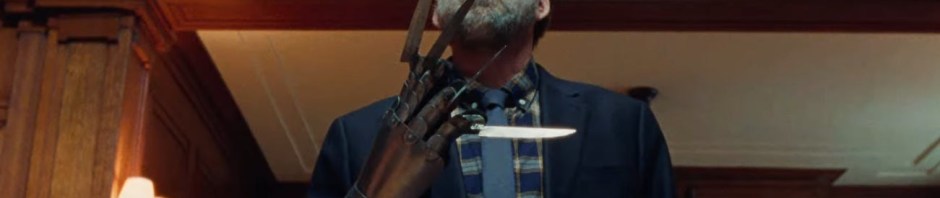

Dream Scenario opens with a quick flash of images, as if the entire film is meant to be remembered as a dream. The film shifts focus too heavily onto its metaphors and real-world analogues to quite live up to its potential, but right off the bat, you know you’re in for a special, unique experience that understands the language of film and uses it beautifully.
In Dream Scenario, evolutionary biology professor Paul Matthews (Nicolas Cage, who also produces) discovers he is inexplicably appearing in the dreams of millions of people around the world, quickly becoming a viral celebrity. Matthews’ roles in the dreams seem to follow his own internal state. At first, when he is unaware of what is going on, he is a bystander, merely passing and waving through other people’s recurring nightmares. As the phenomenon grows, he becomes an agent of wish-fulfillment, sex and adventure, but when he discovers he can’t use his newfound celebrity to advance his life goals, his dream presence becomes violent, and millions of people dream about him raping or murdering them.
Dream Scenario is a highly cinematic treat. The premise is rich for tons of wild scenes and bizarre Nicholas Cage behavior, all created with practical effects to maintain a grounded, frightening realism even when people start floating or alligators appear out of nowhere – much like a dream would really feel. Writer/director/editor Kristoffer Borgli knocks it out of the park in his English-language debut.

The bold decision to shoot on 35mm film affects what content can be approached. If they’d shot digitally, it might have been easier to draw things in or give different dreams different tints without raising the budget too much, but the tangibility of film and was more important to Dream Scenario, and so we get that firm reality, and the special effects are limited to aggressive use of lighting, makeup and wirework.
Films are, themselves, dreams, which use the space of a movie theater to hijack viewers’ visual and auditory input, to the point that dream analysis is often a big part of film analysis. Carl Jung’s theory of dreams as a manifestation of the “collective subconscious” is referenced as a potential explanation for what’s happening to Matthews within the film, but the movies are an industrial version of this idea.
This premise could be explored through a blank slate lead character and it would be fine, but Matthews is not a neutral protagonist, and it is not neutral that he is played by Nicholas Cage. Matthews has severe self-image issues that entangle with his sudden fame, and he works his insecurity into most of his dialogue. The crown of his head is completely bald, but he wears his beard and keeps his remaining hair grown out and shaggy. He’s a doctor of evolutionary biology, but regrets and expresses jealousy that he hasn’t spent enough time on the research side. He frequently uses the notion of the book he hasn’t written yet as a shield, demanding his way out of responsibilities so he’ll have time to write it, or only being willing to use his celebrity to find a publisher.
He refuses to accept responsibility for the force of nature he has tapped into, which is fair, but it becomes unfair when he refuses to allow it to affect his decision-making. His real sins in the film would be akin to a diabetic man binging on candy and claiming it’s what he always does, refusing to negotiate with what his body is capable of because he feels engaging with it at all would be an admission of fault.
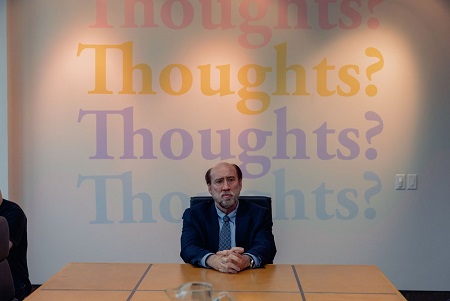
Its pointedness, the ambition and lack of neutrality, is what really makes Dream Scenario stand out. As wild as the dream sequences are, it’s heavily expressionistic in the waking world as well. Nightmares are suitably gory and terrifying, these brief blips into a wide cross-section of fears, but the main plot, which is always driven by Matthews and his tragic flaws, is marked by lots of intense images of isolation. Sound design is rooted in Matthews’ perspective, serving his paranoia and letting viewers into his everyday world. Borgli’s editing also carries a lot of Matthews’ anxiety with it, rushing him to meetings he’s dreading and forcing him to wait longer than he might in uncomfortable situations.
The decisions to have the reality of analogue film and to stay dream-like in the waking world lend themselves, of course, to the crowning technique of all dream-heavy movies – sequences you can’t be sure are dreams or not, at least when they start. The more we journey into Matthews’ mind and the more bizarre his life gets as his celebrity grows, the differences erode between his reality and the kind of sharp, damning dreams the film explores. The emotional core of examining this man who will not confront his own shortcomings is always front and center.
It’s rare to see a director edit his own film, even one he wrote himself, but Dream Scenario was clearly written and shot with this specific end product in mind. This film doesn’t just come from a great idea with great execution, this comes from work ethic and Borgli taking a lot of pride in his work and being the chief creative from pre- to post-production, and you can sense that when you watch the film.
Unfortunately, Dream Scenario is determined to become an extended exploration of cancel culture, to the point of having Matthews record a horrible, feaux-crying apology video common among Youtube creators, and that’s unfortunate because it’s a much more interesting movie than that. The concepts it’s initially exploring of how we process this medium are much stronger and more interesting than where the plot goes.
Leopold Knopp is a UNT graduate. If you liked this post, you can donate to Reel Entropy here. Like Reel Entropy on Facebook and reach out to me at reelentropy@gmail.com.

