

At face value, Saltburn is a simple but extremely colorful story about sex and power dynamics across gender and class lines with a Parasite-esque narrative that twists and coils and becomes something else, and there’s even more to it than that.
It’s a big “vibe” movie, much more about mood than any literal interpretation, which is rough because the literal interpretations are thick and have a lot of variation. It’s way too easy to get lost in the weeds talking about mythological overlap and Barry Keoghan’s penis and miss what actually makes this such a wonderful film – stunning photography and a whole lot of attitude.
Oxford University, fall semester 2006- scholarship student Oliver Quick (Barry Keoghan) struggles to make friends, or even stay in the same bars, with his new upper-class peers. He manages to latch onto Felix Catton (Jacob Elordi), a senior who seems to have dominion over the women on campus, and gets invited back to his home for the summer – Saltburn Castle. Overwhelmed by his new surroundings, Quick proceeds to seduce every person on the grounds.

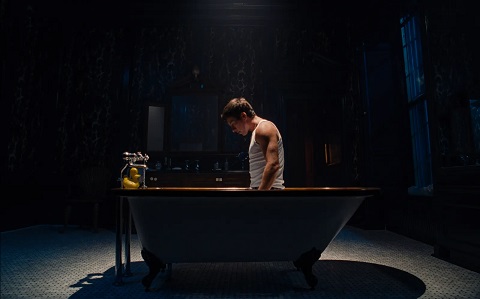
Saltburn is impossibly beautiful, the kind of beauty that makes me sad I don’t have time to see it more than once in theaters. The combination of 35mm Kodak and the compositions from writer/director/producer Emerald Fennell and cinematographer Linus Sandgren make even dried vomit look gorgeous, haunting and vaguely sad. This is the most colorful film of 2023, with rich, eye-popping saturation on almost every frame, intense reds, blues and greens like hard candy tempting you to reach for it.
Fennell chose to shoot the film in a strange 1.37:1 aspect ratio to enhance the sense of a window into a world viewers had never seen before, a tremendous choice that does exactly what she intended. The whole film carries an uncomfortable sense of voyeurism, as if you, the viewer, are peeping in, first for the vicarious thrill, but then with increasing horror as the film turns sour, as if someone you were eavesdropping on slowly turning to lock eyes with you and refusing to let you escape.
Voyeurism drives the film, with several moments of characters watching each other have sex and the plot flowing from the fallout. It’s mostly Quick who does this, and he mostly avoids notice, but the dynamic is used from the other direction as well – Venetia Catton (Alison Oliver), Felix’ sister, invites his advances by displaying herself outside his window. Farleigh Start (Archie Madekwe), the Cattons’ adoptive brother, pushes Quick into the middle of a karaoke party as part of his constant campaign to humiliate Quick, putting him on the receiving end of other gazes as an exertion of power.
The film’s beauty and craft contrasts perfectly against the Cattons’ brutal, sardonic gallows humor. Bored to death in their remote castle with nothing to do but lounge in the sun and argue about who to invite to which party, the dismissiveness with which they discuss less wealthy and beautiful people becomes their only currency, a constant competition to see who can be the most spiteful. This is what sets Saltburn apart from other class-war films – where Parasite, the best comparison for a lot of reasons, focuses on class, Saltburn is all about the war. The Cattons hate everyone who isn’t family, but they’ve filled the castle with conditional “family” members to shed. They also do hate their blood relations. Most of them hate themselves, too.
Saltburn a sex- well, I wouldn’t call it a sex drama, and it’s definitely not a sex comedy, though it’s frequently hilarious. Maybe it’s just a sex?
Saltburn is a sex movie about teenage invasion, focusing on ancient English interiors filled by post-millennium costumes and the attitudes of early millennial freshmen. There’s a palpable sense of youthfulness ready to conduct a hostile takeover by means of sheer will, tearing the old world down even while they still inhabit it. Their mood and environments clash in some of the movie’s most enduring moments – early, Felix Catton complains that Oxford hasn’t ruined its walls to bring in air conditioning. Later in a party at Saltburn, we see an old CRT TV with a karaoke machine plugged into it next to a roaring, walk-in fireplace at least 400 years old.
The children have already taken the background and the soundscape. Saltburn teems with songs and cultural touchstones from the ‘00s – I see Superbad and The Ring on televisions in the background, and the appropriate “Harry Potter” novel – and its emphasis seems to shift. As the movie goes on and the younger characters are more isolated, the music moves further into the future, like the characters are so wound into the time period that they can reach deeper into the decade when they’re alone. Anthony Willis’ lusty original score crops up to dominate the soundscape for key moments of plot advancement as well, sweeping up to bind viewers further into this dark vision.
The mythological angle isn’t what makes the movie good, but there’s quite a bit to dig into. Saltburn is a longform riff on “A Midsummer Night’s Dream,” and there are several echoes and playful interactions. The dynamic at Saltburn reflects the fairy kingdom in the play, with Felix taking the role of King Oberon, House Catton as the fairies and Quick as Puck, Oberon’s faithful, but far less powerful, trickster servant. At the same time, there are pointed parallels between Felix and the minotaur of Crete and Quick as Theseus, a Greek hero and the main character of “Midsummer Night’s Dream.” The center of Saltburn’s hedge maze is decorated with a large statue of Theseus slaying the minotaur, which was commissioned for the film and modeled off Quick’s body.
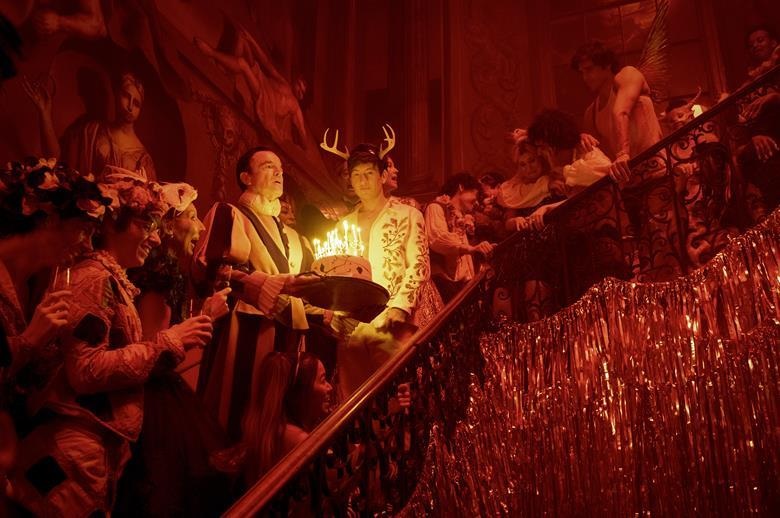
We see several pointed costume choices along these lines, especially at Quick’s “Midsummer Night’s Dream” themed birthday party, where Quick dawns antlers, Felix Catton dawns wings and Start dawns the donkey’s head of Nick Bottom. Felix Catton’s habit of bringing poorer classmates to Saltburn for the summer – Quick is apparently one in a long line – reflects sacrifices made to the minotaur, and there are a whole host of echoed “Midsummer” plot points, from poisoning to the voyeurism and rumors to Felix-as-Oberon’s command of who loves whom. The off-stage conflict that sets the play in motion is there, as well – Oberon has Puck screw everything up because Queen Titania won’t give him a kidnapped child described as an “Indian changeling,” and in the film, Felix’ girlfriend Annabel (Sadie Soverall) pines after him while he instead lays a girl named India (Millie Kent).
In a year that included Barbenheimer, Saltburn stands as the most beautiful, shocking and provocative film of 2023, though its lower profile, being spoken of more in shocked whispers, suits it much better anyway. It will surely call for several technical awards from next week’s Oscar nominations, though who knows how many will venture into this dark fairy tale – perhaps its better if not many do.
Leopold Knopp is a UNT graduate. If you liked this post, you can donate to Reel Entropy here. Like Reel Entropy on Facebook and reach out to me at reelentropy@gmail.com.
 Reel Entropy