

For the past several years as Disney pivoted toward a streaming-first business model, the company line has been that instead of movies about individual heroes leading into a bigger crossover movie, they’ll have solo TV shows, and every movie will be those crossover-scale cultural events. The Marvels is the first execution on that concept, following up on characters and settings introduced in “WandaVision,” “Ms. Marvel” and “Secret Invasion,” and I’m not watching all that shit.
This is actually kind of a painful thing, because I want to be the movie guy. I want to be the person you come to with backstory questions, but it’s 16 hours of “content” that’s cheap even by MCU standards, and I’m not doing it. I can’t do it, I have a job and a social life, but more importantly, I won’t do it. I have a shelf full of movies to watch that aren’t “content.” Disney’s explicit aim here is not to make more art, but to waste more of my time, and I’m not going to participate.
Framing this positively, The Marvels is a new experience for me! This is the first MCU movie for which I won’t have seen all the background content. How each installment stands or fails to stand on its own has always been a major issue for the MCU, and that issue is transforming. This superseries is 15 years old now. There are devoted fans who weren’t born when Iron Man came out.
It’s exactly as exciting as the film is, which is the real problem. The post-Endgame MCU has been marked by a lack of enthusiasm – who on Earth was excited about seeing The Eternals? – but The Marvels, which tries to prop up the series’ first unpopular character by matching her with two more unknown characters, is a valley of hype so deep it may have killed the entire series.
I don’t have any idea what’s happening in The Marvels – not because I haven’t done the reading, but because the movie’s bad.
In The Marvels, a new Kree leader called Dar-Benn (Zawe Ashton) has retrieved a relic that was once used to build the galactic teleportation network, those hexagonal wormholes you remember from other space-set MCU movies, and is trying to destroy the universe with it – well, in the grand tradition of MCU villains whose suspect ideals are not interrogated by their films, she’s got other stated goals, but she knows damn well what she’s doing will destroy the universe and she’s doing it anyway. Part of this process entangles three women with light-based superpowers, Carol Danvers (Brie Larson) Monica Rambeau (Teyonah Parris) and Kamala Khan (Iman Vellani), who begin to switch places whenever they use them, sometimes unintentionally pulling each other across several light-years. The trio gets themselves to the same place to minimize the effect and goes after Dar-Benn.

The Marvels is a blandly poor film that was obviously butchered in post-production, and the poor performance may have been because Disney tried to swallow it – the marketing push was noticeably smaller than usual, with only one or two full trailers. Disney wasn’t even doing an IMAX release until Dune: Part Two, initially scheduled for Nov. 3 a week before The Marvels’ release, was delayed by the SAG strike. Someone clearly didn’t think much of this movie well before it was put in front of viewers, and it shows in final product.
We see a ton of strange choices about whether or not the speaker is onscreen when delivering dialogue, the type of go-to editing tricks to try and get more information in fewer scenes to condense a bad movie. It’s the shortest MCU film, coming in at just 105 minutes, despite having well over two and a half hours’ worth of adventure in the plot. The film skips past reams of story, most noticeably not showing the characters getting back to their original locations after the first teleportation incident, but it’ll slow down for action and dance sequences that are ostensibly what the audience came to see.
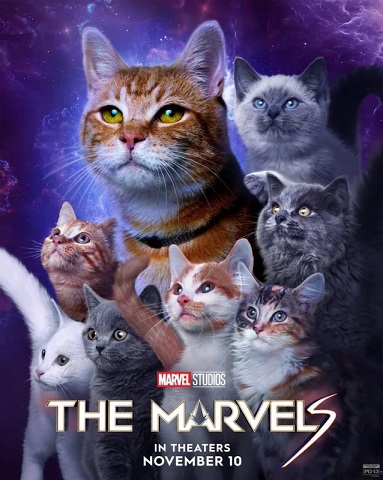
In a film that stinks of an acting troupe breaking character to skip to crowd-pleasing scenes as if someone in charge had anticipated audience’s booing, it’s telling what scenes they choose to fast-forward to. The apparent highlights are massive space battles, of course, the chaotic first scene where the characters realize they’re entangled and an extended sequence where a swarm of flerkens, cat-shaped creatures who first appeared in Captain Marvel, act as a backup evacuation system, set to the tune of “Memory” from Andrew Lloyd Weber’s “Cats.”
“Cats.” That’s a popular bit of media in 2023.
I’d like to see a longer cut of the film, because there’s definitely more to enjoy, but it’d probably still be crappy. This edit shows lots of cramped sets, cheap-looking special effects and poor rear-screen work. That famously terrible MCU action is back, but this movie is about space blasters instead of heightened martial artists, so instead of a unwatchable barrages of edits meant to simulate a single stunt, it’s long, still shots with spreads of digitally inserted space women flying around the screen in a ballet that might make sense in slow motion, but is unwatchable at full speed.

Editing can solve a lot of problems for a film, but it can’t fix poor craftsmanship. It can’t make lines better or the action better, and it won’t convince Disney that lighting and special effects aren’t good places to shave the budget. It won’t change a lack of existing enthusiasm for these characters, which, after forging the Guardians of the Galaxy into household names, Disney can only blame itself for.
It was writer/director Nia DaCosta, the first black woman to direct an MCU installment, who made the now-obligatory complaints that her movie failed because sexists didn’t go see it. Usually, the studio is the one that drives those headlines, but Disney has instead been casting shade at DaCosta, with CEO Bob Iger saying that, due to COVID restrictions, “there wasn’t enough supervision onset,” which is obviously a condescending lie – there’s been plenty of drama about this, of course, but we’re really only talking about two sound bites here.
Iger’s quote could explain The Marvels, why the company would turn its back on this more-than $200 million investment so late in the process, but it cuts to the core of what’s wrong with this entire series – it’s all so corporate, over-produced and allergic to risk. Storyboarding, casting, special effects and of course the final cut are all decided at the boardroom level, and apparently when a director goes “unsupervised,” it’s a valid excuse for her movie to get shredded for scrap.
Well, at least they didn’t cancel it.

The core problem with Captain Marvel was it doesn’t make Danvers an interesting character – well, one of them, that movie was also obviously gutted in post-production – and to prop her up in The Marvels, she’s been surrounded by two more boring characters and a been-there-done-that villain. Vellani is notably more energetic than her castmates, but in a character that’s still thinly written. Her family of Pakistani immigrants is played mostly for clichés and laughs in a way that might be more meaningful to someone who’s watched their show, but at a glance seems closer to benign racism.
I fall into trying to sift out which parts of the movie would have benefited from sitting through 16 hours of “content,” and it’s mostly these types cameos. There are characters who suddenly appear in The Marvels who I assume I’m supposed to recognize based on how they’re framed and some odd detail that get mentioned as a punchline, and I never feel lost when that happens. Those are easy blanks to fill in.
The biggest moment is a scene on what appears to be the Skrulls’ new homeworld, where Dar-Benn continues her campaign against them, and my sense that all this “content” would have been a waste of time only grows. This scene is the destiny of “Secret Invasion,” and it’s not in “Secret Invasion,” it’s in a movie.

What feels missing is what always feels missing in latter-day MCU entries – all the adventures Danvers must have gone on to set this story up. We learn through dialogue that, in between Captain Marvel and The Marvels, Danvers accidentally wiped out the Kree, has become a diplomat, married a prince to solve some problem – those are all full-movie ideas! Produce for me Captain Marvel Becomes the Princess of the Bollywood Planet, that movie sounds fun!
This is another problem created by the MCU collapsing under its own weight, unique to this series but present in almost every installment – these movies are all designed to set sequels up, but none of them actually follow each other. It’s become quite rare to open on our heroes doing what they said they’d be doing at the end of the last movie. Combine this with the “increasing stakes” problem, in which every movie must feature a threat on par with what came before – and they were at “universal destruction” pre-pandemic, so it’s tough to keep up – and you get something like The Marvels, where we’re told reams and reams of fun comic book action happened offscreen, but you don’t get to grab some popcorn and enjoy seeing it.
When comic book movies were first becoming popular 20 years ago, this was a concern – that the cheapness of comic books, which lead to thousands of wild stories being told every year, couldn’t be matched by the massive investment floor of movies, which take years to make and must settle for a select few stories to adapt, all of which must be approachable enough to be in a blockbuster. In early movies like the Sam Raimi Spider-Man series or especially Christopher Nolan’s Dark Knight films, the solution was to mythologize the heroes, to hammer them into a specific, linear story that lends itself to a film series while also making the films themselves seem more weighty than the magazines they’re adapted from, but decades later, The Marvels solves it by casually listing off adventures we don’t get to see.
Maybe this is all in that 16 hour block of “content,” but I’ll never know.
The Marvels is recognized as a box office bomb, pulling in only $205.6 million worldwide, lower even than the oft-forgotten Incredible Hulk movie from 2008. It shouldn’t be so damning that there’d be one or two failures in a string of more than 30 massively successful films, and 2023 was filled with movies that saw their budgets balloon due to COVID-19 related costs, but this isn’t just some failure. This is Disney’s new direction, the new crossover event, the climax of all those Disney Channel shows, and this is still all they have to offer. It’s another CGI slurry almost indistinguishable from the others, but one which the company had clearly lost faith in.
The business model for this film is a lot more complicated than a business model capable of producing good movies – to borrow a phrase, “Make good movies, or die!”
Leopold Knopp is a UNT graduate. If you liked this post, you can donate to Reel Entropy here. Like Reel Entropy on Facebook and reach out to me at reelentropy@gmail.com.
 Reel Entropy