
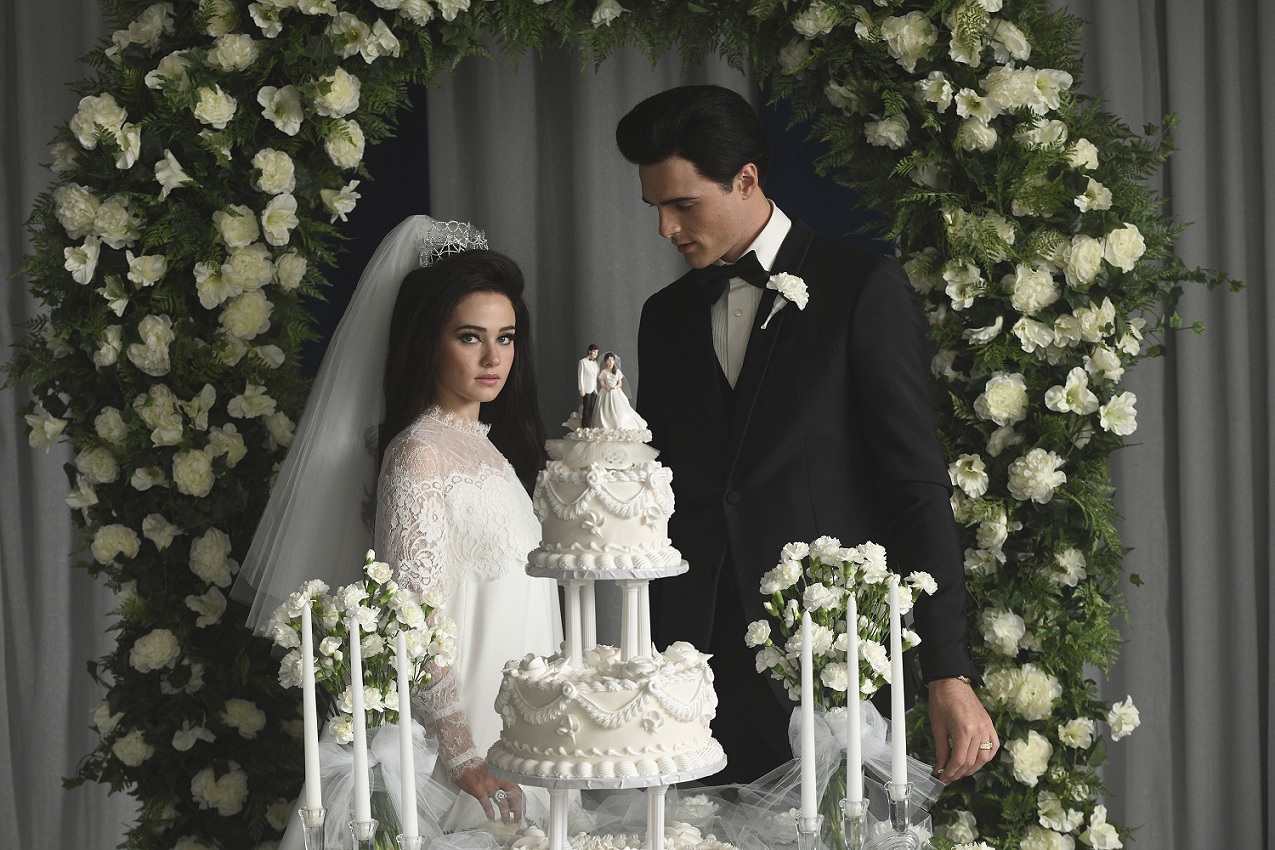
A long-noted omission from the great American tradition of masturbatory, near-identical musician biopics, Elvis has now been the subject of two movies in as many years – though in both films, Elvis himself is a distant figure. First, Elvis, Baz Luhrmann’s extremely Baz Luhrmann epic about his infamous manager, Col. Tom Parker, in which Elvis is star performer whose human needs clash with Parker’s shady deals, and now Priscilla, writer/director/producer Sofia Coppola’s extremely Sofia Coppola moodpiece in which he is an often-absent husband more interested in pills than his wife.
Shooting in the fall after Elvis released, Priscilla is much more a response than it is a sibling, but the more important relationship is between the people who stood to make money from these things. Elvis was finally greenlit by the couple’s daughter, Lisa Marie Presley, who controlled her father’s estate and sold his life rights because she was running out of money. Priscilla, on the other hand, is based on Priscilla Presley’s autobigraphy “Elvis and Me: The True Story of the Love Between Priscilla Presley and the King of Rock N’Roll,” and she’s listed as an executive producer on the film. Coppola approached her for the rights with the explicit intent of giving Priscilla a voice after a movie Coppola felt pushed her aside, and production was announced in September 2022. Priscilla is all about perspective, not from an artistic standpoint, but existentially. This is Priscilla’s narrative, based on her words from the 1980s and made with her blessing and oversight, and having seen the film, I’m not sure what the burning need was for it.
Bad Nauheim, West Germany, 1959- World-famous popstar Elvis Presley (Jacob Elordi), 24, drafted into the Army and stationed in Europe during the first peak of his fame, develops a crush on a nearby Air Force captain’s daughter, 14-year-old Priscilla (Cailee Spaeny). The film follows as he whisks her away to Memphis and marries her after she’s of legal age until their divorce in 1973, filmed almost entirely from their underused bedroom. The visual thrust of Priscilla is the image of a grown man in his mid-20s talking to a girl in her mid-teens, but the lingering image is of Priscilla later in their marriage, now an adult and still eagerly attracted to her sex-symbol husband, lying alone in their bed unfucked.
Priscilla is reportedly rigidly accurate to the autobiography, and it’s important to remember that isn’t a neutral telling. It’s actually quite difficult to take at face value. “Elvis and Me” was published in 1985, eight years after Elvis returned to his home planet and six years after Priscilla had taken over maintenance of his estate, which she stewarded for Lisa Marie Presley until 1989. This had to be a money-making enterprise because of the cost to upkeep Graceland, which Pricilla oversaw the opening of as a museum in 1982, and “Elvis and Me” needed to be popular and make money. Painting Elvis as either abusive or a perfect angel could be unacceptable commercial risks.
So, Priscilla shows this version of Elvis as bad but not too bad, technically abusive, but not violent, and his low sex drive is the bigger issue anyway. The details are just right for the book’s original commercial purpose, private, but not too embarrassing.
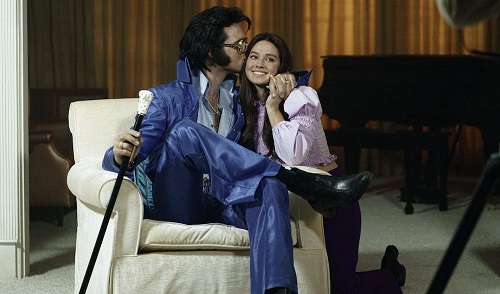
While Elordi and Spaeny are only one year apart, they were cast to highlight Elvis’ and Priscilla’s 10-year age gap. The slender Spaeny looks suitably small and vulnerable as the teenager she’s playing, with a small mouth, big eyes, perfect hair and a soft voice. She looks like a small child despite being 25 during production, and my instinct as a viewer is to protect her.
Height is used throughout the film as a lazy-but-effective shorthand for Priscilla’s immaturity. The 6’5 Elordi, who seems to grow taller as the film goes on, looms over his 5’1 costar, as does everyone else. Priscilla is noticeably shorter than all the other women who arrive to see Elvis off at the airport when he’s discharged, and all of Elvis’ friends at parties are a full head taller than her as well. Their heads often rise out of frame as Priscilla, the focus of most shots, gets the headroom that’s right for her instead.
The film presents a distinctly unromantic vision of Elvis, even beyond depicting him wooing a child. His smooth-talking to Priscilla is flat, and she’s receptive only because she’s already attracted to him and his image. Elvis is portrayed mostly like any other fantasy high school boyfriend, constantly asking for her father’s permissions, hanging out with his friends, fooling around at the bowling alley, sneaking beers in the woods after dark and also taking sex very seriously, insisting on waiting until Priscilla is older and they can be married.
This gets more mean-spirited as the film goes on and builds into Elvis’ flaws as a husband. There is no scene of him performing and the relationship with his manager that was the main subject of the Luhrmann film is entirely offscreen – this is very pointed, that this film is so specifically about Priscilla’s perspective that we only get to see Elvis as a husband, not any of the things he’s famous for, but it’s also because the Presley estate wouldn’t give Coppola the rights to use Elvis’ music. As Priscilla tells it, before their marriage in 1967, Elvis had insisted on not taking advantage of his underage girlfriend, but as she ages and this excuse goes away, his portrayal shifts to a full-on prude who remains disinterested in sex even after they are married.
The main point is his rapid shifts to shouting and abuse. Whenever Priscilla contradicts him, Elvis transforms almost immediately into a frothing, shouting lunatic hurling as many insults as he can think of, and his usual dismount from this is to take a deep breath and threaten to leave her. The film does a great job of riding this particular line, making it clear that this is an abuse tactic, but never quite framing it as deliberate. It’s easy to imagine this character arguing he’s fine because he thinks “abuse” only means physical violence, but also that he isn’t thinking out the abuse tactics he does employ, it’s just spilling out of him and aggravated by the power dynamics of the marriage.
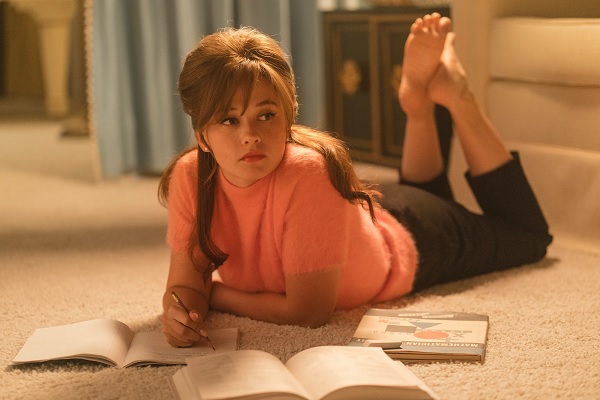
Priscilla is, with the fame stripped away, a coming-of-age story about a too-young woman with an often-absent husband whose power makes her life difficult while making him difficult to leave, but ironically, it’s this woman’s sexual dissatisfaction as she comes of age that drives them apart. That’s a good premise with a lot of room for lustiness and reversed sexual power dynamics, and Priscilla is a very good movie, even if it doesn’t follow through as completely as I’d like.
That’s a story that could be about any fictional couple, which is a trap biopics often to fall into when they focus too heavily on their subjects’ love lives. Priscilla isn’t about two people the director thought up, it’s the story of Elvis and Priscilla – their true story, at least according to her. The context that this relationship was allowed to play out in public is a disquieting fact of the film.
Perhaps the film was meant to interrogate the audience with this, but it would have done that better by keeping Elvis’ real sins more vague and implicit, maybe something more sarcastically flowery and lurid like Stanley Kubrick’s Lolita, but Priscilla must lay his flaws bare, it must stay in Priscilla’s perspective, even if those flaws seem tame by 2023 standards, fueled more by immaturity than evil, compared to the monster Elvis might have been portrayed as.
That’s the bind Priscilla never gets out of – it’s too committed to giving Priscilla her voice, exaggerating what’s exaggerated in her perspective, but unwilling to exaggerate what needs to be exaggerated for the movie to form its own perspective. It’s so focused on staying true to the true story that it can’t be true to itself and become the work of art it wants to be.
The heart of all this is audience expectations for the role of spouses in bipoics. Elvis is not a story about the main character’s marriage, but audiences generally expect to see love lives covered in biopics. From a Hollywood “four quadrant” perspective, this is supposedly what makes movies appeal to women, the inclusion of a sideplot where the hero returns to the nuclear family. In the case of biopics specifically, which are usually aimed at older viewers, focusing on the hero’s family life puts him into context with the rest of the audience – whether he’s present in the marriage, whether he’s using his fame to get other women, what their house and number of children says about their stature in their community, and so on. Going back to the ‘40s and ‘50s, when marrying the hero was the female lead’s only aspiration, this actually constituted a meaningful addition to a film.
The role of the biopic spouse can vary widely these days from primary focal points in films like Goodfellas to absent figures who probably could have been omitted, but because it’s an expected part of the genre, especially if the spouse is a celebrity in their own right – in Elvis’ case, it was so the most decorated female filmmaker of all time has made an entire response movie about it.
Coppola said she sees Priscilla as a Marie Antoinette-like figure, and this is a borrowed observation, but she’s made a Marie Antoinette-like film. Priscilla is another movie about the hardships and voicelessness of women, and ironically, it becomes a real failure when it goes by without ever really giving Priscilla a voice. She’s portrayed as unable to rouse her husband enough to salvage their marriage, and ultimately doesn’t express herself much outside of insisting that her father let her see Elvis at the beginning and leaving him at the end. Then, the movie fades to black to the triumphant tune of music that isn’t Elvis’.
In Priscilla, it seems distressingly like Coppola is also running short of things to say.
Leopold Knopp is a UNT graduate. If you liked this post, you can donate to Reel Entropy here. Like Reel Entropy on Facebook and reach out to me at reelentropy@gmail.com.
 Reel Entropy