The Sea of Siciliy- Ariel (Halle Bailey) is a teenage trans mermaid who needs bottom surgery so she can go to the surface and catch some dick. Her father, King Triton (Javier Bardem), could transform her into a human at any moment, but he thinks it’s too dangerous, so she seeks help from the local drag queen, Ursula (Melissa McCarthy). The sea witch makes Ariel a Faustian bargain that gets her into much more trouble than if her father had just been supportive.
The Little Mermaid is a quietly powerful story about not only self-determination, but internal and external identity. When Ariel trades her voice for the ability to pursue Prince Eric (Jonah Hauer-King), she is unknowingly loaning out the only thing he will recognize her by, the only thing about her that he even remembers. What aspects of yourself can you give up before you aren’t you anymore? How much do the people who care about you value the things that you might change?
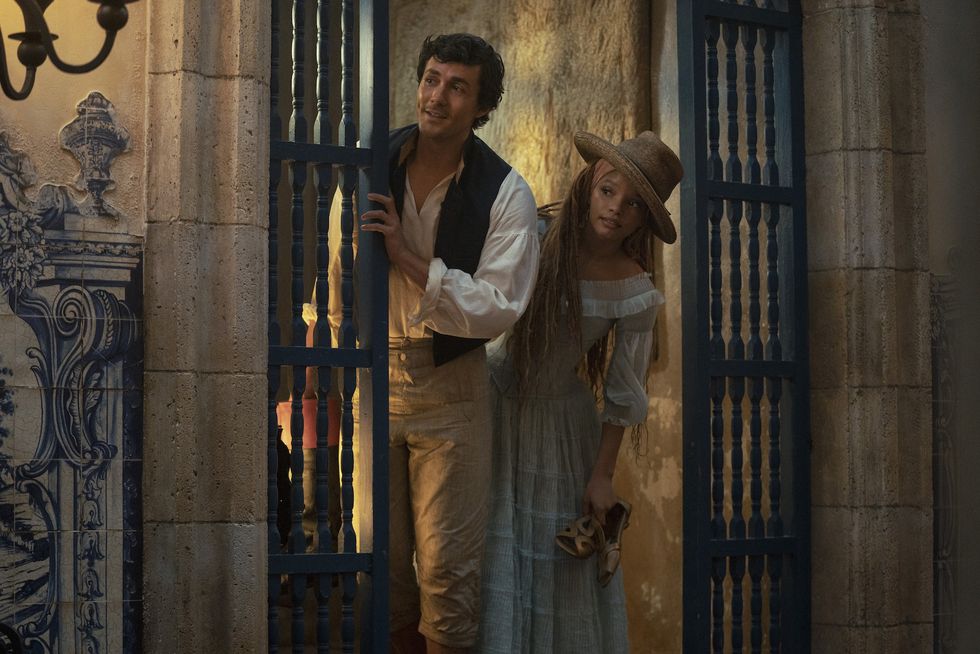
It feels shaky as a trans metaphor, but it isn’t a metaphor. It’s the plain text of the story. The original Ursula was famously modeled on Divine, the drag queen made famous for her performances in John Waters movies, and every Disney Renaissance villain that followed behind her was queer-coded. Ariel is shown delightedly examining her new limbs. Her conflict with Triton has all the relevant subtext – it’s a fight for self-determination and the right to live as her authentic self. It is an irrevocably queer story because it is that self-determination, to live and love according to her authentic desires whether or not they are in line with the biological and economic circumstances of her birth, that queerness enables. Being “part of that world” is possible.
As the Republican Party attempts to eradicate queerness, to remove all mention of it and encourage a campaign of stochastic terrorism against the trans community in coordination with the decades-long effort to eliminate women’s access to medical care and freedom over their bodies and lives, we cannot consume this story passively. We have to look directly at this part of our culture, the freedom to fight for and be part of a better world and the celebration of characters who do so, and we have to look directly at how these same concepts are playing out in the real world.
***
In 1989, Disney, the iconic animation studio that was fading from public conversation after an ill-advised string of more mature and frightening features, released The Little Mermaid to rapturous critical acclaim and commercial success. The film forced the entire culture of children’s entertainment to turn on a dime overnight, immediately setting many of the standards of a 10-year period that would become known as the Disney Renaissance, named because of how closely The Little Mermaid and its imitators hewed to classic Disney tropes. It wasn’t the peak of this format and there were more elements that would later be added to this formula, but for every children’s movie that’s come since, The Little Mermaid is genesis.
The key aspect that enabled the film’s success was its animated format, bringing viewers into a world that could never be captured on camera, and the film was very aware of this. In its first moments, the camera brings us down from a ship into the ocean, through the open water and to the seafloor until we are eventually looking up at a school of passing fish, and the stream of real creatures gives way to merfolk as we enter the magical story world. The first thing the movie does is walk its audience step by step through how many layers of impossibility there are between us and what we are about to see.

Over the past 30 years, there haven’t been any paradigm shifts that begin to compare to the original Little Mermaid. For several reasons, the film industry has grown into an uncomfortable corner where studios are funneling incredible amounts of money into large-scale “tentpole” productions, but are unwilling to bet that money on anything that isn’t an established intellectual property.
The perception is that audiences want something that is both familiar and new, and Disney has been giving that to them with live-action adaptations of classic cartoons. This started with the runaway success Tim Burton’s Alice in Wonderland adaptation in 2010, which was only the sixth film ever to make $1 billion in worldwide ticket sales. Touching these separate, seemingly contradictory desires may seem impossible, but it’s actually very easy when there’s a real idea at the heart of the project as with Alice in Wonderland or Universal’s Snow White and the Huntsman, another example I point to constantly, but most Disney live-action remakes are simple technological updates with maybe a few new songs or some updated cultural posturing.
The overarching goal here is to make the same onscreen impossibilities the original Little Mermaid walked us through, the things the film highlighted about itself to distinguish its format from live-action, seem possible in live-action. Who could have imagined that wouldn’t work out.
There’s a weird gap in the effort that’s put into doing this, and it mostly comes down to how the lighting and swimming are animated – because it is still animated. Nobody’s out here singing underwater. Everything about this movie that was impossible in 1989 is still impossible in 2023, this version of the project is just trying to convince viewers that it isn’t.
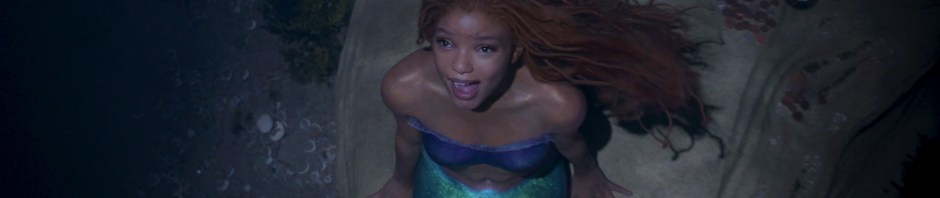
The swimming animations are shockingly bad. Bailey can move her arms and wiggle her torso, but her underwater hair is animated horribly, and her tail is moving in a completely different sync with her body. Where it should look like one spine is running from her skull to her tail, she instead looks like two different beached fish floundering next to each other with her hair exploding outward from the top of this mess, and when she swims, the whole haphazard package levitates through the water as if it’s being dragged across the screen by a mouse, which is of course what’s happening. Sometimes, characters will be dragged around like this without moving at all. It looks unfinished. It looks like a mock-up to show at a first-quarter check-in with heavy cautioning that someone was going to sort out the details on later.

There’s a much higher degree of effort put in to making sure the lighting is accurate to this ocean world, where the sun is king and bioluminescence is the only other source of light, which is something I appreciate because I see it done poorly very often, but in this case, it makes the movie a lot worse. The whole thing seems like it was composed without lighting in mind, and then the animation department came in afterward and insisted on making sure the lighting was realistic, so there are a lot of scenes that are tough to see out of what feels like spite. Scenes in Ursula’s lair are so dark, with the only light coming from the pink underside of her legs, that they’re basically all that can be seen. During the climax when she becomes an Akira and summons a gale to torture our lead characters, she’s completely backlit, and you only get the outline of her head.
Unfortunately, this one department’s insistence on realism creates a lot of problems related to Bailey’s skin tone. When the hubbub about casting Bailey, who is black, as Ariel first hit, I assumed it was just Disney being Disney, and that is how they’ve handled it. Just about every commentary on Bailey’s casting and the racist backlash against it is some pearl-clutchy, condescending variation on “Princesses can be black too” –the Disney Princess distributors, in their mercy and wisdom, have heeded black Americans and graced them with a princess, so their children will finally have someone they can look up to. Buy our products to support anti-racism!
However, casting a black woman in the role is actually a deliberate grounding in reality. The Little Mermaid shows us maps that explicitly set it off the coast of Sicily. This lines up with the original myth – Hans Christian Andersen was Danish and a lot of people assume the myth is set in Denmark, but he published “The Little Mermaid” soon after returning from traveling in Italy, and it appears to describe an Italian landscape. For centuries before Italy organized into a single country, Sicily was a crossroads in the Mediterranean and major embarkation point for immigrants from North Africa, Arabia, Greece and the Riviera. A black little mermaid, then, is a keen reflection of the specific history of this part of the world.

All of that said, Ariel’s skin tone, because her character shows so much skin, changes the compositions of The Little Mermaid in some difficult ways. The ’89 cartoon Ariel is three-tone – bright red hair, stark white skin and an aquamarine tail, and because she’s a cartoon and not subject to realistic lighting, she can be drawn just as brightly near the ocean floor as she is near the surface.
Bailey is a different story. Her hair has been dyed an orange-ish shade that matches her skin tone at a glance, and because this movie is going for photorealism, her tail is drawn to be highly reflective, but also barely noticeable in murkier water. This creates a character who, at times, appears to be one color – just a shadow inside the blue.
The way racism has historically been expressed in film is underexposing black actors so that they look like shadows, and The Little Mermaid does this to Bailey several times. It’s easy to write this off as carelessness, but making the deliberate choices to put a black actress in this position and to focus on photorealism where none was ever needed, with images like this as the ultimate product, is inexcusable.

Watching this bizarre grab-bag of choices and levels of quality, it’s tempting to throw your hands up and say “what could they do? It’s an underwater movie!” but every part of this is a deliberate choice. Disney chose to remake this film, one that is welded to the history of animation and revels in its own format, as a photorealistic cartoon that’s pretending to be live-action. Someone chose to put it together in this slap-dash manner six months after Avatar: The Way of Water cracked all these same problems, and at $250 million, The Little Mermaid isn’t all that much cheaper. Someone chose to apply this muddy, poorly lit, low-contrast look to a children’s musical about pursuing freedom that doesn’t match the tone of it at all and creates these horrible images. Someone chose to cast a black woman in this role knowing that it would be a big deal, knowing that it would put her in the crosshairs of a bunch of racists they were knowingly riling up, only to star in a movie where she can’t really do anything – underwater, she’s a cut-out torso being dragged around the screen, and above-water, she can’t speak.
All of the things about The Little Mermaid that make me wince and grit my teeth are even sharper knowing how little soul is behind this project. Money demands to grow, and the 1989 film was just an opportunity that a corporation hadn’t converted yet. Pretending there was any artistic drive behind this would be a lie.
Last week, this same corporation released a new streaming series with an AI-generated opening credits sequence, to a predictably cold reception. We’re quickly moving into a world where corporate art is made by a machine that has no interest, not even the capacity to have interest, in making art, that has no soul to put into its work, something that simply churns out input into imagery for its operator to package and sell.
The Little Mermaid shows us we were already part of that world.
Leopold Knopp is a UNT graduate. If you liked this post, you can donate to Reel Entropy here. Like Reel Entropy on Facebook and reach out to me at reelentropy@gmail.com.
 Reel Entropy