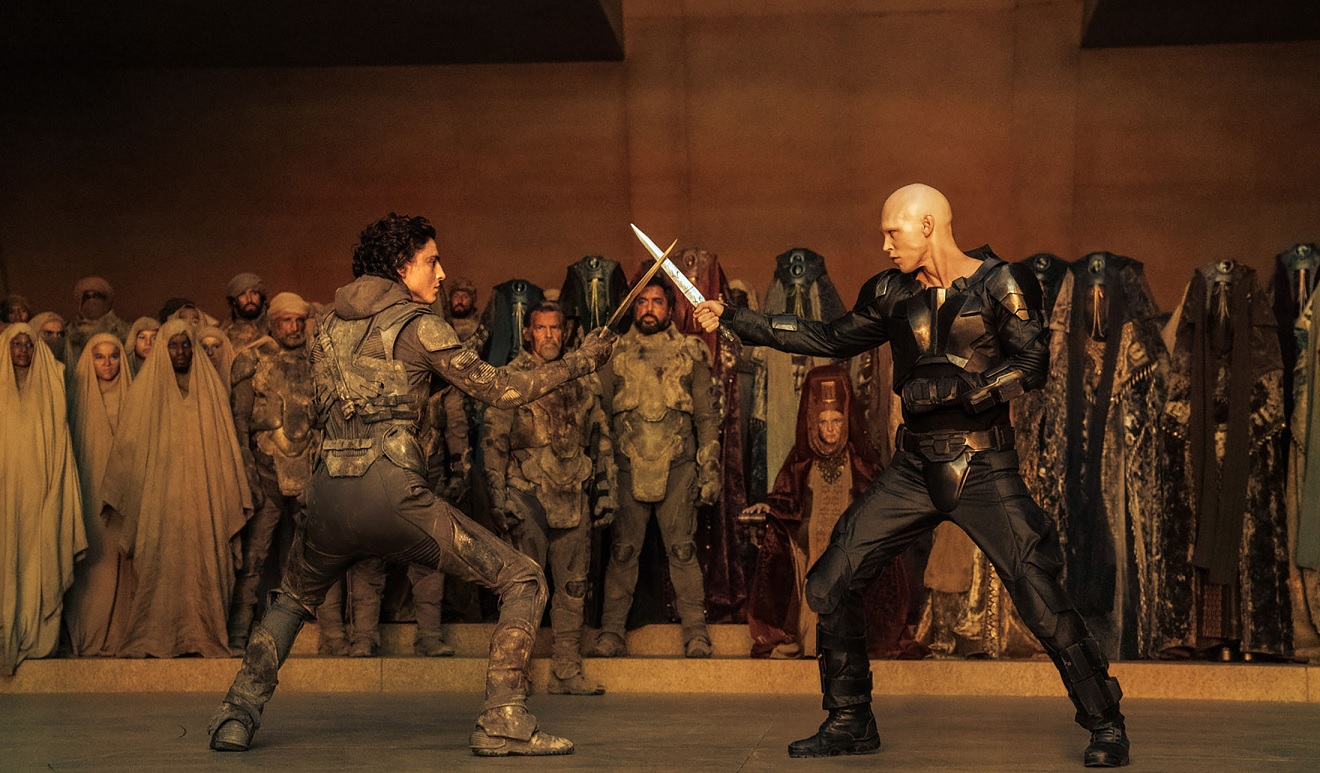
Now complete, ‘Dune’ still disappoints

Images courtesy Warner Bros. Pictures.

Rating: 3 out of 5.

Dune began its life as a deliberately incomplete project, with writer/director/producer Denis Villeneuve insisting on adapting the famous novel in two parts, but only securing funding for one of those parts, with a follow-up film contingent on its success. There are several problems with this approach, but Dune was successful enough – well, no it wasn’t. Its box office performance certainly didn’t warrant a sequel, but that was hindered by Warner Bros.’ unilateral decision to release all its 2021 movies day-and-date on HBOmax, so executives gave it a handicap and took all its technical Oscars into account. They’ve all been sacked, that’s not even what the god damn website’s called anymore, everything’s much worse now – whatever logic was used, someone decided this was worth another $190 million, so here we are. 

Ironically, this is not the first attempt at adapting “Dune” to film that is known to be incomplete – David Lynch’s 1984 adaptation ran out of money in the middle of production, leaving an obviously incomplete film relying on cheap “Star Trek” style sets that starts skipping like a broken record halfway through, fortuitously at almost the precise point part one of Villeneuve’s adaptation cuts off. This second part is the realization of not just the last film, but more than 50 years of trying to bring this novel to the screen.

Continue reading
Posted in Entropy | Tagged , , , , | 1 Comment

‘Poor Things’ an artistic, crowd-pleasing snuff film

Subscribe to continue reading

Subscribe to get access to the rest of this post and other subscriber-only content.

Posted in Entropy | Tagged , , , , , , , | Comments Off on ‘Poor Things’ an artistic, crowd-pleasing snuff film

Knopp’s first Miyazaki, likely Miyazaki’s last film

There is no “quit” in this kid at all. Images courtesy GKIDS.

Rating: 5 out of 5.

I thought it would be disingenuous of me to see and write about The Boy and the Heron because just about anyone who knew about the film would know more about it than me. Writer/director Hayao Miyazaki is a titan of animation, of course, but I’d never seen any of his films, and this one was noted even in Japan for its lack of promotional material. The Boy and the Heron is an encore after a decade of retirement, and only the people who were already at the show would have known about it. This post is by reader request.

March, 1945- School-aged Mahito Maki (Soma Santoki) loses his mother in the Tokyo bombings. His father promptly marries his late wife’s sister and whisks Maki to her rural estate, far from the war. Isolated, dejected and angry, Maki encounters a grey heron (Masaki Suda) in the backyard, who taunts him with the possibility of seeing his mother again. Their conflict takes them into the hidden world in the abandoned watchtower behind the estate.

Continue reading
Posted in Entropy, White Noise | Tagged , , , , | Leave a comment

John Woo quietly returns to American theaters with ‘Silent Night’

Subscribe to continue reading

Subscribe to get access to the rest of this post and other subscriber-only content.

Posted in Entropy | Tagged , , , , , , , , , | Comments Off on John Woo quietly returns to American theaters with ‘Silent Night’

‘Godzilla Minus One,’ plus international acclaim

Minus One had already become the most successful Japanese-language film in American history before the black and white re-release. Images courtesy Toho International.

Rating: 4.5 out of 5.

In 1954, less than 10 years after the atomic bombings of Hiroshima and Nagasaki, Toho and writer/director Ishirō Honda reconceptualized the attacks as a monster that emerged from the sea, its skin cracked and charred as if by nuclear blast, its breath befouling the air around it with fallout, and its name was the wrath of God. Godzilla immediately became a pop-cultural sensation and symbol of the Japanese mood as it changed over the decades, frequently fighting off bigger threats as an anti-hero or even a goofball. The title Godzilla Minus One comes from the idea that Japan was at “zero” after the bombings, and Godzilla’s emergence put them at “minus one.”

It’s remarkably similar to the original film, but with 80 years’ hindsight instead of 10, Godzilla Minus One is less about exploring the trauma of the nuclear attacks and more about interrogating the Japanese culture that led the country to this and the traumas of demilitarization and emasculation of individual Japanese. Perhaps the most notable difference is that, while Godzilla was contemporary to its 1954 release, Godzilla Minus One begins months before the nuclear attacks.  

Continue reading
Posted in Beta Decay, Entropy | Tagged , , , , , , | Leave a comment