SATIRE: New Die Hard OK, not really necessary

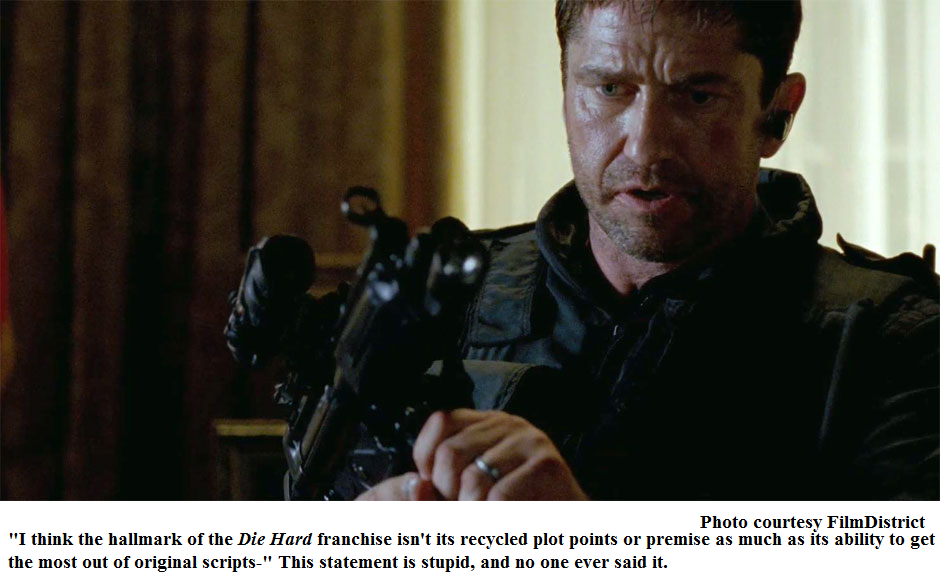
ImageDie Hard: Olympus has Fallen is a very mild movie, but it’s all just too much.

In his astonishing sixth time around the block, John McClane (Gerard Butler), action movie garbage man, must save the president (Aaron Eckhart) from a Korean terrorist (Rick Yune) who wants to force America to allow the Korean War to resume.

McClane is retroactively painted as a former secret service member who allowed the first lady (Ashley Judd) to die in an accident and was kicked off the force. Part of his motivation is guilt over this incident, but they don’t really do very much with that storyline so whatever.

In Olympus has Fallen, the Die Hard series returns to a simpler chapter. Instead of saving the entire East Coast, McClane is again only responsible for one building with a hostage situation. But, because that building is the White House and the hostage situation threatens the reignite the Korean War, it seems bigger.

The action stays small, though. Outside of an early sequence in which the terrorist team all-too-easily captures Washington D.C., the action is limited to small arms fire with a handful of explosives. The film keeps a nice mix of fire fights and martial arts, and further, it keeps the fire fights interesting and manages to minimize Asian martial arts stereotypes.

It is unclear why Butler replaced Bruce Willis as McClane. He’s a good candidate, but there wasn’t any reason for Willis to step down. Shooting for Olympus has Fallen overlapped with its predecessor, A Good Day to Die Hard, but there’s no reason they couldn’t have delayed production and allowed Willis to maintain his role. Butler does a good enough job, but couldn’t he shave his head or something? For continuity, I mean?

The biggest problem with Olympus has Fallen is the context it places itself in. Die Hard has a sterling history going back to the 1988 classic of being able to convert action scripts into profitable-if-cheesy movies that have Bruce Willis’ name attached. If your story idea has a lot of explosions but isn’t getting traction, call the folks at Die Hard! They’ll squeeze it out!

But now, with Die Hard: Olympus has Fallen (and A Good Day to Die Hard), producers seem to be using Die Hard as a go-to option. Unlike the previous movies in the series, both are original scripts that were always intended to be Die Hard movies.

Why? Who would take a perfectly good recycling factory and jam new material into it? They’re doing it so fast now that, as mentioned earlier, the production schedules overlapped.

If Die Hard continues down this road of using scripts written from scratch, it’s bad news for crummy screenwriters everywhere.

On its own, Die Hard: Olympus has Fallen is an OK movie, but there are just too many Die Hards now. The day of the completely disposable action movie is long gone.

Joshua Knopp is a formerly professional film critic, licensed massage therapist, journalism and film student at the University of North Texas and a staff writer for the NT Daily. He is unbelievably tired of hearing about how good those boys were at football. For questions, rebuttals and further guidance about cinema, you can reach him at reelentropy@gmail.com. At this point, I’d like to remind you that you shouldn’t actually go to movies and form your own opinions. That’s what I’m here for. Be sure to come back next week for a reviews of The Host and G.I. Joe: Retaliation.

Posted in Entropy | Leave a comment

Oz, the sexist and terrible

Image

Oz the Great and Powerful is so bad… so bad…

The film keys on Oz (James Franco), a ladies’ man circus magician who aspires to “greatness” and is thrust into the fantastic, incredible, 100 percent CGI world of Oz. There, he meets Theodora (Mila Kunis) and Evanora (Rachel Weisz), who send him to kill the wicked witch, Glinda (Michelle Williams). Upon her death, all his wildest dreams will come true.

Oz the Great and Powerful is viscerally bad. The scenery, which seems to be the key drawing point of the film, is on par with a nice screen saver. All of the main cast members, Kunis in particular, turn in willfully bad performances that point to director Sam Raimi as a root problem. When visual effects are asked to do more than just liven up the background, they fail spectacularly. This is most notable in the completely unnecessary visual enhancements to the Wicked Witch of the West, who is the most awkward thing in cinema so far this year.

Despite being a children’s film, Oz sets a disturbingly poor example for children. The main character is a slime ball with no redeeming qualities, yet the story makes him into a messianic figure.

The weakness of the female characters would have L. Frank Baum spinning in his grave. A firm feminist, the majority of Baum’s Oz books featured strong female leads. This film features three pathetic female supporting characters, all of whom exist as a function of the wizard. The film goes so far as to paint The Wicked Witch of the West, one of the most iconic film villains of all time, as a product of heartbreak from the wizard’s schmoozing.

But this isn’t just a bad movie. If it were just a bad movie, it could go off in a corner and be bad without drawing attention to itself. No, this is the prequel to The Wizard of Oz, one of the most enduring, beloved movies ever made.

By tying itself to a piece of American iconography, Oz gains instant market credibility and guarantees itself a good opening weekend, despite being garbage. This kind of piggybacking is painfully common and seems more and more pronounced as time goes on. It can come in the form of categorically worse remakes (The Amazing Spider-Man), a never-ending stream of sequels (Ice Age, Madagascar) or prequel trilogies that advertise the same creative team as their predecessors, but manage to invalidate them anyway (The Hobbit). All of these were top-10 at the box office in 2012.

The baffling part is Disney put the effort in to make a new, lame story for this simple end. If they’d re-made The Wizard of Oz to be closer to the book, it would have done the same thing but been more interesting. If they’d adapted Wicked, which is based on the 1939 film version, it would have done the same thing but been much more interesting. Writer Mitchel Kapner has said that they wanted a male lead character and went on to imply that there weren’t enough of those already.

Oz the Great and Powerful is bad and its editorial decisions make no sense. It claims famous source material that it spurns at every turn, usually for something stupider or more far-fetched. It is a soulless cog in a soulless machine, not suitable for viewers of any age group.

Joshua Knopp is a formerly professional film critic, journalism and film student at the University of North Texas and a staff writer for the NT Daily. He also holds a BFA in political theory  from Shiz University.  For questions, rebuttals and further guidance about cinema, you can reach him at reelentropy@gmail.com. At this point, I’d like to remind you that you shouldn’t actually go to movies and form your own opinions. That’s what I’m here for. Be sure to come back next week for a review of Olympus has Fallen.

Posted in Entropy | Leave a comment

Jack slays giants, not audience

ImageHas the dark nursery rhyme film fully cycled in less than a year?

Jack the Giant Slayer marks the most recent in a string of just three movies that regurgitate fairy tales for an older audience. It follows the familiar Jack (Nicholas Hoult), a farmer who trades livestock for magic beans and climbs their stalks to a land of giants, where he finds his fortune. To beef it up, this film adds in a princess (Eleanor Tomlinson), a bureaucrat (Stanley Tucci) and a magic crown that lets its wearer rule the giant race.

This film is way too fast and has a tell-tale assembly-line feel to it that could signal one of two things — either the film was made on a whim to milk a built-in audience (generated by the conceptually similar Snow White and the Huntsman and Hansel and Gretel: Witch Hunters), or it was produced into the ground by bean counters who wanted to turn an adult’s film into a child’s film.

The movie’s flaws support the latter hypothesis. What few character development scenes are there are so brief they don’t even have establishing shots. To compensate, the characters are boring, predictable and utterly devoid of internal conflict. In lieu of actual humor, the audience is expected to laugh when the giants fart. Also, Jack the Giant Slayer was actually written, re-written and shot before its siblings.

I wonder, though, whether it would be as bad without that stale feeling it gets from being the third movie of its type to come out within a year. Sequentially, Snow White and the Huntsman wasn’t the best movie in the world, but it was an inspired adaptation. Hansel and Gretel was a B-movie that at least changed it’s source material’s perspective. Jack the Giant Slayer simply falls flat, adding generic sillyness to an already generically silly story. The order of release shows movies growing worse, but the order of their production shows them getting better. Which is it?

Jack the Giant Slayer is nothing to write home about, and hopefully represents director Brian Singer clearing his throat before X-Men: The Days of Future Past. Don’t hold hope, though- his last serviceable film was X2 in 2004, and the only time he was ever truly exceptional was 1995’s The Usual Suspects.

Maleficent, an adaptation of Sleeping Beauty as told by its iconic villain starring Angelina Jolie, is scheduled for release in 2014.

Joshua Knopp is a formerly professional film critic, journalism and film student at the University of North Texas and a staff writer for the NT Daily. He sincerely hopes Seth MacFarlane never hosts anything again. For questions, rebuttals and further guidance about cinema, you can reach him at reelentropy@gmail.com. At this point, I’d like to remind you that you shouldn’t actually go to movies and form your own opinions. That’s what I’m here for. Be sure to come back next week for a review of Oz, the Great and Powerful.

Posted in Entropy | 1 Comment