
American bomb dispos- sniper! Sniper.

So, it’s called American Sniper, but he spends most of the movie leading door-to-door teams. Photos courtesy Warner Bros. Pictures.

Remember The Hurt Locker? Well, American Sniper is basically that with a sniper instead of a bomb disposal expert.

The movie tells the ostensibly mostly true story of Chris Kyle (Bradley Cooper, who also produces), a SEAL sniper who accumulated 160 confirmed out of 255 probable kills over four tours in Iraq. He garnered widespread fame among both the military and the insurgency, called “The Legend” by one side and “The Devil of Ramadi” by the other, which eventually put an $80,000 price on his head. Kyle also participates in door-to-door searches and leads teams hunting Abu Musab al-Zarqawi and Mustafa (Sammy Sheik), an Olympian insurgent sniper.

American Sniper’s most obvious characteristic as a film is how similar it is to The Hurt Locker. In terms of setting and aesthetics and in terms of visceral appeal, they are the same movie — Sniper is significantly faster, but they’re both about watching high-tension situations against guerrilla warriors in Iraq. Locker is the better of the two because William James is a more interesting character and, though it doesn’t claim to be a true story, it’s based on an embedded journalist’s experiences and probably about as accurate as Sniper, based on Kyle’s autobiography — Kyle had a nasty streak of unverifiable claims, and some of his more famous confirmed exploits are heavily altered in the movie. But that doesn’t mean Sniper isn’t an intense, overwhelming experience in its own right.
Continue reading

Posted in Entropy | 1 Comment

Selma snubs stun silver screen scribes

Photo courtesy Paramount Pictures

When it comes to the Oscars, both the winners of awards and winners of nominations have been purely political statements for as long as anyone can remember. Awards are garnered more on subject matter than quality. The Academy as an organization has a massive straight white male savior complex and an equally massive armchair activist complex, and as such, it has an incredible hardon for watching racial and sexual minorities suffer. So, particularly in a climate of heightened racial awareness, no one should have expected anything other than Selma being nominated for every award ever in a transparent show of solidarity meant less to actually change the world and more to make the Academy look like it’s trying to change the world.

Wait, what?

Continue reading

Posted in The Möbius strip, White Noise | Leave a comment

Neeson’s journey to B-action flick dark side complete

Just write “Taken 3.” “3” may be lite-speak for “E,” but that doesn’t mean it looks good. As a matter of fact, stylizing the title is never good. Photo courtesy 20th Century Fox.

The “It ends here” tagline plays heavily in the advertising, but there’s nothing material preventing a Taken 4.

In his third go ’round the super-retired-spy block, Bryan Mills (Liam Neeson) is now the target of a massive LAPD manhunt after his ex-wife (Famke Janssen) is murdered in his bed. Mills uncovers a vast criminal conspiracy aimed square at him, and, in Taken tradition, karate chops the whole damn thing in the neck.

Tak3n isn’t worth taking seriously — it’s bad, not for a particular reason as much as it’s just low-grade.

Continue reading

Posted in Entropy | Leave a comment

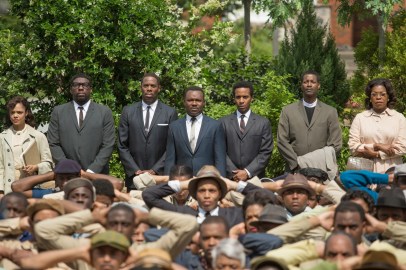
Selma masterful, shows height of 1960s racism

Selma finished shooting in July, about a month before the shooting of Michael Brown. This is all just a big coincidence. Photo courtesy Paramount Pictures.

Martin Luther King Jr. accepts his Nobel Peace Prize. In the next scene, four black little girls get blown away in the 16th Street Baptist Church bombing, one of many acts of violence perpetuated a year earlier in Birmingham, Ala. over the city’s agreement to desegregate.

Selma follows King (David Oyelowo) through the three months leading up to the Selma-Montgomery marches directly preceding Lyndon B. Johnson (Tom Wilkinson) signing the Voting Rights Act of 1965, King’s crowning legal achievement. An ensemble cast includes Keith Stanfield, Oprah Winfrey (who also produces) and Tim Roth.

Ignoring, for a moment, its horrible timeliness, Selma is an incredible film. Where the past few months have been a sea of biopics that did everything wrong, Selma does pretty much everything right. The movie doesn’t pause to point out important characters and warn the audience what’s going to happen. Some extras are obviously important because Oprah is playing them, but it’s still a much more free-flowing story. Only history buffs will know when characters are about to die, and when they do die, it’s felt deeply because they were played as just another person.

Continue reading

Posted in Entropy | Leave a comment

The title is referring to the game of imitating other movies that have won Oscars because that’s what this whole exercise was really about

They do a thing where the computer, which is of course 100 percent Turing’s project, is named after his first love, Christopher. In reality, it was called Bombe. Photos courtesy The Weinstein Company.

The Imitation Game is disheartening. It is a movie to be angry about and disappointed in, but also one which should never have been expected to be any better.

The movie is a biography of the sexy, new interpretation of Sherlock Holmes Alan Turing (Benedict Cumberbatch), hailed as the father of computer science. Turing, with the assistance and backing of the British military and mathematician Gordon Welchman with no help or encouragement, develops the world’s first computer to break Germany’s communication cipher at the height of World War II. Afterward, much higher levels of government Turing all on his own decides how many pieces of information to act on — the Coventry conundrum Turing Sherlock talked about in that one episode — because Turing is smart and special and talented and everyone else is just dumb. Later, Turing is persecuted for being gay, because you win Oscars for playing Gay People that Die.

This movie is an insult. Not just to Turing, not just to the British military, but to everyone who sees it. Every aspect of the story is dramatized into terms beyond black and white, beyond any need or even opportunity for the audience to participate in the film.

Continue reading

Posted in Entropy | Tagged , , , , , | Leave a comment