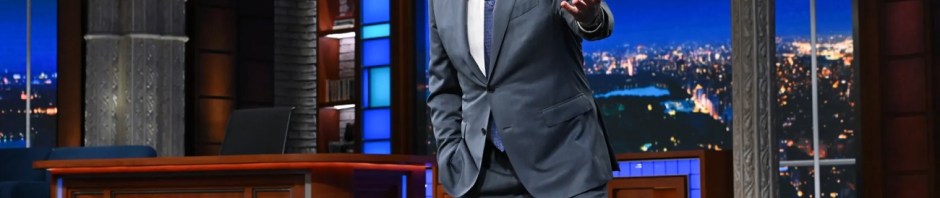

CBS, weeks after parent company Paramount agreed to donate $16 million to the Trump presidential library to settle a nonsensical lawsuit it would easily have beaten had it fought, announced this week it would not renew the contract of leading late-night host Stephen Colbert and that “The Late Show,” which has aired since 1993 and Colbert has hosted since 2015, would be cancelled.
“The Late Show” was the highest-rated late-night show in the nation at the time of this announcement. Colbert, a frequent critic of President Donald Trump, had also criticized his parent company for its capitulation. CBS lied and called it a purely financial decision. Multiple U.S. senators and the Writer’s Guild of America, on behalf of “The Late Show’s” staff writers, have all called for an investigation.
Trump had already extracted a similar commitment from Disney over a similarly laughable lawsuit, and the same week this was happening, began the process anew with a shocking public threat to sue The Wall Street Journal and parent company Dow Jones, which he followed through on the next day.
I set out to write about why there’s more nuance to this situation, and there is, but that nuance doesn’t change the calculation. This is exactly what it looks like, and exactly what Colbert said it was days before being told his contract wouldn’t be renewed: a big fat bribe.
The big fat bribes
Trump has filed multiple billion-dollar nuisance lawsuits against news organizations in the past year. In both settled cases, a massive conglomerate parent company stepped in to appease a president who has approval power over their monopolistic practices – for Paramount, in the middle of an ongoing merger with Skydance, this need was acute, but Disney acquired 21st Century Fox during Trump’s first term in office and may see a similar opportunity within the next three and a half years. Fifteen or $16 million is a small price to pay to maintain a relationship with the president in the calculus of two companies that regularly budget 10 times that much for blockbusters, and much more importantly, do not care about the freedom that their bribes cede.
In December 2024, just after Trump had been elected for a second term, Disney, owner of ABC News, agreed to donate $15 million to his presidential library to settle a defamation case stemming from anchor George Stephanopoulos saying that Trump had been found civilly liable for raping writer E. Jean Carroll in a March 10, 2024 segment. This is inaccurate – Trump had merely been found civilly liable for sexually abusing Carroll, as well as defaming her by calling her a liar when she said he’d raped her, and for defaming her again by continuing to call her a liar after the case was settled. “Rape” has a narrower legal definition than “sexual abuse” in many states’ legal codes, and rapists frequently use this type of wordplay to continue to harass their victims.
Though these terms are not legally interchangeable, they tend to be practically interchangeable, and they were positioned as interchangeable in this specific case. Court documents in the case specify that “sexual assault” and “rape” are functionally the same terms in the speech that the case is concerned with. On Aug. 7, 2023, during procedures for the second defamation case, Judge Lewis A. Kaplan held that Carroll could accurately say that Trump had “raped” her, and went into 24 pages of detail on why the prior case had, in fact, established this.
Stephanopoulos misspoke here in a way that is so negligible that the judge in the case he was speaking about had already written 20 pages about why this specific error was not defamatory. Disney agreed to pay Trump millions for it anyway.
In a nearly identical display of cowardice earlier this month, CBS’ parent company, Paramount, agreed to donate $16 million to Trump’s presidential library to settle an even sillier lawsuit – “60 Minutes,” the legendary news program, had advertised its interview with Democratic presidential nominee Kamala Harris with a clip from their interview that they didn’t end up using in the full show, and Trump sued them over this basic act of editorial discretion.
Instead of laughing off this incredibly stupid lawsuit from a man known for incredibly stupid lawsuits, Paramount entered negotiations with the incoming president, who handily defeated his never-popular opponent weeks later. Colbert expressed his disappointment with the company July 14 after returning from vacation, and was told days later that his contract will not be renewed.
In between these events, Trump started the whole thing over again with a detailed public threat on Truth Social to sue The Wall Street Journal and parent company Dow Jones if they published an apparent hand-written letter from Trump to notorious child sex trafficker Jeffrey Epstein celebrating Epstein’s 50th birthday in 2003. In the post, Trump touted these prior capitulations by ABC and CBS. Trump, who was tied to Epstein for decades before entering politics and is widely speculated to have rented child sex slaves from him, has been attempting to end such speculation for weeks. He would follow through on his threat with another baseless lawsuit that should be easily thrown out the next day.
Trump will not stop. He will use his name, his lawyers and his vindictiveness, whether he is president or not, to punish anyone who draws his ire.
The “agonizing,” “purely financial” decision
The decision to cancel “The Late Show” is obviously politically motivated, but there is a purely financial argument for it. It’s worth examining how pathetically thin that argument is.
The American population is aging, and digital natives, who are far more likely to consume media according to their own schedule, are becoming the dominant purchasing demographic. The shared schedule of work and cable, which made late night such a dominant, uniform genre, is gone now, and the late night block is rapidly going with it. Advertising revenue for this block has halved since 2018, and the decline shows no signs of slowing.
Despite its dominance in the block, “The Late Show” would never have been spared from this societal shift. According to insider sources who became suspiciously candid after the cancellation was announced, “The Late Show” had a $100 million budget and was losing $40 million per year, despite being the highest-rated show in the block – since the economics are changing rapidly, these apparently static figures from behind-the-scenes sources deserve a great deal of skepticism.
A sensible person might say that if a department is too expensive but otherwise successful, the answer is to cut costs, or that CBS as a business needs to find new ways to convert viewership into cash, that canceling the whole thing is throwing the baby out with the bathwater. That sensible person would be correct, but corporations are not sensible people. Accounts payable and accounts receivable are usually different departments, even in mid-sized companies. These facts are not presented to decision-makers at Paramount in their full context, or even as directly related costs and revenue streams, they’re presented as line items.
The older a brand gets, the more expensive it is to maintain. “The Late Show” is an institution. The best and brightest want to work for the highest-profile and most-established companies, and they also want to be paid like the best and brightest. For this show, with a high floor for both total personnel and the talent of that personnel, downsizing is generally not an option, or at least not one fast enough to keep up with the losses that are being reported.
That being said, CBS is in the business of turning attention into cash. If the company can’t turn its most attention-grabbing show into its biggest revenue stream, even if that may at times fall out of line with costs, that’s a revenue-side problem. The company obviously needs to improve this conversion, and those improvements will obviously be more effective with the best-rated late night show still on the air.
Compliance in advance
Wading courageously into the middle of these incentives is Colbert, who has spoken out against the obviously unfit president on an almost daily basis since taking over “The Late Show” in September of 2015. For this, he and his staff have been punished.
They have not been punished by Trump, but rather by their own employers, who, unlike the all-star lineup of comic actors who have become the faces of late night shows or the courageous reporters at “60 Minutes” and their colleagues, have no appetite for conflict with the president. Their only considerations are the bottom line, and Trump has demonstrated he can control them by threatening it.
Colbert’s mentor, Jon Stewart, who left his show “The Problem with Jon Stewart” over the potential for meddling from parent company Apple, put this contradiction the most simply– “Corporations are pussies. They are now, and they always have been. They’re not looking to cause problems.”
Though Trump’s authoritarian behavior is cause for severe alarm, he has won no victories in this space that have not been freely surrendered. The would-be dictator is not dictating. He’s filing nuisance lawsuits and relying on corporations to comply in advance. To the extent that he is defeating the press, he’s only able to do it by taking advantage of the ways the press has already been defeated by corporate centralization. The press’ independence has been withered away to nothing, and so Trump can attack the companies they depend on without directly challenging their First Amendment protections.
When you see a monster, you must kill it
While the “purely financial” argument falls apart immediately, it’s important because it dovetails with the core cynicism of this decision.
When departments within multimedia corporations, from individual shows to movie production brands to entire TV channels and genres become too big to succeed, they are usually discarded, not salvaged. Popular streaming channel original shows often get cancelled after two seasons maximum because they can’t increase revenue to match growing costs. As one studio known for Westerns or films noir discards them, smaller ones spring up with cheaper takes on the genre.
We see this behavior at the personal level, as well. When companies downsize, we take buyouts to hopefully move upward at another company. When a friend or partner chafes, we leave them preemptively, avoiding the cost of conflict and forfeiting the relationship.
It is a societal sickness that entwines laziness at the personal level and free-market capitalism at the economic level. Cowards and corporations both seek the path of least resistance.
But fighting authoritarianism will never be the path of least resistance.
The battle for Freedom of the Press and Freedom of Speech affects us all, and we must all fight it. Not all of us have audiences in the millions backed by a $100 million production budget like Colbert does. That means we don’t have the baggage that comes with it.
If you have a blog, blog. If you have social media, speak out on it. If you are near a demonstration, demonstrate. If you have a voice, call out with it.
Authoritarianism is only enforceable with compliance that, though it can be coerced, must eventually be willing.
And so, we must never be willing.
 Reel Entropy
Pingback: Kimmel suspension another stupid, cowardly Free Press failure, but I’m not worried | Reel Entropy