

It feels like the Disney logo at their films’ openings has extended longer and longer over the past several years, as if declaring the company’s dominance and overshadowing whatever film it leads by taking up more and more time. Frequently, we’ve seen this logo tailored to specific films, making the iconic Disney castle itself the setting of whatever we’re about to see. The individual show you paid for isn’t the important thing – it’s the Disney brand, so much so that films are shown to literally take place under the same Disney roof.
After at least five years of this and almost exactly 100 years of the Disney Company, we see Wish, the celebration of Disney designed for its centennial, and a movie that perfectly captures the contrast and competing motivations represented by the company’s storied past, the discarded failures of its history, its ongoing attempts to monetize that history and the crummy business practices that have become the norm over the past several years.
Somewhere in the Mediterranean, the Kingdom of Rosas rests in peace and solitude, protected by the magic of King Magnifico (Chris Pine). As part of living under his rule, on their 18th birthday, every citizen must surrender to Magnifico their wish, what appears to be a physical part of their soul that contains their artistic passion and truest desire, ostensibly for safekeeping. When Magnifico reveals to Asha (Ariana DeBose), a 17-year-old interviewing to study as his apprentice, that he hoards these wishes to keep them from ever being pursued, she instead gives her wish to a star. The star falls, befriends and begins following Asha, spreading its magical dust everywhere it goes, animating the trees and plants. Feeling threatened, Magnifico sets the entire kingdom searching for Asha and quickly turns to a forbidden school of magic that consumes his hoarded wishes to help capture her.
Rosas is a vague, hazy mix of islands in the Mediterranean. My instinct is to guess Sicily, but I’m reading that the Illes Balears off the coast of Spain were a bigger inspiration. Officially, it’s a “melting pot of cultures from the Iberian Penninsula, North Africa and even the Silk Road,” and it needs to be because Disney is doing that thing again where the main character has a whole crew of friends with exaggerated racial characteristics who mostly hang in the background delivering one-liners. It’s a very common type of blockbuster “representation” that doesn’t really represent anyone, isn’t really a melting pot and doesn’t connect to the tension of immigrant experiences that actually occur in melting pots.
That’s not the point, the point is for people with as many racial backgrounds as possible to point to this lineup, say “that one looks like me,” and buy a toy. Wish might make this intention more obvious than other films that use this type of lineup – they have a song to introduce everyone everyone in a barrage of names and shots and catchphrases. Apparently, Asha is Snow White and all of her friends represent the seven dwarves, but I didn’t realize this until I looked it up, so that’s a fun concept poorly executed.
Maybe this was all primed in a marketing campaign that didn’t penetrate the media diet of a 31-year-old with no children. I remember losing track of this specific scene where they’re all introduced because I got bored and started thinking about sex, a problem I wouldn’t have if I were in Wish’s target audience. No matter how important the Disney Renaissance and early Pixar was to my childhood, I’m too old for these movies now.
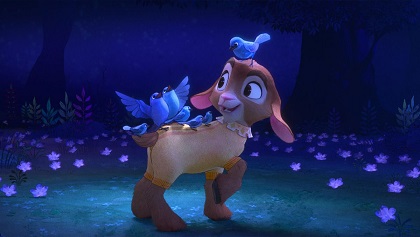
Wish is a classic original Disney musical, and unfortunately, it’s never going to be listed as one of the greats. The songs all stink. There’s no “Reflection” or even a “Let it Go” here, and they come at you one after the other like a toppling stack of cards. They’re all noticeably short, as if no one believed in them enough to flesh them out. The whole movie feels half-hearted and off the mark, like it needed two or three more drafts’ worth of work to bring it up to snuff.
Wish certainly seems to be fishing for a “Let it Go” type breakout song, as most Disney movies have done since Frozen, and months after its release, we know no such breakout will come. Pulling in just $63.4 million domestically, Wish is going to go down as one of the biggest box-office bombs in Disney history, where it will not want for company. The line of recent Disney belly-flops is enormous – Lightyear, Strange World, Ant-Man 3, The Little Mermaid, Elemental, Indiana Jones 5, Haunted Mansion and The Marvels have all released in a post-COVID world and done poorly enough to cause speculation about the doom of the company.
As always, the real problem is Wish’s astonishing budget number somewhere in the neighborhood of $200 million, which a short, small animated movie like this simply doesn’t need. So much of what made Disney a special studio over the past century was its ability to streamline animation without sacrificing quality, and that may be the most ironic thing about this film.
The most distinctive and best thing about Wish is its animation, meant to simulate the watercolor look of classics like Snow White and the Seven Dwarfs and Sleeping Beauty with the freedom of camera movement provided by CGI animation – a major workflow aspect that powered Disney’s Golden Age was reusing the same backgrounds for several shots, and that only works for static shots where the background isn’t moving.
After a whole lot of thought and effort, Wish ends up with what looks like a 2D filter placed over a 3D movie, multiple layers of flat art that create depth perception sort of like a pop-up book. More and more layered on top of this are the special effects associated with Magnifico and the star, which are both delightful, distinctive and serve the story wonderfully.

Magnifico is the film’s best animated character, and it’s a shame he’s so boring. There’s a barrel full of 21st Century movie villains who are thinly disguised tech CEOs, usually portrayed as throwing tantrums when they don’t get their way or when their fragile ego is threatened, and more recently, those tantrums have been less disguised as films scramble to all make the same point about upper class white men. Magnifico, a former idealist, thinks he’s a just king and that what he’s doing is best for everyone, and he’d be a much more interesting character if the film let him pursue what he thinks is right and display the power he has over Rosas in the process, but instead his mask drops immediately and he becomes a mustache-twirling, forbidden magic-wielding villain the first chance he gets.
The disaffected white man is obviously not a new problem or trope, and as a disaffected white man myself, I’m getting pretty sick of movies that incorporate this image of masculinity without incorporating the social factors and existential angst that drives this behavior and worldview. Going from films that understand how masculine angst forments to something like Wish, where it’s simple evil and selfishness, seems like a move backward, and our understanding of masculine angst really needs to move forward right now.
What Wish really needs from a story perspective, and this also connects to Disney hitting the century mark, is to lean more heavily into the theme of cynicism growing with age. All of Rosas’ elders who have seen Magnifico not make their dreams come true don’t seem to suspect anything, and they encourage their children to hand over the best part of themselves to him as well. That many people being held down for as long as they have is fertile groundwork for a, what’s the word? Revo- something?
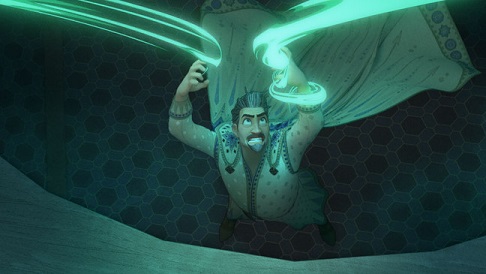
It’s always uncomfortable when a Disney film approaches revolutionary politics and the types of power consolidation that lead to revolutions, and it’s extremely uncomfortable in this 100th anniversary celebration film that’s supposed to be self-aware and is close enough to the mark that it actually might be. Magnifico’s hoarding of wishes and the power he derives from them is an obvious metaphor for capitalism, which steers Disney into even thornier territory – this is the company that hoards intellectual properties like Lucasfilm, Marvel Studios and the 20th Century Fox catalogue and whose past decade of output might look a lot like Magnifico’s solarium of floating dreams that will never be pursued, dreams not stolen but bargained for from a position of enormous advantage, playing on repeat for no one but him.
In the end, we see what feels like a denial of this specific hypocrisy. Wish reverses the logo trend described above, visually making Rosas into the Magic Kingdom at the end instead of the beginning, and decorates its end credits with constellations of iconic characters from the studio’s past, in the process making it clear that Wish is a celebration of Disney, but only Disney. The Millenium Falcon and Buzz Lightyear aren’t included here. A little-used hoard of other people’s original ideas and artistic passions locked behind a paywall? Where? Monopoly? What monopoly?
The “3D posing as 2D” is a great look. Wish is an interesting, fun film to look at, but, especially in the age of generative art models frequently referred to as “artificially intelligent,” the knowledge of it is rather haunting. Wish is an extended homage to the aesthetics of beloved classics, and instead of using those aesthetics, it developed a completely new, exciting and unique one to more keenly resemble them. The entire film represents technology walking backward into the future, faster and faster but never turning around to watch where it’s going. It reflects a company that sees its best days as the ones spent reminiscing, and promising that more of those days are ahead.
Leopold Knopp is a UNT graduate. If you liked this post, you can donate to Reel Entropy here. Like Reel Entropy on Facebook and reach out to me at reelentropy@gmail.com.
 Reel Entropy