
9/10 Director David Fincher, backed by Netflix, has been angling for awards lately, first with flagship series “House of Cards,” then a black-and-white stab at the great American biopic with Mank, and now The Killer, another American arthouse cliché of the lonely man of mystery. It’s effectively two separate genres, the deep urban neo-noirs like Taxi Driver or globe-trotting fantasies about secret spies with their secret ways like The Killer, but both genres are aimed toward the same point – you can’t kill your way out of loneliness.
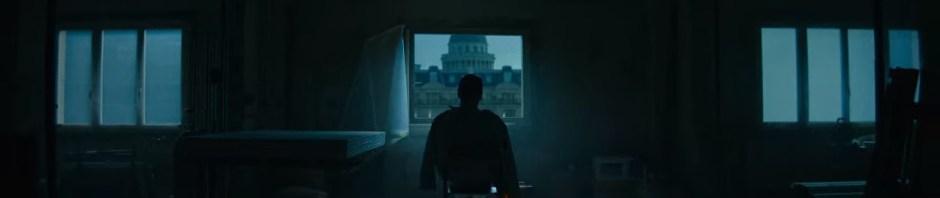
Paris, December, post-pandemic- A black-gloved killer (Michael Fassbender) misses his shot and immediately becomes his employers’ new target. He rushes home to the Dominican Republic to find his girlfriend beaten and raped, but recovering well. The killer sets off on a quest that takes him to four corners of the U.S. to take revenge on everyone responsible.
The film is divided into six chapters, one for each location, most of which begin and end with long stretches of routine, the killer gathering equipment, staking out the location, doing his stretches and blasting his Smiths albums, and then cleaning his staging area and disposing of everything he can. For flow reasons, the first chapter is the only one that opens with a long stakeout, establishing a baseline and using the time to set the rest of the film up, and the last chapter skips its long stretch of falling action, but the thrust of the film is seeing all this preparatory work – “this is what it takes for success,” you see. The moments of confrontation and killing are highly satisfying, but brief.
The killer, insistently silent unless absolutely necessary, repeats a mantric inner monologue to himself about maintaining focus, justifying his crimes with population statistics and “not giving a fuck,” but we see his mental and physical condition deteriorate over the course of this very personal revenge quest. I begin to wonder if this monologue was pre-recorded, not the killer’s thoughts at the present moment but simply a broken record of what he’s told himself for years, something he’s developed explicitly to shield him from being present in any given moment, continuing to play after he’s abandoned it. The whole thing has a major “Tiny Rick” vibe to it.

As usual, Fincher takes aim at the unique charms of post-Cold War capitalism, but Fight Club is almost a quarter-century old, and his crosshairs have wandered from Starbucks to the app economy, the always-online environment that the killer has adapted to and moves through like his own personal slipstream. Either used by the killer, mocked in his internal monologue or called out in passing are AirBnB, McDonalds, “Storage Wars,” creatine, Amazon and Bitcoin, and a special place is reserved for delivery services as his primary means of ingress. “Who needs a Trojan horse when you’ve got Postmates?”
The film goes out of its way to establish the killer as the hypermasculine fantasy in line with this genre, a fantasy that necessarily entwines with all his prep work. He has extremely well-stocked safehouses in New Orleans and, he claims, five other American cities to go along with a plethora of different identities – he uses nine over the course of the film, and we see several other matching sets of passports and driver’s licenses that he discards, every one of which appears to have vast resources associated with it.
Despite this, his surroundings are noticeably cheap, and he seems to take pride in cost-efficiency. We meet the killer operating out of an abandoned, top-floor WeWork office – this brand gets probably the worst treatment, never named and with its logo shown prominently, but only in reverse as the killer leaves the office. With working fixtures, still-operating mail and booking and the flowing plastic construction sheets, it’s hard to tell if this office was abandoned after years of work or mid-construction, and it seems almost haunted. This space dedicated to the flashpan work-from-home economy has become a hollow, a cavity in the city for anonymous assassins to hide indefinitely.
The film’s disdain for the app economy is part-and-parcel with its disdain for the killer’s hypermasculine bullshit, starting with his insistent nihilism but extending to name-drops just as frequent as the brands. The 10,000 hours axiom, “empathy is weakness,” “what would John Wilkes Booth do?” Mensa and referring to non-assassins as “normies” are just more beads in his rosary.
The Killer is a technical masterpiece befitting an Oscar attempt from one of the greatest directors of the past 30 years, with astonishing attention to Fincher’s usual key details – editing, credited to his main editor of the past 15 years Kirk Baxter, and sound design.

I’m ecstatic I got to see The Killer in a theater. It’s got an extremely subjective soundscape with what’s audible changing in every shot – the film cues us into this actively with the killer’s constant Smiths songs alternating between blasting and distant from shot to shot. Moving past the music and into the action, there follows an intense focus on what gets foley and what doesn’t and how much focus any sound effect gets.
Trent Reznor and Atticus Ross are back to score, of course, and the film’s original compositions are just as interesting as the Smiths tapes – though they can hardly be called music. At the film’s most intense moments, the killer seems to hear a low buzzing and crunching in the background, perhaps the “diesel grind” he describes in the mornings of Berlin and Damascus, perhaps the pure background noise of his own mind as his internal monologue gives way. The Killer is a film about a man falling back on his habits and learning what they’re really worth, so this would make sense. The grinding rises to its loudest and most rhythmic during his encounter with the brute (Sala Baker), one of the best, longest and most exhausting fight scenes of the year, and that’s including some stiff competition from almost every scene in John Wick: Chapter 4.
The brute is the one who raped the killer’s girlfriend, a fact the film makes explicit more than once. Sexual assault hangs over the film, not this one example of rape-as-torture, but as a general possibility, a fact of life, one of the extremes of human behavior that form the borders of the killer’s ethics-free worldview, much like the murder he regularly engages in.
Audiences’ relationship to sex in film has become weird and maladaptive lately, primarily because it’s been sucked out of so many mainstream movies for so long, but this is a great example of how it can add to a film. Sex is constantly on the killer’s mind, but as a social and bodily function to be leveraged for his work, never as needs that he, as a human being himself, has – the lyric “I am human and I need to be loved” playing just before he misses his shot is obviously no coincidence. His girlfriend, whom he’s rampaging across the U.S. in vengeance for, is mostly absent, tucked away in a supposedly safe modern Dominican mansion that they seem fine returning to at the film’s end. It adds so much to this portrait of desensitization and isolation, which he asserts is by his own choice, that he could withdraw and live indefinitely with his girlfriend whenever he chooses.
The Killer is available to stream on Netflix.
Leopold Knopp is a UNT graduate. If you liked this post, you can donate to Reel Entropy here. Like Reel Entropy on Facebook and reach out to me at reelentropy@gmail.com.
 Reel Entropy