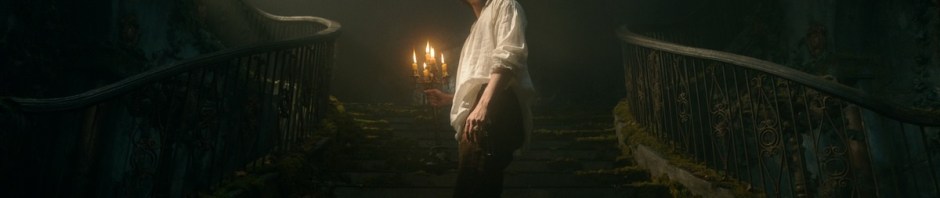
What’s happened is writer/director/producer Guillermo del Toro has made the same movie he’s been making for 30 years and stitched a heavily altered Sparknotes version of “Frankenstein” overtop of it, just detailed enough that you’ll hear some of the main metaphors talked about, but with attention shifted to the point that they are now themes of a different story altogether. Del Toro’s film is about what all his films are about – cruel male authority figures and the lasting wounds they cause and uncomfortably conflated mother/maiden figures who want to drop everything fuck that monster.
In a painfully on-the-nose way, the patchwork of parts sourced from different narratives doesn’t really fit together.
The Farthermost North, 1857- The crew of the Horisont, a Danish expedition searching for the North Pole that has become lodged in Arctic ice, is shocked to discover two far-flung travelers in this frozen hell, Baron Victor Frankenstein (Oscar Isaac), badly injured and near death, and a wretched creature (Jacob Elordi) stitched together from the corpses of the Crimean War, impervious to bullets and with the strength of a hundred men, who hunts him. Sheltering in Capt. Anderson’s (Lars Mikkelsen) quarters, Frankenstein tells him that he created this creature and has been haunted by him in the years since.
“Frankenstein,” much like “Dracula” and its film-native counterpart, Nosferatu, was popular and adapted in the early 1900s when movies were still new things, made by generations of artists who’d been raised on books and stageplays and still considered them higher artforms. Sets were expensive and tickets were cheap, and movies were so tied to mass appeal that everything had to be flattened into a uniform narrative, which was a sort of inoffensive rom-com stuck tightly to sound stages. Their uniformity mostly resembles mainstream blockbusters of today, just with fewer tights. It wasn’t until Citizen Kane and the film noir explosion of the ‘40s that Hollywood found a way to consistently sell more complicated stories, though this was partially just the passage of time as they were now selling tickets to 20-somethings who grew up with talkies and were prepared for them to develop a darker side.
The bottom line for “Frankenstein” is it has a cinematic tradition distinct from the source material, one strong enough that a true book-first approach is culturally prohibitive. There’s never been a filmed version of this without the extravagant animation scene, for instance, which is pointedly not described in the novel.
Del Toro has been talking about making a book-accurate ”Frankenstein” adaptation since at least 2007, long standing as one of his many unrealized projects. He’s been busy during that stretch of time, as has “Frankenstein,” with several around-the-edges adaptations – pour one out for I, Frankenstein and the “Dark Universe,” which had cast Javier Bardem as the creature and approached Angelina Jolie for his bride, but no one for the man himself, before the entire franchise was cancelled after its debut faceplant in 2017.
After seeing it, I’d half-expected to learn his new Frankenstein adaptation started its life in that doomed boardroom, which has seen several of those initial projects repurposed, but then it wouldn’t be on Netflix. Del Toro dusted his plans for the film off for the second of a three-film deal he signed with the streaming platform, and though he may have been on my same page 18 years ago, his views have done a 180-degree turn since. He told Mundo America three weeks ago, “when you create a universal myth … the myth itself rises so far above the original material that any interpretation is equally faithful if done with sincerity, power and personality.”
If you read that and imagine he’s flattened “Frankenstein” to his personal uniform narrative, well, I’ve got a movie for you.
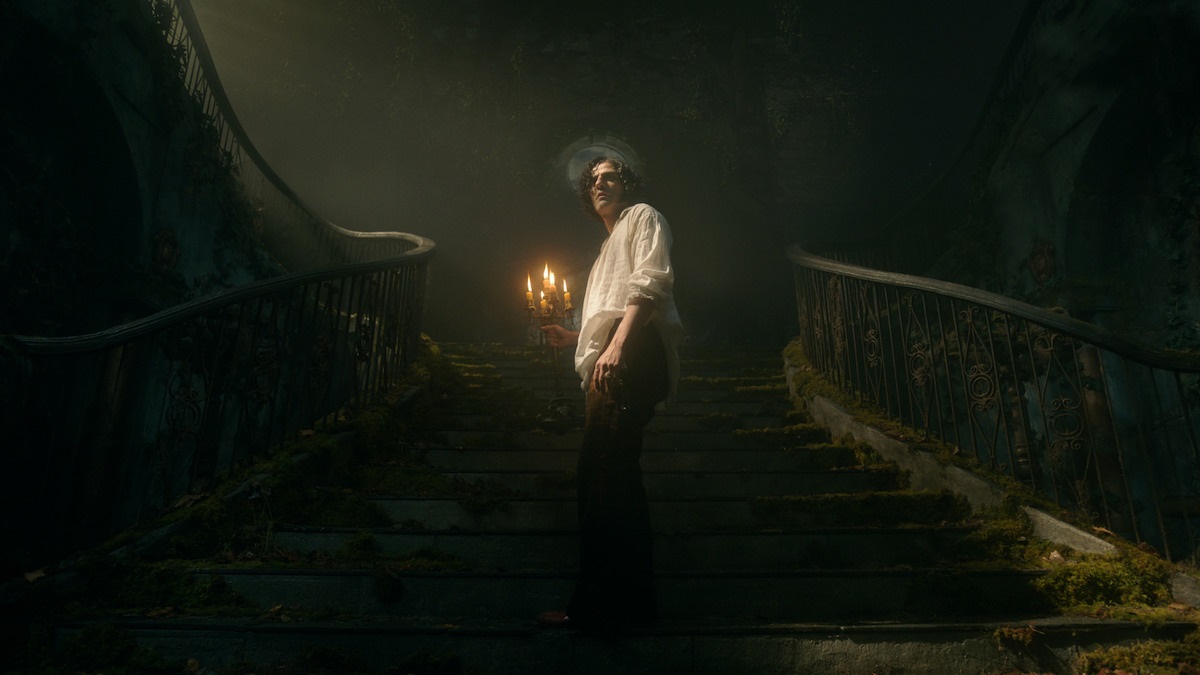
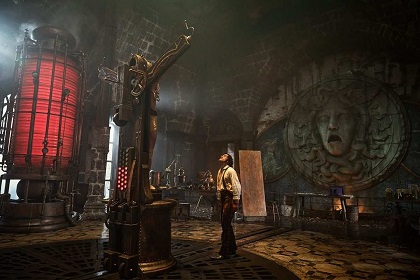
Frankenstein is certainly a Guillermo del Toro creation. All the sets and costumes are luscious and exaggerated and on-brand – production designer Tamara Deverell and costume designer Kate Hawley are each on their third del Toro project here. The creature is marked with these perfect little lines all over his body, long, straight scars absent of stitch marks that seem more for aesthetic than grotesquery, especially as we watch his bullet wounds seal in moments with his X-men-style healing factor. The score from Alexandre Desplat, also on his third time out with del Toro, dances lightly overtop of the film’s many expository scenes.
I had the opportunity to see Frankenstein on 35mm film, which Netflix is distributing this year for its Oscar-season theatrical releases – prints of Train Dreams and Jay Kelly are getting similar tours – but while those films were shot on 35mm, Frankenstein was shot on Codex and printed afterward. Many of del Toro’s recent films have been shot and printed this way, partially because he’s started tinkering way too much with the color grading, dipping further into that signature “too much work done” digital look than many mainstream blockbusters dare go. Frankenstein is colorful in a way that might serve it, with sickly, too-thick greens and yellows contrasting against deep blues and reds, but it feels more thoughtlessly overboard than symbolic, especially since it just looks like every other del Toro film. It’s also in 1.85:1, a boxy aspect ratio he uses to call back to the low-budget ‘50s movies he’s still in love with.
I hate to fall into listing out differences between a book and a film, especially in this case, but Frankenstein spends most of its runtime telling you about these alterations. Frankenstein, much like your deadbeat ex who just started therapy, spends the first half-hour or so preemptively explaining why this is really all his parents’ fault. The film commits so much time to re-working Frankenstein’s Freudian makeup that his parents are renamed from Alphonse and Caroline Frankenstein to Leopold and Claire Frankenstein (Charles Dance and Mia Goth), which does give the game away a bit that the narrative changes are where the focus really was here. Anderson is also renamed, even though he’s the exact character from the book, and the geography is remixed, with every scene in the Europe-trotting story set in a different city than it was originally. Couldn’t tell you why, but the film makes a point of it.
In fairness, this is the creature’s excuse as well – it’s called a “Frankenstein complex,” it’s OK for both of them to have it. Watching Frankenstein and Elizabeth (also Goth) give us an ESPN instant-replay of Frankenstein’s parental relationships with the creature is the film’s main thesis, and the whole thing feels appropriately whiny. It becomes more fan fiction than adaptation, working to create a long list of excuses for favorite characters instead of portraying them and examining their actions. The remixed love interests contribute to this sense as well.
The biggest addition is Heinrich Harlander (Cristoph Waltz), a new character who carries most of the movie’s new themes with him. Harlander, a war profiteer who funds Frankenstein after he’s thrown out of the Royal College of Surgeons of Edinburgh, is hiding a terminal illness and hopes Frankenstein can transfer his consciousness into the body he’s building. The new character echoes up-to-the-minute anxieties about modern arms manufacturers, who rule the global economy with more transparency than ever, and front-facing tech giants, modern-day vampires who won’t shut up about running away to Mars or uploading themselves to the internet or whatever Frankenstein-esque way to cheat death they’re fixated on. Del Toro has been up front about his feelings, declaring “Fuck AI” after a New York City screening of the film.
Aiming the narrative of “Frankenstein” at large-scale computing barons in 2025 is a great, completely applicable use of this story – the people driving this fad are a lot like Frankenstein. They’re largely born rich, they think themselves as gods whose work would inevitably be done by someone else, they ignore all the destruction they’re causing and, transparently, what they really want is an end-run around having to talk to a woman ever again. This is more a reminder of how timeless the underlying story is than any credit to the film.
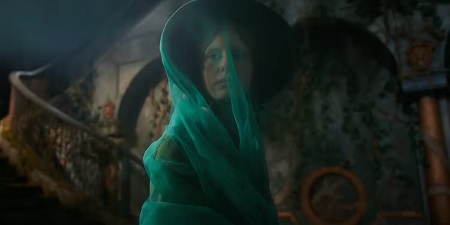
We haven’t mentioned the subplot in which Frankenstein is regularly visited in his dreams by a guardian angel of war that he’s prayed to since he was a child who also looks like his mother/crush and, man, what is going on here? This has turned into a scatterbrained fever dream so tonally dissonant that simply describing what happens feels like dashing around off-topic, and I couldn’t tell you what the topic is supposed to be.
Then the creature says “Let us be monsters together,” so maybe it’s just Hot Topic? We’re going to be seeing hoodies with pictures of this thing and “relationship goals” on it for years!
Actually, I’ve got a couple movies for you – The Shape of Water, the purest distillation of Del Toro’s monster-fucking fantasy, and Nightmare Alley, his dark, lower-profile follow-up that tracks a carnie through Upstate New York in the early ‘40s repeating his dead father’s mistakes. Both films come from the same man’s love of the same early-Hollywood Gothic monster films, and both are considered his best, Shape of Water by the Academy and Nightmare Alley by me personally. Crimson Peak, a great introduction to the del Toro aesthetic that he leans on heavily for Frankenstein, is another solid option. I’ve also got a book for you – “Frankenstein; or, the Modern Prometheus.” It’s a singular work of art, and there’s still nothing quite like it, certainly no movie.
It’s very difficult to recommend this strange, patchwork combination of them.
Leopold Knopp is a UNT graduate. If you liked this post, you can donate to Reel Entropy here. Like Reel Entropy on Facebook and reach out to me at reelentropy@gmail.com.
 Reel Entropy
I think you’ve got it wrong. Calling it a “monster-fucking fantasy” strips the story of its actual meaning. The Monster represents far more than a creature, which is a core idea in his movies like The Shape of Water and Frankenstein. His monsters are emotional, moral beings, often more humane than the people who reject them.
Intimacy with the Monster isn’t about shock or fetish, it’s about empathy and challenging who society labels as “monstrous.” The real horror isn’t the Monster itself, but the cruelty, fear, and exclusion directed toward it.