
After 12 excruciating years, Warner Bros. has given up the ghost and paved over the muddy, miserable Man of Steel with a sunny, cheerful new Superman movie, with James Gunn as writer, director and producer and affixed as the chief of a new cinematic DC Universe. This time, there’ll be no debilitating fear of God, no neck snapping and no director’s cuts.
I want to love Superman, but it’s just OK. What it really fails to do is escape the terrible legacy it inherits. After years of the DCEU desperately responding to criticism in each new entry, the DCU enters the world with the same personnel responding to the same criticism in a lot of the same ways the previous series had settled on by the end.
We drop in media res three years into Superman’s (David Corenswet) career as the protector of Metropolis, and three years into billionaire businessman Lex Luthor’s (Nicholas Hoult) covert campaign to take him down. The Man of Tomorrow has just unilaterally prevented one fictional country from brutalizing another, and where his coworker at The Daily Planet and girlfriend Lois Lane (Rachel Brosnahan) wants him to navigate the political, personal, financial and social ramifications, he just wants to save all those helpless people.
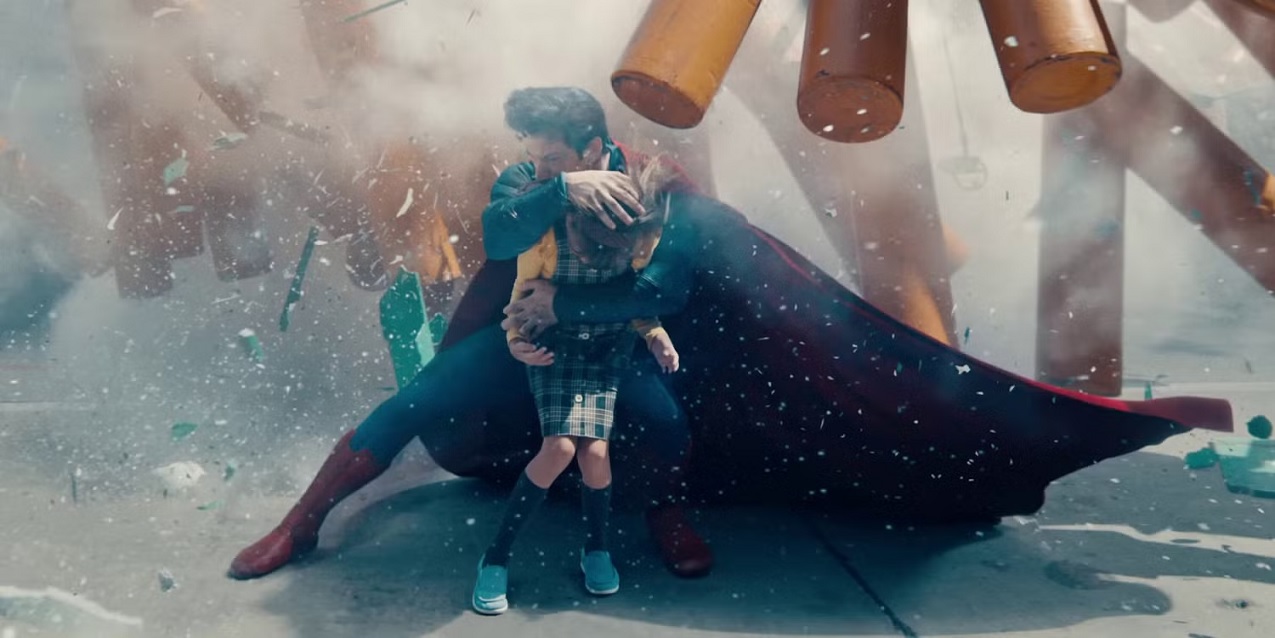
Superman is a breath of fresh air in a lot of ways. One of the most frustrating things about the prior string of DC films was they seemed to be made by people who hated comic books, filed with horrible colors and wantonly violent heroes who never seem to care who they hurt. Superman is true to what people love about comic books. It’s sunny and colorful, cheerful and optimistic, and Corenswet nails it as a young, eager Superman who can’t help but save everyone he can. He’s up in the sky, enforcing mercy on the small creatures, freeing all the prisoners and always being careful to do as little damage as possible.
As the world has deteriorated, many wanted a Superman story specifically that deals with immigration and journalism – Clark Kent is both a refugee and a reporter, after all. Superman can’t help but address these things. Luthor’s slurs against Superman recall recent anti-immigrant rhetoric, even if they don’t directly mirror it. The current financial crisis facing newspapers isn’t around, as The Daily Planet is still in its custom skyscraper, but Kent and Lane brush up against the ethical tangles of anonymous sources, and the publication is what nails Luthor in the end.
Luthor, who directly parallels businessman and political figure Elon Musk, is the most in-line with current events, though I’m not sure how much of this is deliberate reference and how much is Musk’s natural overlap with the character – both men are driven by a sense of inadequacy deep enough that it overwhelms their immense wealth and sense of superiority, but Superman finds other commonalities as well. Luthor fights Superman directly through what appears to be a machine of comparable strength who he has an employee issue commands to as if he’s a character in an action RPG. The reckless, unethical genetic and space-time experimentation he’s built his empire on also mirrors Musk’s, specifically Musk’s privilege to be inefficient and risk everyone else’s safety in ways that government-funded competitors can’t, as does his apparent habit of silencing former lovers. Hoult shines capturing this obsessive husk of a man who has spent so long torturing himself with schemes to control things outside his already incredible grasp that he can no longer sense anything else, while still embodying the fantasy of a would-be planet-saving tech mogul that he represents.
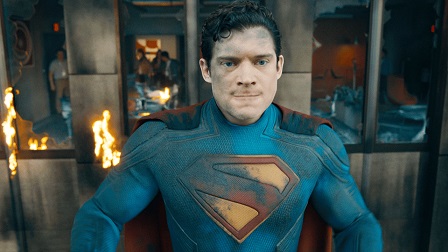
Gunn has come a long way since 1996’s Tromeo and Juliet, but has he really? In his heart, he still wants to make these crass, sarcastic horror-comedies, and Superman is brimming with his idiosyncrasies and particular sense of humor. He’s a terrific filmmaker even if he’s limited by the fact that he never really wanted to leave the world of low-budget filmmaking. His resume glitters with hits, but counterintuitively, he got into this position with DC by failing upward. After the poor reception of Man of Steel in 2013 and spectacular reception for Gunn’s Guardians of the Galaxy just a year later, Warner tried to reedit its 2016 film Suicide Squad to be more like Gunn’s film. Then, when that failed and Gunn was temporarily fired by Disney over 10-year-old Twitter jokes – again, risqué humor is what’s actually important to this guy – they snatched him up to make a brighter, more colorful Suicide Squad movie that shifted tone, but carried many of the same problems. Now, he’s made a brighter, more colorful Superman story, and you can figure out the rest.
Both films feature extra-dimensional prisons, black holes on the planet’s surface and climaxes with two cataclysms set on opposite sides of the world, so to test Superman’s ability to be in two places at once. Both focus heavily on shifting public opinion of Superman, show him causing international incidents and being arrested.
Warner Bros. never actually cleaned house here. They hired Man of Steel director Zack Snyder, then hired people to replace him every few years, and Gunn is the latest guy in that chain. He may have gotten a continuity break in-universe, but not in the board room. After years of observing the DCEU imitate the MCU at every turn behind the scenes and inserting this alarming terror of God into everything, this movie starts out a slate of “Chapters,” and the first chapter is titled “Gods and Monsters.” Almost every individual movie seemed to insist “Man of Steel would be a masterpiece, if,” with the “if” getting more and more caveats attached over the years.
Looking at these films in sequence, it’s hard not to see this throughline, that Superman is making the same surface-level transformations from Man of Steel as The Suicide Squad (Gunn, 2022) made from Suicide Squad (David Ayer, 2016). He makes a decent superhero movie, audiences respond to the corrections he brings to the table, but they’re just corrections. In Superman, the “if” may as well be the entire 129 minute runtime, but it’s still built on that same exhausting foundation.
It’s also concerning that the parts of Superman that make it a James Gunn film don’t seem to be landing. I’m laughing pretty consistently at its self-effacing throwaway lines and admiring the grosser elements, but, though there’s smatterings of applause at pertinent moments from the kind of person who insists on doing that, it’s a pretty dull crowd. This is a packed opening night house that’s ready to riot, but I’m the only one laughing at this not-so-disguised comedy. Am I the only one in the theater who actually likes James Gunn?
Superman is big, shot in IMAX 1.9:1, but much of Henry Braham’s camerawork punishes viewers more for bigger-screen viewing. Almost every action sequence drops into this unwatchable fishbowl spinning clockwise around the event, which becomes impossible to see despite being center-frame. We also get those awful in-flight close-ups directly from Black Adam, a film that no one in their right mind would ever imitate.
It’s been 17 years since Iron Man, and in Superman, we see the hero spend most of his time fighting a doppelganger yet again. Comic books, even mainstream ones, are lurid, counter-culture magazines. Film adaptations used to be these wild, unconventional things, but after decades of reiteration and centralization into the uniform genre defined by everyday MCU blockbusters, they’ve lost so much. After trying to stand out in a deliberately bad way, Warner Bros. has been racing to the middle with repeated attempts to blend in, to be the least remarkable iteration of this tame, mainstream genre instead of an adaptation of this wild source material.
It feels unfair to fault one Superman adaptation for brushing up against another, but just across the bay, Matt Reeves’ The Batman is a lively, fresh adaptation of the Dark Knight character that came just 10 years after the Christopher Nolan series took pop culture by storm, one that feels new and incomparable despite adapting several of the same specific stories. Fans of the characters can enjoy the irony that, the task that Superman finds to be impossible, The Batman has already made to look incredibly easy.
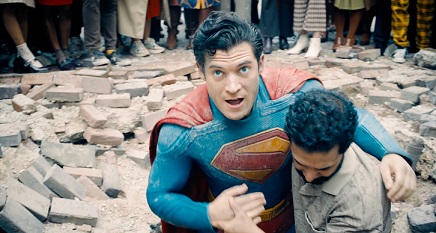
It also feels fairer here because marketing material for Superman seemed to promise more focus. Looking to hide plot details, we saw a very narrow focus on the early interview scene with Lane and the war scene, specifically the moments of people appearing to pray to Superman. This might have been a terrific evolution of the traditional heavy religious elements of Superman films – a world, our world, full of people who grew up thinking their lives would be quiet and secure but are increasingly losing hope against an unresponsive political system and an owner class that wants to privatize the very air we breathe, turning to the sky and calling for a savior, and that savior comes. Here on the other side of release, these are just two small scenes in a much less distinctive final product. When you look back and see that the marketing team understood so clearly what viewers wanted from this, you can’t help but wonder why actual production seems to have understood it less.
Superman wants and desperately needs to be a hard reset, free from the history of the DCEU and the MCU, and it can’t. It’s still just a slightly different version of what came before. I can’t shake this terrible crawling feeling that we’ll never escape the damage of the past 12 years. This history will just keep repeating itself. Warner Bros. will never stop trying to “get the formula right” for a genre that was already blasé before their first real run at it. Until the day I die, someone with the power to greenlight movies will still be insisting, “Man of Steel would be a masterpiece, if.”
Superman is undeniably decent, joyful and inoffensive, but they still need to make a different movie.
Leopold Knopp is a UNT graduate. If you liked this post, you can donate to Reel Entropy here. Like Reel Entropy on Facebook and reach out to me at reelentropy@gmail.com.
 Reel Entropy