
In Captain America: New World – woah, WOAH! This movie is titled what now? OK. OK, that’s better.
In Captain America: New World Order Brave New World, after the COVID-19 crisis and the 2023 double-strike combined to form a long production pause, the MCU finally returns to the form we saw during the early COVID years – an incredibly overexpensive TV show that charges movie ticket prices per-episode that is deeply inbred, at once desperate for new fans and completely impossible for a new viewer to approach, ugly as sin, a years-long catastrophe of writing and a completely unwatchable disaster of editing.
March, post-election- President Thaddeus “Thunderbolt” Ross (Harrison Ford), last seen officially dismantling the Avengers in Captain America: Civil War as Secretary of State, approaches the end of his first 100 days in office on the edge of brokering a deal to share adamantium, the new near-magical metal that’s been discovered on Celestial Island – you know what? World peace! He’s basically about to broker world peace. He remains anxious and insecure, however, because his daughter still won’t talk to him after he tried to kill her boyfriend, the Hulk, 16 years ago in The Incredible Hulk. On the brink of this historic deal, Samuel Sterns (Tim Blake Nelson), the genius behind his political maneuvering with the apparent power to control minds whom Ross has kept imprisoned in a blacksite since that time, plots to take his revenge by scuttling the deal and spoiling Ross’ place in history.
Sam Wilson (Anthony Mackie), Captain America née Falcon, isn’t really involved with that conflict, he just tries to stop Sterns’ minions whenever he’s in the same room.
Captain America: Brave New World is top-tier MCU recycling, a beat-for-beat re-tread of Captain American: The Winter Soldier, one of the best-regarded entries, while revisiting characters abandoned after The Incredible Hulk and locations from Eternals, two of its most forgotten, and setting up elements of the X-Men universe that they only recently required the copyright for. This is all in service of a direct follow-up of “Falcon and the Winter Soldier,” which doesn’t matter because it’s a TV show. I’m sure it all seemed brilliant to a lot of producers who’ve decided to never leave this tiny little world.

Captain America: Brave New World is bad because, well, it’s just so bad. Most scenes feel like shots are missing. The movie is constantly rushing, especially in the early portion where new characters come in at a breakneck pace – this is an almost ever-present, self-inflicted problem with contemporary comic book movies. Then, once the first act is done, the breakneck pace continues so the movie can introduce as many plot developments as possible, because the movie is also tasked with introducing X-Men components to the MCU – creating the exact same ever-present problem for another movie down the line.
Brave New World seems like two movies spliced together because that’s exactly what it is. This film has been through a ringer of press attention functionally since its companion TV series, “The Falcon and the Winter Soldier,” was announced in April 2019. Its months of reshoots were reported on breathlessly, and the story they tell reads almost like a satire of things Disney has done in the past, but the reported extent of the reshoots is what’s so damning. Sidewinder’s (Giancarlo Esposito) entire subplot is new, the character wasn’t even cast until second production. Sterns was redesigned, and Nelson has confirmed that the character’s almost every scene was redone. Ending details were changed, and apparently set photos from the first production indicate a completely absent brawl between Wilson and all his superfriends and the entire Serpent Society, under Sterns’ control instead of Sidewinder’s.
It’s obvious that we’re talking about a completely different movie here, so different that company men like Mackie look silly when they try to minimize it. He stressed that they only took 22 days – so, “only” more than enough time to shoot an entire movie if you can afford a big enough crew.
The splicing is so sloppy that Brave New World is actually a great movie for pointing out the kinds of techniques editors use to try, and usually fail, to salvage movies like this. First is the constant use of ADR, “automated dialogue replacement,” dialogue that’s been re-recorded and inserted in post-production into scenes it wasn’t originally scripted for. Any time you hear a character speaking who’s off-screen or shot from behind so you can’t see their mouth, there’s a chance that dialogue wasn’t in the scene when it was first shot. Sometimes this is for artistic effect, but in Brave New World and other Franken-movies, you start to see almost every other line coming from off-screen.

The second leg that Brave New World makes extremely visible is different production processes – every production is different, and whenever a movie is the product of two productions, there will be some difference. In this specific case, however, it appears the first production was single-camera, a shooting style in which the entire crew focuses on one angle at a time, and the second was multi-camera, a shooting style in which several angles are set up and the actors run through the scene as fast as possible. Brave New World is full of these striking, beautiful compositions, the kind of imagery of disconnection emphasized by the film’s marketing, interrupting long sequences of thoughtless coverage. It’s almost impossible to miss, they’re right next to each other!
The third leg is, of course, the heavy use of CGI for its main action scenes. For most of the series’ existence now, the main MCU action scenes, the CGI-heavy climaxes and midpoint battles like the airport fight in Civil War or the dragon fight at the end of Shang-Chi, are primarily drawn and often separate from individual production – during the director search for Black Widow, the company was apparently telling people to “not worry” about the action scenes. This is a constant, crippling problem for the series, but Brave New World takes it to another level by reportedly creating the entire midpoint sequence on the Indian Ocean from whole cloth.
The film would have been mostly salvageable if at least the martial arts were decent, but of course, action is what suffers the most from missing shots and terrible pacing. The breakdowns are everywhere in these scenes. The transitions from dialogue to action are neck-snapping, mostly in a bad way. The action itself seems like choppy flashes of a fight instead of one that we actually get to see, as if a few moves each were choreographed each day to slap together in post – that may even have been what happened. After years of pumping out the worst action in cinemas, it feels like the studio just doesn’t care anymore whether or not their content is inexcusable like this.

There’s two credited editors to look at for this – Matthew Schmidt is a company man, credited as an assistant editor on The Avengers and now receiving top billing on his 10th MCU project. Co-editor Madeleine Gavin worked with director Julius Onah on his 2019 breakout thriller Luce, and this is her first Marvel credit. It’s easy to imagine Gavin fighting tooth and nail for some of the striking shots that burst through the morass of Brave New World as Schmidt argues to just move along and put the scenes together, though given the background, it’s more likely that they never worked together at all.
It’s hard to assess Onah personally, but these peeking glances of beauty and terrific performances from Ford and Mackie speak well for him. Mackie has been a superstar ever since The Hurt Locker way back in 2008, so it’s tough to see him getting his chance in a movie that lets him down so badly. Ford is still spectacular as a gruff old man delicately navigating a global alliance, but with a rage he doesn’t know the full extent of trembling underneath.
Disney and Warner Bros., the companies behind most comic book movies, constantly create the type of narrative problems we see in Brave New World for their own movies because they’re trying to treat movies like comic books. Movies are closed-ended – no matter how much other media is related to a film, the beginning, middle and end of every plot point need to be maneuvered into one runtime, or viewers will come away dissatisfied.
Simply put, if the payoff is in the next movie, the setup needs to be in the next movie – and the really stupid part is it’s going to be in the next movie anyway, because someone on that project is going to realize it needs to be in there, which will create another dizzying rush of exposition dumps that infuriate faithful viewers and turn off new ones. And so, we get movies like Brave New World caught in the middle of this self-destructive cycle, like a piece of laundry that is born and dies within a single cycle of a washing machine never knowing what it is like to be dry.
For Brave New World, this manifests most clearly in how it depicts its central character, Ross. Is the film for new viewers? Wilson’s packed dialogue about “who Ross really is” will certainly imply something that doesn’t match the character we see. Is the film for long-time fans who remember everything he’s ever done? His previous actions are villainous, but justifiable, at least for a man who thinks he can solve the world’s problems if he imprisons the right people without trial – perhaps if he were using the presidency to arrange mass deportations, something that would fit his character and the in-universe reality of the MCU, instead of negotiating an international trade deal, his treatment would make more sense.
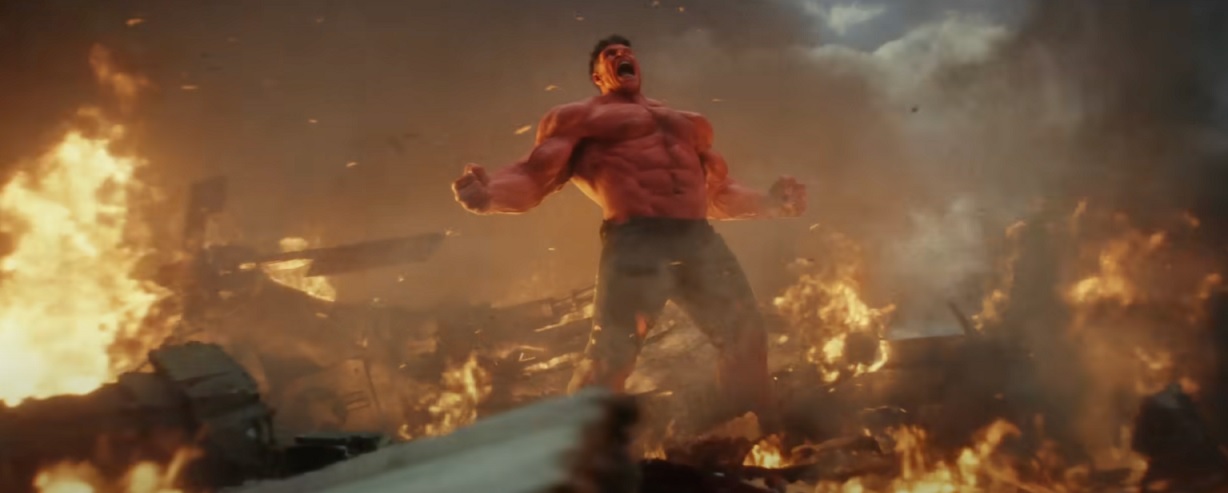
What we see of Ross in the film is fairly mundane. He’s a divorced dad – well, a widower with keen divorced dad energy – who wants to get his daughter to talk to him again, but he’s so stubborn that he wants to do it by proving himself right at a global scale rather than by admitting that he was wrong to her personally. The president of the U.S. is a divorced dad who wants to prove he was right to his estranged child, and when he gets angry he transforms into an enormous red rage monster. If there was deliberate effort to make this movie not about President Donald Trump, it failed.
A film featuring a black Captain America, introducing his new Hispanic sidekick Joaquin Torres (Danny Ramirez) and an Israeli Black Widow character Ruth Bat-Seraph (Shira Haas) and featuring his black mentor Isaiah Bradley (Carl Lumbly), who had been imprisoned and experimented on by the government for decades, can’t help but be political, if only in the most passive possible way. American imperialism is inherent in the plot – Wilson’s first mission is in Oaxaca, Mexico. Japanese Prime Minister Ozaki (Takehiro Hira) spits out the quiet part, that he expected the U.S. to simply take the adamantium, at Ross. Like “Falcon and the Winter Soldier” and its cringe-worthy “do better!” speech before it, Brave New World steers well clear from taking any material stance.
What happens to Ross, being transformed into a hulk after losing his daughter because he hated the original hulk so much, is an ironic punishment directly connected to a tragic flaw, perfect in the Greek tragedy tradition. It’s a shame the bones of this story, as well as Ford’s wonderful performance, is trapped in this corporate puree of repurposed movie.
Leopold Knopp is a UNT graduate. If you liked this post, you can donate to Reel Entropy here. Like Reel Entropy on Facebook and reach out to me at reelentropy@gmail.com.
 Reel Entropy