
It’s over. It’s finally over.
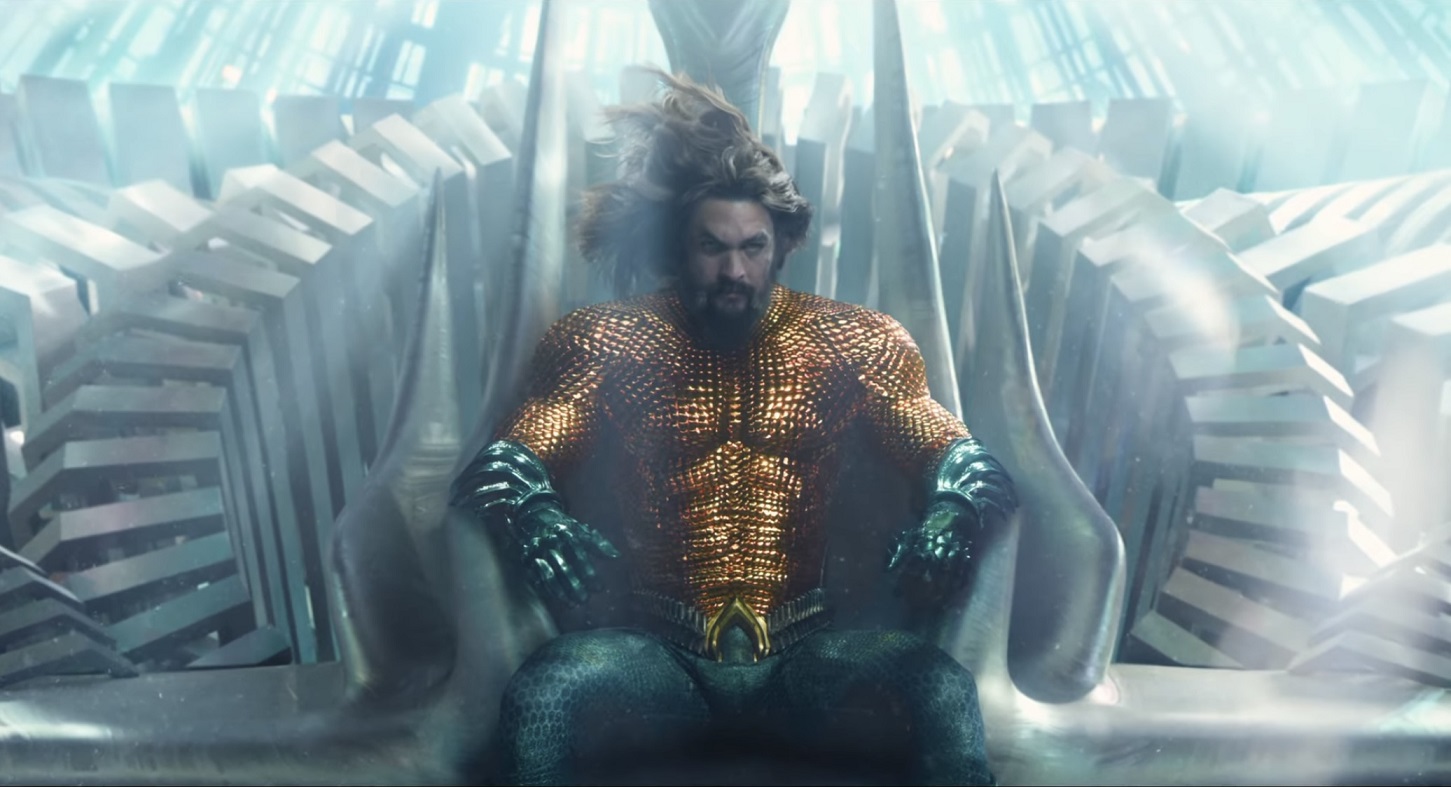
Aquaman and the Lost Kingdom begins with a DCEU signature – way too much plot exposited in multiple prologues, with characters telling us all about the fantastical world we are about to enter and little about the humans that inhabit it. We find frog person Arthur Curry (Jason Momoa), miserable in his new dayjob as King of Atlantis, as he has no ambition to rule, little connection to the kingdom he knew nothing of growing up and limited executive authority. He takes joy, however, in his wife and newborn son. In a terrible opening narration that should have been cut, Curry describes feeling lost as both a king and a father and feels like he’s only good at his rock’n’roll lifestyle as a vigilante, an uncertainty captured beautifully in a shot of his refrigerator full of one-half baby formula and the other half canned Guinness.
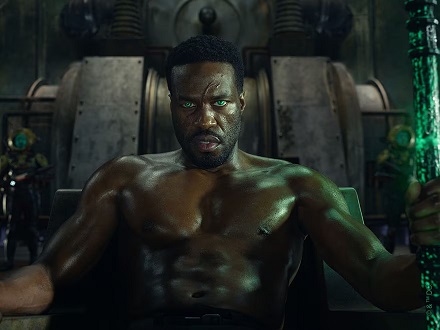
On the other side of the world is David Kane (Yahya Abdul-Mateen II), a mercenary pirate who ravages the seas in his horrible, stupid Power Rangers outfit, who has sworn to kill Curry and his entire family in vengeance for Curry killing Kane’s father in the prior film. With the vast resources apparently at his disposal and a little help from climate change, Kane discovers another ancient Atlantean weapon – THE BLACK TRIDENT.
THE BLACK TRIDENT is the zirconium-forged memory of Atlantis’ lost kingdom and its lich king, Kordax (Pilou Asbæk). With the unearthed armada of the black city of Necrus and the power of THE BLACK TRIDENT making him the equal of any frog person in underwater combat, Kane sets out to have his revenge, but the spirit of Kordax rearranges his priorities, and he works instead to burn off the ancient fossil fuels associated with Necrus, dramatically accelerating climate change. Desperate to stop Kane, Curry turns to the only man who knows how to find him – his half-brother Orm Marius (Patrick Wilson), whose throne and bride Curry usurped in the prior film, imprisoned in the desert.

It’s no surprise that climate change is front-and-center in Aquaman and the Lost Kingdom, and the film goes out of its way to bring in not only real-world politics, but a mythologized version of oil as black magic. Necrus is described as having become a great power through heavy use of oricalcum, which is described as releasing five times as many greenhouse gases as gasoline when burned, almost causing a climate catastrophe in ancient times before the other underwater kingdoms united against it. Necrus, like the Western powers, was built on the back of fossil fuels that we are now asking other countries to forswear, fuels that Kane, under the influence of THE BLACK TRIDENT, now burns for spite. Curry, with his direct plan of finding the bad guy and beating him until he stops, is handcuffed by political gridlock and infighting that is always headlined by the impending ecological collapse, but never interested in solutions.
Instead of being a boring political movie, Aquaman and the Lost Kingdom shifts its focus to family and the unbreakable bond between brothers, and the way it displays kinship as the solution to global problems is actually its strongest point. At every turn, these issues are tied together – in the opening, when Curry describes the two main threads of his life as family and politics; in the villain, who wants to destroy the world and Curry’s family, and advances on both goals simultaneously; in Curry’s kingship, as a councilor threatens, “if he can’t protect his own family, how can he protect us?” and in the main plot, as Curry’s solution is to reconcile with his brother, who puts his commitment to law over their feud.
The message is that we can save the world by saving each other, and Curry is driven into a position where that’s the same thing. It’s heartwarming, and I leave the movie feeling upbeat. The complex conflict and narrative strength shines through.

The movie’s weakest points? Everything else.
A lot of the same garish design choices and horrible, lazy special effects are back in Aquaman and the Lost Kingdom. Almost every costume is an eyesore, and I don’t know what they were going for with the design of any set, especially Kane’s cavernous submarine with yards and yards of empty space.
Almost everything that happens underwater has that same horribly lazy image compositing, where you can see the mouse dragging elements across the screen. Plenty of the film is set on land, but that doesn’t feel like a great solution for an Aquaman movie. All action features the return of that swooping, circling and diving camera that makes anything within it unwatchable, and even when the camera holds still, wide shots of mass destruction are so busy, there’s so many elements on the screen, I feel like I can’t see anything.
These movies realize “Entourage’s” seasons-long joke of “James Cameron’s Aquaman,” but now, we don’t have to imagine what that would have looked like. Cameron finally released the mostly aquatic Avatar: The Way of Water in 2022, which was performed in a 900,000 gallon tank with waterproof motion capture suits. Cameron spent years fighting Fox to let him do it this way instead of with wire-work and rear-screen projection, the exact slapdash way the Aquaman movies are put together, and the difference is stark. The burst of recent underwater movies have swum into these distinct camps – The Way of Water and Black Panther: Wakanda Forever look great and real, and Aquaman and The Little Mermaid (Rob Marshall, 2023) do not.
Aquaman and the Lost Kingdom stands out as the only superhero movie, perhaps ever, to not introduce a new villain – THE BLACK TRIDENT can’t throw its own punches, so it doesn’t count. Director/producer James Wan said he planned this narrative from the start, which is why he introduced Kane as, in his own words, “a glorified side character” in the first movie, a decision that looks even stupider now that it’s paying off. The character screamed for removal in the bloated Aquaman, and Aquaman and the Lost Kingdom dips heavily into flashbacks anyway. It’d be stronger in principle to introduce Kane in the movie where he becomes relevant, and we see now it’d be stronger in practice as well.

It just keeps getting lazier for Wan, whose artistic signature at this point is which corners he consistently cuts. The DCEU, which was made following up the Christopher Nolan-directed Dark Knight series, tried to stand out against rival comic book movies with a focus on “master directors,” and the personnel they’ve ended up employing is telling. The series started with guys like Zack Snyder and David Ayer, who had distinct visions that were really bad, and they’ve burned out of the series, but Wan, the only name director they have left at the end, is exactly who this series deserves to have directing it. Actual master directors have their own visions, they don’t make time for superhero movies.
Wan is more businessman than filmmaker, making his name and fortune by establishing brands like Saw, Insidious and The Conjuring, series that all had installments in 2023 and that Wan still gets a nickel for on every ticket purchased – Aquaman is scaled up, but he talks about it in the same terms, full of ideas for spinoff material someone else can direct that explores all the locations the main films brush over. This gravy train is decommissioned, but it shouldn’t surprise anyone the guy operating it at the end is the guy who explicitly handles movies like a gravy train.
Wan pushed out Malignant between superhero movies, an incredibly strange B-movie that finally started to display a little of his acidic-yet-dull sense of humor, and Aquaman and the Lost Kingdom carries this through. I don’t exactly like it, but there’s significantly more personality here, and that’s always nice to see.
Where the first film focused on frog people mostly indistinguishable from normal humans, The Lost Kingdom gets much more Star Wars with it. Dozens of sea creatures are built out into humanoid, seemingly sentient designs, and the Rule of Cool is the only possible explanation. Bipedal bodies aren’t great at swimming, so seeing a hammerhead shark, for instance, who still lives underwater despite having arms and legs, feels like a cruel joke. Maybe a better movie could explore the implications of the apparent sentience of millions of other species, but that’s overthinking this one.
There are way, way too many things in Aquaman and the Lost Kingdom that look like giant centipedes. When Curry and Marius track Kane to Devil’s Deep, the South Pacific island where he’s burning all the fuel, we get into a lot of actual giant bug designs. It’s very King Kong, but not what I want out of an Aquaman movie – never really liked that part of King Kong, either.
After becoming the first DCEU film to pull in $1 billion, the crush of articles asking whether Aquaman would save the franchise nearly drove me mad. Five years later, Momoa ends Aquaman and the Lost Kingdom by grinning at the viewers who just watched his terrible new movie and leaping backward into the water, carefree. Wan, Momoa and the rest of the players have all cashed their checks, and it’s palpable that’s all anyone was here for. The people who wanted the DCEU to stand in powerful artistic contrast to other comic book movies are long gone.
These are the people who insist to this day that Man of Steel is an underappreciated masterpiece, so it isn’t exactly a fond farewell.
Leopold Knopp is a UNT graduate. If you liked this post, you can donate to Reel Entropy here. Like Reel Entropy on Facebook and reach out to me at reelentropy@gmail.com.
 Reel Entropy