

Denton, Texas- In the 1950s, professional wrestler Jack Adkisson incorporates his grandmother’s maiden name to develop a Nazi-themed “heel” character, Fritz Von Erich (Holt McCallany), and all of his sons and grandsons who follow in his footsteps adopt the Von Erich name in the ring as well as his signature move, the Iron Claw. Over time, a curse appears to befall the family. The film primarily follows second-born Kevin Von Erich (Zac Efron), the one-time WCWA World Heavyweight Champion who would eventually take over his father’s ownership duties in the league.
Fritz Von Erich had six sons, and he would bury five of them, three of them after dying by suicide. The Iron Claw omits one of the suicide victims, partially for time and partially for believability concerns, worried that viewers would find three suicides unrealistic. It’s a tacit admission of failure from writer/director/producer Sean Durkin to approach this story and then shy away from telling its full extent, and it’s especially sad to see because he wouldn’t have failed.
The Iron Claw is slow, dark and doomed, a surreal journey into the strange, artificial world of pro wrestling, bolstered by incredible cinematography from Mátyás Erdély. I would believe whole-heartedly that the haunted family depicted in this film suffered at least three suicides. Billed as a piece of history, it’s much more of a moodpiece, not about the facts but the feelings they elicit – as all the best biopics are. It’s a lovely, depressive film to stew in if you can handle its harder edges.
The tension winds up in every shot, every line and every move from the Von Erich children. Something’s always wrong, they’re always holding something back, especially when their father is in the room. The moments of confrontation and catharsis are weak, leaving the film anti-climactic and disquieting, but it works better here than a more satisfying emotional journey might – making a movie about four or five dead children not to feel tragic isn’t what anyone was going for here.
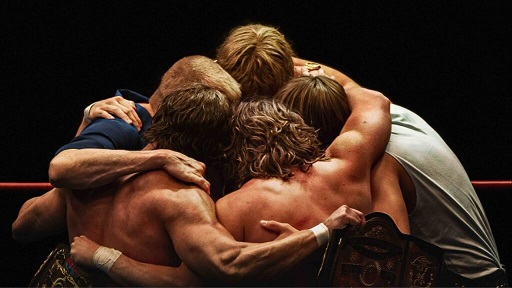
The performativity and faux-athleticism of pro wrestling, or “kayfabe,” is something I’ve never been able to wrap my head around – a bloodsport needs blood, not choreography and crowdwork – but The Iron Claw is entirely in kayfabe, and suddenly it all makes sense.The film portrays a Von Erich family that is always in-character at home, fostering an anchorless environment in which telling what’s real and what’s dreamed isn’t the problem, because like wrestling itself, it’s all “real.” The question is, how real is it?
At the center of this dynamic is the Iron Claw itself, the Von Erich family’s signature finishing move. The wrestler spreads his fingers, grabs his opponent’s forehead and squeezes, applying so much pressure to the temples that he’ll crush the victim’s skull if he doesn’t tap out. Obviously this is impossible, and the move relies on a coordinated performance from receiving wrestler to sell what’s supposed to be happening – but in The Iron Claw, it’s real. There are multiple scenes of a Von Erich using the move to torture a victim.
The one time someone is actually hurt in the ring and not performing, it stands out like a lightning rod, and everybody within the film world can tell the difference as well, so there is a line between fact and performance somewhere on the screen, it’s just near-impossible to tell where it’s supposed to be.
The Iron Claw explores child abuse from this narrow angle of identity erasure, starting so young it functions more as identity suppression. Fritz Von Erich is the classic abusive sports dad, but in his case, he forces not only his athletic dreams onto his children, but a stage name and performance as well. He raises his children in-character, and for them, the performance never ends, and no real identity outside one a tongue-in-cheek pro wrestling character is able to form.
Between the mystery of who these people really are, the mystery of how seriously any of this should be taken and the thick black fog that hangs over the ring, we swim through this troubled, dark film, always unsure what direction Kevin Von Erich should or will take.
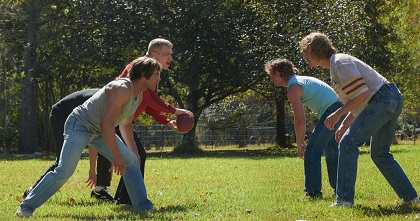
While the emotional damage of always having to play a Von Erich builds as the film goes on, The Iron Claw maintains a steady focus on the physical toll on the wrestlers’ bodies. They are giant and beautiful and just as muscle-bound as an audience would expect, but also covered in scars and stretchmarks. The film focuses immediately on the consequences on their bodies and stays there, denying viewers the chance to lust over these bodies by shoving the pain of existing that way in our faces.
The Iron Claw doesn’t believe in itself as much as it should. The film admits failure at the outset by omitting Chris Von Erich, and its other missed opportunities are also the spots where it doesn’t lean into its best elements. The tension between the Von Erich and Adkisson names, which eventually does come back, could be used to draw attention to the difference between reality and performance and Kevin Von Erich’s inability to distinguish them. The plague of suicide among contemporary pro wrestlers, which makes the trio of Von Erich family suicides all the more believable, should also have been tied in.
Leopold Knopp is a UNT graduate. If you liked this post, you can donate to Reel Entropy here. Like Reel Entropy on Facebook and reach out to me at reelentropy@gmail.com.
 Reel Entropy