
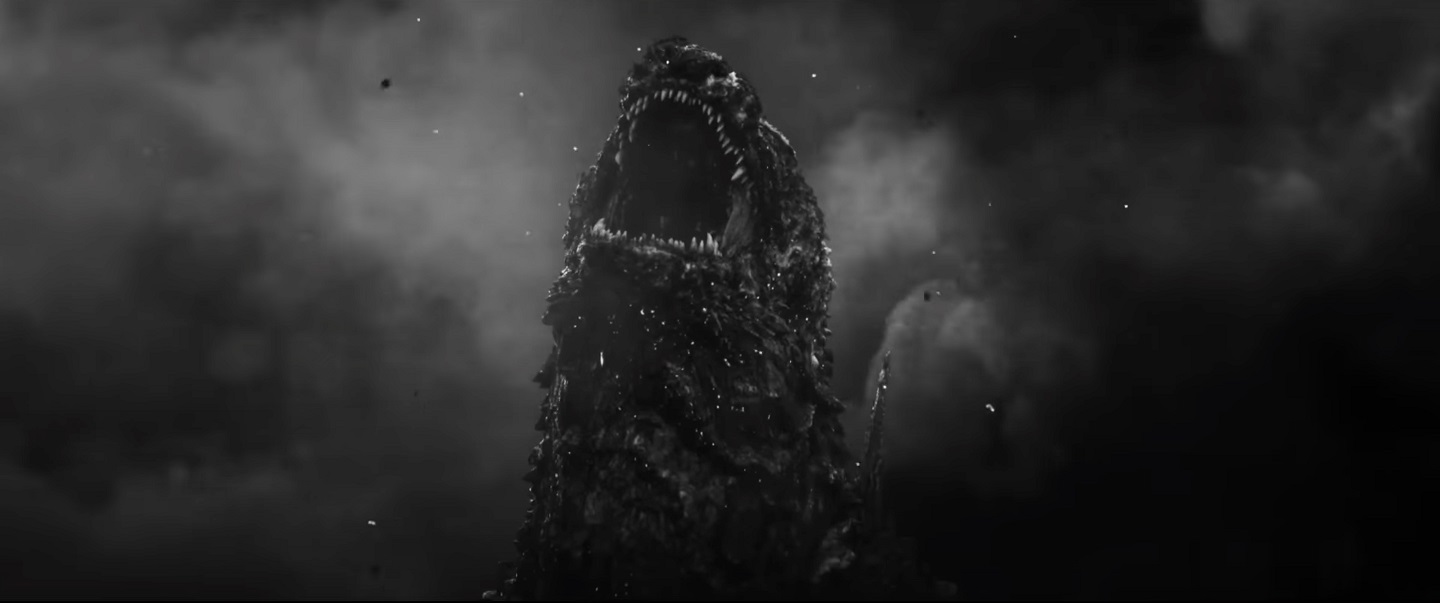
In 1954, less than 10 years after the atomic bombings of Hiroshima and Nagasaki, Toho and writer/director Ishirō Honda reconceptualized the attacks as a monster that emerged from the sea, its skin cracked and charred as if by nuclear blast, its breath befouling the air around it with fallout, and its name was the wrath of God. Godzilla immediately became a pop-cultural sensation and symbol of the Japanese mood as it changed over the decades, frequently fighting off bigger threats as an anti-hero or even a goofball. The title Godzilla Minus One comes from the idea that Japan was at “zero” after the bombings, and Godzilla’s emergence put them at “minus one.”
It’s remarkably similar to the original film, but with 80 years’ hindsight instead of 10, Godzilla Minus One is less about exploring the trauma of the nuclear attacks and more about interrogating the Japanese culture that led the country to this and the traumas of demilitarization and emasculation of individual Japanese. Perhaps the most notable difference is that, while Godzilla was contemporary to its 1954 release, Godzilla Minus One begins months before the nuclear attacks.
Odo Island, March, 1945- Kamikaze pilot Kōichi Shikishima (Ryunosuke Kamiki) deserts the skies over the Pacific, where he would have been ordered to commit suicide by flying his plane into enemy watercraft for what was at that point a losing cause. Japanese culture has an extremely strong tradition of death being preferable to defeat, to the point that suicide attacks like these were openly part of their military strategy in World War II. That night, Godzilla attacks the plane mechanics stationed on the island. Shikishima hides again, and is again one of only two survivors.
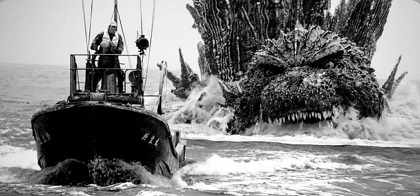
Two years later, Shikishima has returned home to the charred remains of Tokyo, where he learns his family was killed in the firestorm and the sting of defeat is so strong that his mere presence as a fighting-age man who is still breathing marks him as a pariah. He takes up with a woman and her adopted baby, both also orphaned in the firestorm, forming what appears to be the only young family for miles around, and finds work sweeping mines left in the Philippine Sea. Things are looking up, but the beast, who has more than tripled in size after gorging on the radiation from American nuclear tests at Bikini Atoll and now plays with Takao-class cruisers like bath toys, returns to finish off Tokyo.
Godzilla Minus One is exceptionally good, and it knows it. The 37th Godzilla film is a complicated, sympathetic and political exploration of personal and national survivor’s guilt with a black and white cut already included, and has become the first ever Godzilla film nominated for an Academy Award.
Godzilla Minus One brings a great deal of history to painful life, but that’s not the reason you see it – you see it because it totally rules. Godzilla is onscreen and mercing people almost immediately, and about an hour in, they straight-up do Jaws with him. The monster action is satisfying, the human cast is heart-wrenching and, in an era of systemic governmental failure, the story of citizens coming together and overcoming Japan’s unique national trauma is incredibly cathartic.
After 2016’s astonishing Shin Godzilla, in which Godzilla is a reaction to the 2011 triple disaster, Toho eventually decided against a sequel because none of the proposed ideas seemed to live up to it. The project to quickly reboot the character again was awarded to Takashi Yamazaki, credited in Godzilla Minus One as writer, director and visual effects supervisor. It was his pitch to drive the monster deeper into the despair of post-war Japan.
Under U.S. occupation, Japan wrote a constitution that forbade the country from keeping a standing army, but they established one anyway in 1954 because, though the country was under U.S. occupation, it was not under U.S. protection. This is reflected in Minus One. The U.S.’ continuing nuclear testing reawakens Godzilla, and he is initially mistaken for a new American or Soviet weapon. To make matters worse, the U.S. won’t send vessels to pursue him for fear of striking off the Cold War. Japan is left with minesweepers like Shikishima, who are ordered to use the mines to stop the monster.
When Godzilla makes landfall, tanks and fighter planes that were supposed to have been decommissioned rev up to meet him, but they have no effect. The military couldn’t solve Japan’s problems in the war, and it won’t stop Godzilla now. It is a scrounged civilian fleet, albeit one full of surviving navy personnel, that eventually stalks the creature.
The color cut of the film is fine, but it was shot for black and white. Billed as Godzilla Minus One Minus Color, the black and white cut is scarier, darker, angrier and more majestic. The dark, low-contrast look flattens the image, making Godzilla seem closer and more frightening in many shots, and the details of his pockmarked skin look more fearsome. Many images look more like paintings. Increasing the artifice gives it a sharper edge as a horror film.
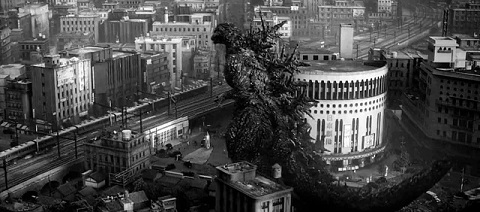
In his initial continuity, Godzilla quickly became friendly, but Godzilla can’t be friendly. This is a scarier, angrier Godzilla. The monster is traditionally played by a man in a rubber suit on a specialized set to make him look enormous, but Godzilla Minus One creates its title character digitally, removing all trace of humanity. His arms are fixed and his feet drag, maximizing destruction as he stares straight ahead. He is enraged, a blind rage that changes targets quickly, but he mostly keeps his dignity in an oddly regal march across Kanagawa.
Much of the attention on Godzilla Minus One has been for its spectacular visual effects relative to its tiny budget – the exact number is disputed, but Yamazaki said it was significantly less than the rumored ¥3 billion, which would equate to roughly $20 million. Godzilla is created digitally and in extreme detail, with Yamazaki saying he took digital work as an opportunity to perfect the creature model beyond where physical costumes could go.
The integration isn’t perfect, and you can easily tell the digitally created elements apart from the physical, especially in the black and white cut, but it adds more to the experience than it takes away. What really stands out are the sets – the film spends most of its time in small, cluttered rooms, especially the shanty town that is most of what we get to see of Tokyo, but more often on the water or near the docks. It’s great for the film to spend all its time in these cramped spaces that used to be for Japan’s war production, but you can tell the production is counting every yen.
I would point to Shin Godzilla, which looks even better for just ¥1.3 billion, or The Creator, which also puts standard Hollywood productions to shame at an $80 million budget, significantly higher but still much less than a standard blockbuster production, as better illustrations, but if producers are realizing that cheaper visual effects are actually much more effective while looking at Godzilla Minus One, at least they’re realizing.
Leopold Knopp is a UNT graduate. If you liked this post, you can donate to Reel Entropy here. Like Reel Entropy on Facebook and reach out to me at reelentropy@gmail.com.
 Reel Entropy