
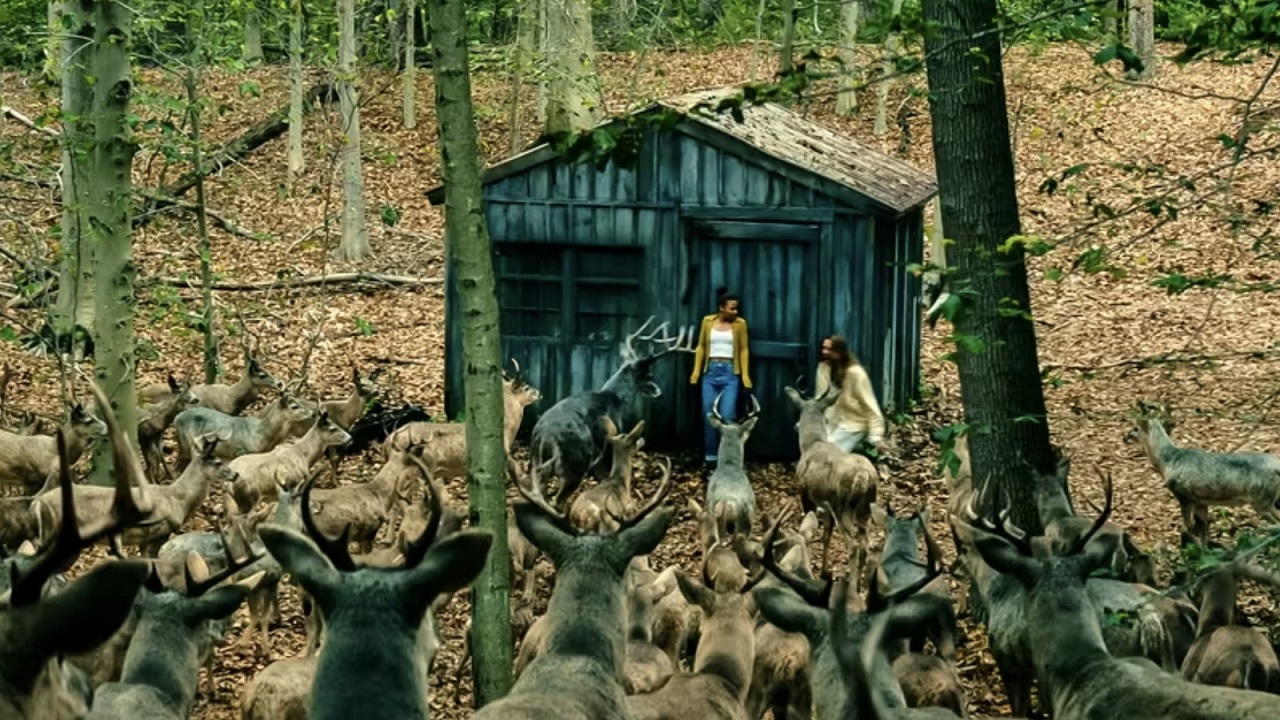
Leave the World Behind opens with several shots from space, tracking the sun as it crawls across the sky over the Upper Bay, and many of its chapters start by zooming back out to space as well. At first, the motif hammers in the idea that this is all happening on a random Tuesday morning, that the events of the film are society snapping under the tension of the everyday, and it becomes something more sinister as it zooms further out.
This reading is complemented by the first moments. The first thing that happens in the film, arguably its real inciting incident, is Amanda Sanford (Julia Roberts, who also produces) packing up for herself and her entire family and leaving. She’s had enough, she is snapping, and everything else in the world is snapping after her.
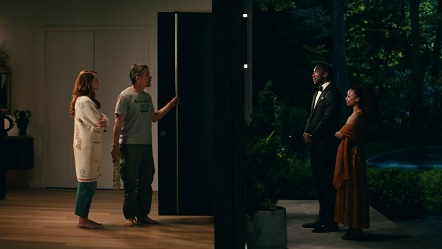
Brooklyn- Sales executive Amanda Sanford whisks her family, husband Clay and children Rose and Archie (Ethan Hawke, Farrah Mackenzie and Charlie Evans), away on a surprise vacation to the Hamptons. Suddenly, a black man claiming to be G.H. Scott (Mahershala Ali), the owner of their short-term rental house, appears, along with his daughter, Ruth (Myha’la), telling the Sanfords of a blackout in the city and asking to stay the night, and they realize all smart devices in their houses and cars aren’t working. Tensions mount between the two families in the isolated modern mansion as society appears to collapse completely in the background.
Leave the World Behind is a movie with a lot on its mind, from racial tensions to the silent screams of hurtling toward our tech nightmare future. You generally appreciate that, but it follows those threads their separate ways and fails to tie them together into a satisfying statement.

The whole film feels like an extended TV pilot, as if the point is to offer producers and viewers various threads that could be picked up on if everyone’s interested, and it uses a lot of the same toxic, post- “Lost” storytelling techniques we see in TV that’s more interested in hitting a runtime and piquing your interest with hanging questions and big water cooler moments than telling a complete story – we even get to see samples of those water cooler moments every 20 minutes or so. Lots of different setups, no payoffs. It’s not a closed loop created by an artist with something specific to say, but a collection of characters and plot threads that could be expanded later – it all depends on what people are saying on Twitter.
The biggest offender and best example are the scenes in the second night, when G.H. Scott and Amanda Sanford pair off upstairs and Clay Sanford and Ruth Scott talk by the pool. The sexual tension is laid on thick in both scenes, the film wants viewers to really wonder about how these romantic entanglements could play out, but then they all go to bed quietly with their established partners. It’s exactly the type of thing that might work in a pilot that’s proposing future plot points, but in a film, if conflicts don’t come to a head within the runtime, they’re never going to.
It’s episodic as a work, divided into five chapters, many of which begin by zooming back out to space for a few shots and many of which end on long cross-cutting sequences of different disasters separate characters are experiencing – they split up a lot. For example, chapter two ends with a painfully extended cross-cutting sequence of Clay Sanford driving around aimlessly, G.H. Scott discovering his dead neighbors and running from terribly unconvincing airplane crashes and Rose and Archie Sanford wandering around in the backyard. The same few stressful chords are blasting over the entire sequence to tie it together and try to make it seem more exciting than it is. It’s like listening to a broken record for 10 minutes while next-to nothing happens onscreen, it’s torturous.
The disasters look awful. When Leave the World Behind wants to get going, it busts out the greenscreen for some lazy, unintentionally hilarious scenes of massive but obviously not to-scale oil tankers or planes hurtling toward the screen while the cast play-acts running away from them. It feels even more like TV, like a show on a shoestring budget simulating the climax of a more ambitious piece of work.
At 140 minutes, “extended” is a key descriptor as well. This movie has a ton of time on its hands for cinematographer Tod Campbell to float around this house and shoot every sideways pan he can find. There’s a ton of style here, but style is what feels like it’s wasting the most time.
The biggest theme is overreliance on space-age technology, to the point that the Sanfords and Scotts are unfamiliar with analog ways to solve their problems. Clay Sanford can’t find his way around the hamlet without his car’s built-in satellite map and doesn’t seem to recognize static on the digital television set. When he jokes about putting rabbit ears on it to help pick up the signal, Rose Sanford asks why a rabbit’s ear would help, because she’s never heard that phrase before. The film has a wonderful way of working this sort of disconnect into dialogue.
Barack and Michelle Obama, who are fans of the book, had input on the screenplay and are credited as executive producers, and fittingly, the film starts in an Obama-like conception of America, this beautiful modern mansion built and owned by black people who volunteer to sleep in the basement to make the white family currently renting the place more comfortable. The racial tension is palpable, but this scenario would inspire distrust between any set of people, nobody says out loud that it’s a race thing and G.H. Scott is a great orator, so it’s fine.
The image of a verbose black man talking until everything becomes OK is a big part of Leave the World Behind. Way too many of the movie’s core ideas are expressed through G.H. Scott’s monologues, which are frequent and given equal weight to the film’s biggest set pieces. It’s a collision between separate major failings – it doesn’t know how to express its ideas visually, and again, the disaster set pieces all suck in a cheap way.
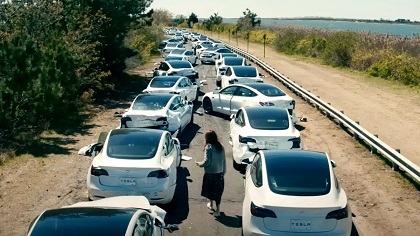
The one exception, a set piece that sucks in a funny way, is the massive pile-up of self-driving Teslas that have all decided they need to enter the highway as fast as possible and are slamming into each other at highway speed. To the movie’s credit, its anxieties about a tech-reliant future are up-to-the-moment. The whole scenario with the short-term rental is very “Black Mirror.” A stranger knocks, but who’s the stranger in this context? Whose home is this?
Writer/director/producer Sam Esmail, best known as the creator, producer and head writer of “Mr. Robot,” has a lot to say about television here – ironic not just because of his best-known work, but because of how heavily this film dips into lazy storytelling tactics generally associated with television. The Sanfords often twist to relate whatever their children are experiencing back to television, with choice lines like, “Kids seem to have gotten over it like it’s something we saw in a show and they’re onto the next episode” about how well they handled the oil tanker scene, and, “We were really bored back then” from Amanda to explain clipshows to Rose, who is watching “Friends” for the first time. Her desperation to see the series finale is a major motif, arguably even the main narrative, of the film. Clay Sanford, a media studies professor, mentions one of his student’s books about what the internet has become, and the Scotts use relatable jokes about how awful the internet is when they’re trying to make the Sanfords comfortable with them.

The moral arc of the film’s universe bends toward a very Trumpian conception of America. In the film’s final scene, Scott seeks help from his survivalist neighbor Danny (Kevin Bacon), who greets him with his Mossberg and stands framed dramatically with his oversized American flag behind him as he explains at length the principles that stop him from sharing some ibuprofen.
The scene escalates to the point that Clay Sanford diffuses it by crying, “I can barely do anything without my cell phone and my GPS! I am a useless man!” winning Danny’s pity and pivoting the scene toward a lot of blather about America being so dysfunctional it can’t handle being cut off from satellites and electricity, not as a basic observation, but as a moral failure, like it’s some kind of indictment that 21st Century Americans are adapted to a 21st Century environment.
It’s a very “stop hitting yourself” type of argument. “You’re not a real man if you can’t change a tire,” pay no attention to the fact that cars don’t come equipped with spare tires anymore. The final point of Leave the World Behind seems to be that the U.S. couldn’t withstand this coordinated, simultaneous knockout of all electrical and satellite technology across both coasts, and no, of course it couldn’t. The attack depicted in this film would immediately become the most devastating and difficult in human history, and yes, if the entire country were attacked like this, a lot of people would die. What’s your point here?
Everyone in this country has been through decades of capitalist oppression, disinformation, racial reckonings and a wrath-of-God level plague. Maybe it’s OK if we want to watch a little TV.
Leave the World Behind is available on Netflix.
Leopold Knopp is a UNT graduate. If you liked this post, you can donate to Reel Entropy here. Like Reel Entropy on Facebook and reach out to me at reelentropy@gmail.com.
 Reel Entropy