
The Hunger Games: The Ballad of Songbirds and Snakes is a horrendous title. It’s about three times as long as it should be, painful to say and somehow even more embarrassing than a placeholder like “Untitled Hunger Games Prequel” might be. By stretching to incorporate so much of the series’ symbolism, it’s not just inviting you up its own ass, it’s forcefully dragging you there merely for thinking about it.
Also, it’s so close to several perfect titles for what’s really going on here, like Hunger Games: The Snake eats its own Tail or The Ballad of the Dying Business Model.
For anyone unfamiliar with the series – The Hunger Games is set in a post-apocalyptic U.S. in which one city, the Capitol, hoards the vast majority of wealth and resources while 12 states, or districts, starve. As penalty and continuing show of force after an uprising, the Capitol hosts an annual “Hunger Games,” in which 24 teenagers, two from each district, are compelled to fight to the death until only one remains, which has become an ersatz reality show. The setting is pregnant for commentary on imperialism, capitalism and class warfare, police violence, celebrity, reality television, a couple different media-industrial complexes, 24-hour news and entertainment media’s broader ability to pacify an oppressed population.
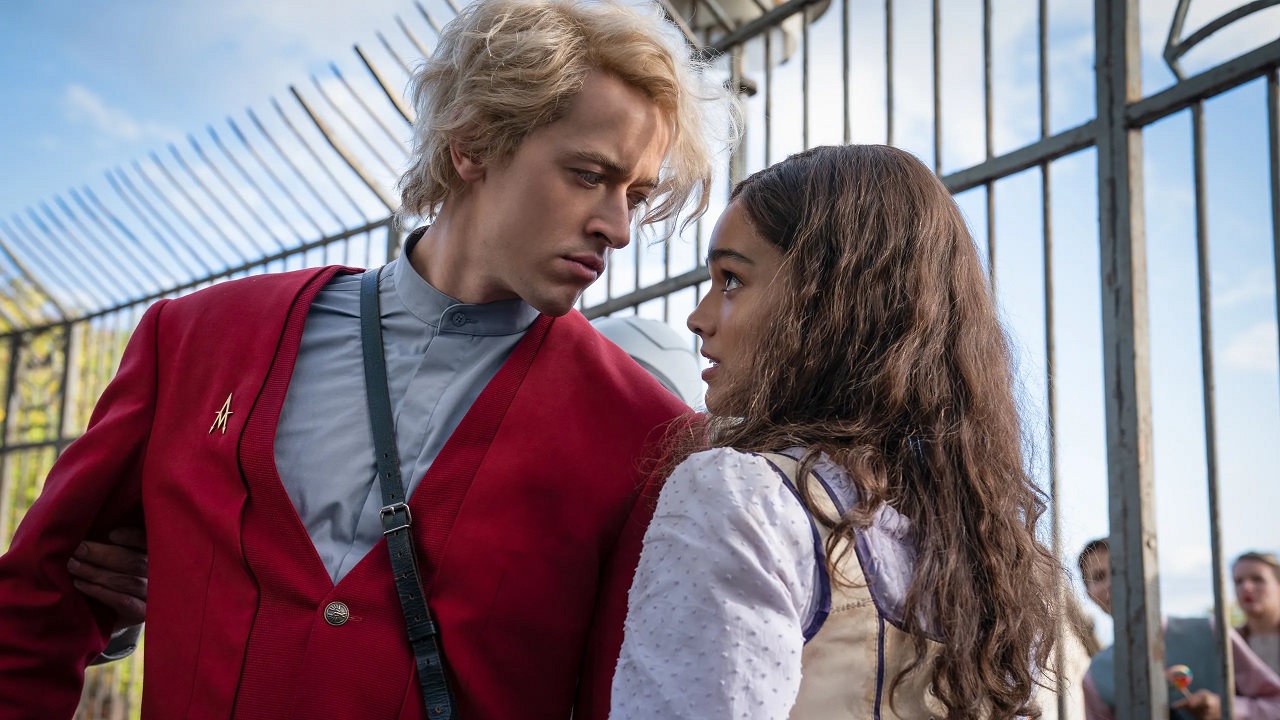
The Hunger Games: The Ballad of Songbirds and Snakes is set 64 years before the first Hunger Games film and follows Coryo Snow (Tom Blyth), president and chief antagonist during the main series, who appears to be attending some kind of Hogwarts for Hunger Games staff – despite the avalanche of exposition in this movie, but I still have several basic questions about what’s going on. The sprawling narrative is divided into three chapters. First, Snow is assigned as mentor to the District 12 tribute, Lucy Gray Baird (Rachel Zegler), whom he’s immediately smitten with; the second covers the 10th Hunger Games, in which several of his suggestions are implemented to revive viewership; and in the third, he’s reassigned as a stormtrooper in District 12, and we explore Panem for really the first time.
Structure is a huge problem here. These three legs vary hugely in quality. The first leg is a blizzard of jargon that threatens to chase you out of the theater but still gives only a vague understanding of what’s going on. I barely remember it by the time I leave the theater – I barely remember it another hour into the film – I think there was some level of detail about Snow’s family history that must have been important to book fans, but it doesn’t matter to the film at all.

Songbirds and Snakes becomes much more watchable as the blathering and namedrops I don’t recognize slouch toward a good old Hunger Games ceremony, but this is by far the worst battle royale the series has shown – well, to be more charitable, they’re trying to show different sides to the ceremony than previous films had focused on. There’s a ton of effort and prestige, but no coordination.
Shots in the arena expand from glorious 2.39:1 anamorphic widescreen to slightly more glorious 1.90:1 IMAX, or maybe equally glorious in a slightly different way. It’s technically bigger, and the name “IMAX” is much bigger in marketing material, which was more the point – it certainly doesn’t serve the film. The Games are set in a massive, drab, dusty beige arena, and fights within it suddenly take on Kingsman-esque camera movement, constantly zooming in and out and wrenching along with the action. What you end up with is a ton of negative space, negative space the film has deliberately added to by widening the aspect ratio for these sequences, and this nauseating, jarring camera movement that wants to be more violent than a fight that’s taking up maybe 20% of the screen.
Songbirds and Snakes is at its best in its third leg. Four and a half movies in, it’s the first stretch of the entire series where everyone isn’t preparing for a Games immediately on the horizon, Snow’s been demoted and his hopes have been dashed for anything other than bedding Baird, and we get to stew in this police state with no end in sight. You can tell this is where the film really wants to be, this slice-of-life cruise through District 12 full of horny young cops and miners, relieved to have survived another year, celebrating the impoverished life they have while dreaming of a better one, like a 23rd Century American Graffiti.
Not only is this where the film becomes the slutty little CW show it always wanted to be, this is where the film breathes. For all the pipelaying in the first act, this third act is where the emotional groundwork is laid, and you get the constant fear of living under and enforcing the poverty of this regime. The paranoias and conflicts that emerge here seem to do so almost by accident because the day-to-day status quo is so untenable.

You generally appreciate a movie that gets better as it goes along, but while Songbirds and Snakes rises in quality, it does not rise in action, and the flow is still a letdown. This third leg needs to be placed at the beginning somehow – really, it needs to be the entire film – so the action ramps up toward the Capitol and games instead of away from it.
What’s happened is they’ve Fantastic Beasts’d The Hunger Games series. “The Hunger Games” is one of many prominent young adult book series that followed in “Harry Potter’s” wake, and it followed the same path to the silver screen – the first Hunger Games film came out a year after the mainline Harry Potter films wrapped up. This was 2012, the year of The Avengers and the Lucasfilm purchase, when studios were suddenly scrambling to find franchises to compete with Disney’s stable of properties that could reliably scare $1 billion per entry, and as part of that scramble, Warner Bros. eventually went back to Harry Potter, which was still on an upswing when the main series ended, with the spinoff Fantastic Beasts and Where to Find them series, and we really don’t need to say any more about how that’s going. Lionsgate is doing the same thing with The Ballad of Songbirds and Snakes.
Searching for a way to maintain connection without any plot threads, The Fantastic Beasts series leans heavily into the music, effects, costume and set design aesthetics established in the main Harry Potter series, and we see this in Songbirds and Snakes as well. The main course here is expanding on the visual bible that was written to realize the prior books – and to be fair to all films involved, those bibles were written lovingly, and the spinoffs deliver on them vividly.
Songbirds and Snakes is the first Hunger Games movie to be shot digitally. The prior installments were shot on 35mm film. These movies need desperately to be shot on film, and they need plenty of handheld camerawork that’s also largely missing from this prequel. The pipelaying, all the blathering on about fictional histories and speculative moves forward that I’m sure will mean more to people who follow the series more closely, needs to be removed, because the movie can’t be about the details of this fictional world, it needs to be about the horror of it.
Songbirds and Snakes has the costumes and sound effects, but it’s taken them out of these brutal, harshly beautiful films where every moment felt like impending doom and reset them in a teenage rom-dram, and what’s left? The perfect hairlines and elaborate makeup that used to be symbols of everyday wealth inequality are now just pretty things on a big screen. It means so much less.

The biggest thing this film is missing, of course, is blood. The first kill in the film is a broken bottle to the throat, a stab wound with a hole for blood to spurt out of built into the weapon, clear glass eager to refract that evil shade of red. The attack is shown in graphic detail, and when no blood comes from the wound at all, it’s almost more horrifying. Is she not a man? Does she not bleed? The actress, Lilly Cooper, is screaming and crying and hyperventilating and putting her all into fleeing from the fact that she will die in moments, and she looks like she could get up and walk off!
Bloodless violence is a signature for corporatized franchise movies that can’t withstand an R rating, and Songbirds and Snakes betrays itself most deeply by exploring this battle royale concept, heightening it and everything else to try and keep viewers coming back, and making it so distressingly bloodless. Don’t worry, it’s fine, it only looks like children are being murdered – it’s all in good fun. See? Their insides are already empty.
It’s neither surprising or important than The Ballad of Songbirds and Snakes is a letdown – the whole project is a cashout, of course it won’t be a good movie. What’s interesting here is to see the steps taken when motives change from telling a good story to squeezing as much cash out of its aesthetics as possible.
Well, not interesting enough to justify watching.
Leopold Knopp is a UNT graduate. If you liked this post, you can donate to Reel Entropy here. Like Reel Entropy on Facebook and reach out to me at reelentropy@gmail.com.
 Reel Entropy