
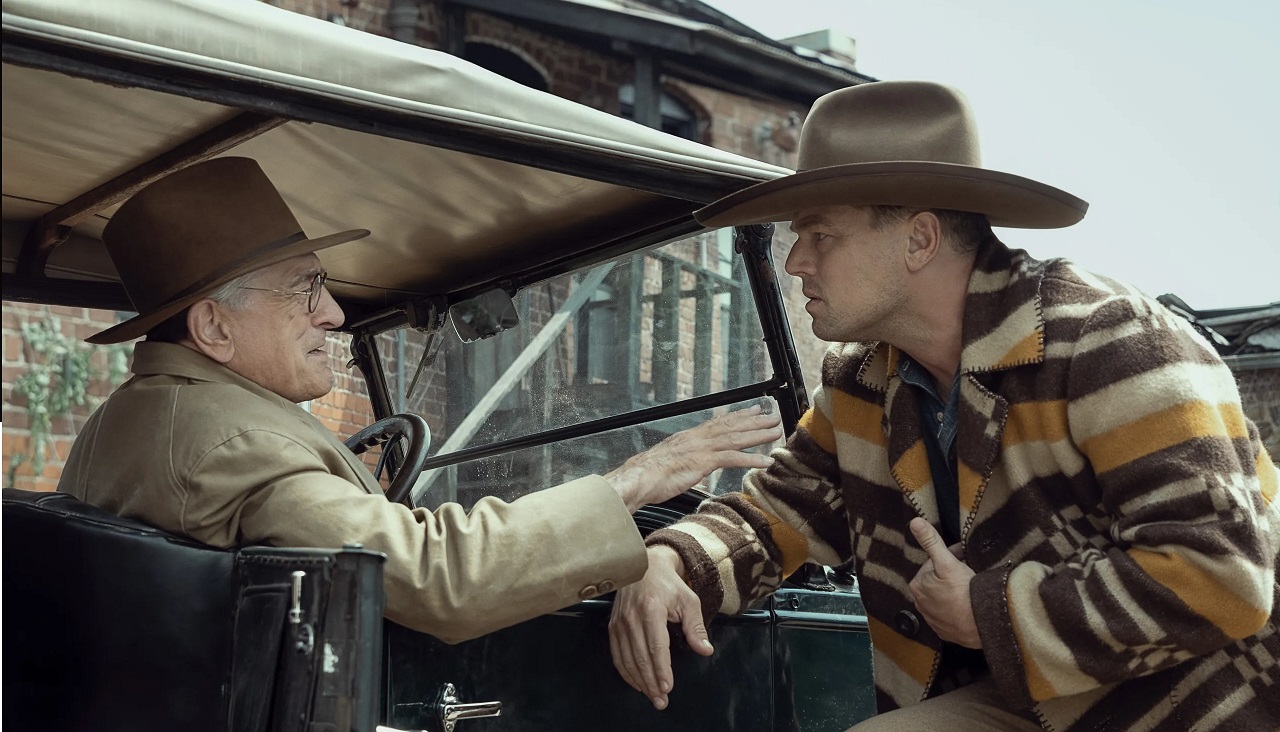
8/10 One of history’s greatest filmmakers is still going strong. Killers of the Flower Moon is everything you can expect from a Martin Scorsese picture – an emotionally driven, human look at a vital moment in history with spectacular performances, sharp editing and a pointed, direct look at the emotional truths driving the story. If it isn’t his best film, it’s certainly one of his most timely.
Fairfax, Oklahoma- Killers of the Flower Moon, based on the book by David Grann about the FBI’s first investigation, tells the story of the Osage Indian murders, which peaked from 1921-26. After being driven off their ancestral lands when Missouri and Kansas became states, the Osage Nation was one of the few tribes to buy their reservation from the government, which remains in present-day Osage County, Oklahoma, a purchase that included mineral rights. This meant that when oil was discovered on the reservation in 1906, the U.S. government’s go-to plan of just killing everyone until they left wouldn’t work. Almost 3,000 mineral “headrights” entitling the owner to a quarterly share of the Osage Mineral Estate were allotted to full-blooded Osage, each individual right worth more money than anyone could possibly spend. But crucially, until the law was amended in 1925, they could be inherited by non-Osage. De facto Fairfax crime boss “King” Bill Hale (Robert de Niro) oversaw a campaign to fuck and murder the Osage out of existence in such a way that the oil rights would flow to him, which was described as a “reign of terror” in the press at the time. At least 60 Osage were murdered or died under suspicious circumstances between 1918 and 1931, but Grann’s research indicates the death toll may reach into the hundreds.
The film enters this story through the perspective of Hale’s nephew, Ernest Burkhart (Leonardo DiCaprio, who also produces executively), a slow-witted infantry cook who returned from France with a hole in his stomach unable to do any heavy lifting. Burkhart takes work as his uncle’s go-for, coordinating with various outlaws drawn to the oil fields to carry out Hale’s various insurance fraud schemes, but also the scheme to acquire the headrights. This includes marrying Mollie Kyle (Lily Gladstone), one of four sisters, each of whom has an individual headright.
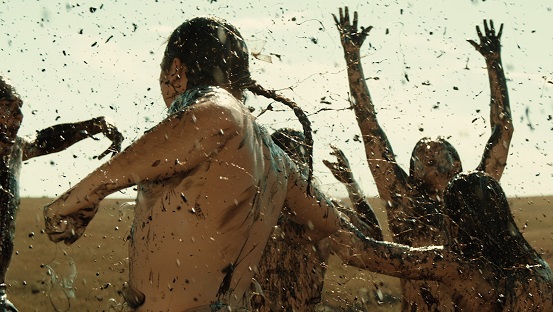
The first thing that will stand out to many viewers about Killers of the Flower Moon is its 206 minute runtime, and frankly, I wouldn’t recommend setting aside a full day for this to most people. It’s a talkie that’s much quieter and less energetic than July’s Oppenheimer, rarely leaving the Fairfax suburbs or main street, with marketing that makes it seem much more violent than it is – most onscreen violence is featured in the trailers. This is a movie exclusively for people who appreciate subtle performances in dialogue scenes and can sit through three and a half straight hours of them.
As much as Killers of the Flower Moon might benefit form shaving an hour of runtime, it’s hard to point to anything in particular to cut. Frequently, a movie that feels too long will have a character or plotline that screams for removal, but this film never drags or feels like it wanders off topic. It doesn’t feel like three and a half hours in the theater, more like two and a half. Well, two and three quarters.
The pacing and length is part of the movie’s point. It covers 11 years from the end of World War I to Hale’s conviction in 1929, and the urge is to make it feel like a decade in the dead-end oil town. Hale tells Burkhart at multiple points that this will never end, that God will never come down to stop what’s happening to the Osage, and the film’s length reflects that sense of inevitability.
On the other hand, there is one fairly early scene that feels like it could replace most of the rest of the film. Kyle, who already has Type 2 diabetes when we meet her, receives what would have been one of the first ever treatments of artificial insulin, which was first synthesized in 1921, but she distrusts and refuses treatment, sending doctors out of her home, prompting a racist shouting fit from Burkhart. The film frequently invokes a cringey-but-benign racism from white characters who have clearly never met an American Indian before and don’t know what is or isn’t appropriate to say, but in this scene, Burkhart weaponizes his dismissive attitude toward his wife’s culture, berating her and insisting that this, the newly discovered mystery fluid that must be injected by needle, is real medicine, as opposed to Osage rituals that he reductively mocks, and that she should be thankful his uncle is a mob boss who can pull strings to get it for her. This progress, the progress dictated by the science and technology of European colonizers, is the only possible progress, the only direction in which the world can move. The rest of the film reflects the seeming inevitability of European victory and also the implication that the violence it requires is just the natural way of things.
The Osage are visibly colonized by the oil workers in a campaign of marriage. Almost immediately, the field of identical interracial marriages starts to look like an episode of “South Park” as couples merge to form the same abstract colors and shapes. Blonde or dirty blonde white men with pale, thoroughly creased faces, all made into blocks by the shoulders and lapels of their beige or gray dinner jackets, stand next to dark-eyed Osage women, burnt brown skin rolling smoothly down their faces, with black hair and blankets that appear to taper down their bodies to a vanishing point somewhere below the frame. From a glance at them or their mass-produced prairie box houses, it is obvious that these are not individual couples, but a result of a systemic effort.
Killers of the Flower Moon is one of several media in recent years to focus on later phases of American genocides that have been mostly washed from history books, too recent for comfort. The Osage killings are the main subject, but Osage County extends into Northwest Tulsa, and the 1921 Tulsa race massacre ratchets up the tension in Fairfax.
It’s surreal seeing a story of American Indian genocide release just a couple of weeks after violence flared up again in Occupied Palestine, which has also seen an indigenous population forcibly taken from their homes and herded into slums. The historical straight line from American genocides to the present-day genocide of indigenous Palestinians is bright and clear, but seeing this tale of Manifest Destiny set 100 years ago while mass-murderers argue about who God promised what land to as they bomb schools and hospitals makes history seem not just repetitive, but like a broken record.

This is Scorsese’s second straight three-and-a-half hour movie produced by a streaming service, but where Netflix put 2019’s The Irishman in only 250 American theaters for a month, Apple contracted Paramount Pictures to put Killers of the Flower Moon in more than 3,600, including IMAX houses. This was announced after Oppenheimer, another three-hour long talkie from a name director that promised to blow up faces to IMAX scale, among other things, blew the doors off with its 70mm roadshow that was sold out for weeks. More art films in premium formats could be a direct result of Barbenheimer.
Flower Moon and The Irishman are both streaming properties, and streaming makes a big difference with more-than three hour runtimes. If it weren’t for the way streaming services have established “binging” as a mainstream way to consume media, this may not have even been attempted.
The new film reminds me a lot of The Irishman. They are both quiet films, focusing heavily on tense, lengthy two-person discussions, often between parties who have motive to kill each other. Killers of the Flower Moon gets more into shot-reverse shot volleys that would become quite boring with lesser performances or set design. Both films are based on true stories that concern a mountain of corpses but show relatively few of their murders, sticking tightly to their protagonists’ perspectives.
The protagonist, Burkhart, represents Killers of the Flower Moon’s biggest departure in the context of Scorsese’s filmography. The saying goes that every director makes the same movie over and over, and almost every Scorsese film is about a man with a distorted self-image who is finally forced to confront reality, in various ways and to varying degrees of success. They are often villain protagonists, but they are highly motivated villain protagonists in pursuit of clear goals, even if those goals are often intangible and emotional, and this is where Burkhart is unique. He’s a dope. He doesn’t seem to want anything, he just does what his uncle tells him, drifting on autopilot through a dull marriage and simplistic life of crime. He even seems to not realize that Hale’s been planning to kill him from the first shot.
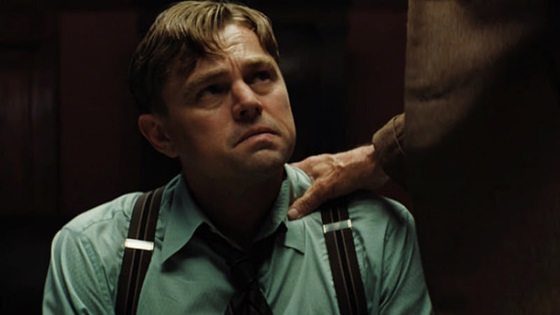
Burkhart’s confrontation with reality takes place in court as he testifies against Hale, a lapsed Catholic finally making confession. He’s shot from dead-on, with the divide between window light and shadow on his face almost exactly center frame, looking just above camera as if he is speaking directly to God. The shot rarely breaks, with prosecutor Peter Leaward (John Lithgow) sending his questions through the camera lens. Over the course of some minutes, Burkhart lays out his uncle’s requests and, after having already spent parts of three years in prison, considers the weight of his crimes for apparently the first time.

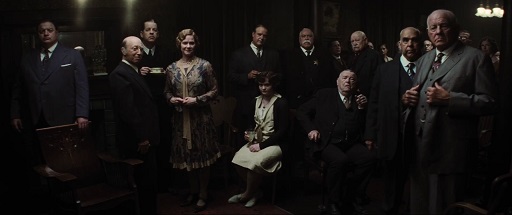
The stark, enduring image of Killers of the Flower Moon is of white men who don’t seem to understand that what they’re doing is wrong, or are convinced they won’t face consequences for it, or maybe they’re just all this stupid? The film is packed with completely buck-wild “quiet part out loud” moments – the highlight comes late when a side character asks his lawyer if it would be profitable to murder his wife’s children. He follows that up by reassuring the lawyer that he’ll only do it if it’s legal. Hale’s trial is marked by frank confessions of mass murderers, and Hale is depicted turning himself in as if this is all a big misunderstanding, having a laugh with the sheriffs he all knows by name.
This degree of disconnect is shocking no matter how many times you see it, and we’ve all seen plenty of it during Donald Trump’s time as a politician. The film routinely hits that unique feeling of watching him not only commit crimes on camera, but sometimes looking directly into the camera.
For much of these outlaws’ lives, though, getting away with it might have been a reasonable expectation. Killers of the Flower Moon is a revisionist Western burrowed into a liminal moment during the post-war economic boom, when men took off their wide-brimmed cowboy hats as they walked into suburban houses that look like they could still stand today. Arguably, the film records the specific final moment of the Wild American West when Bureau of Investigation agent Tom White (Jesse Plemons) and his posse saunter up to Burkhart’s door to announce the law will now be enforced at the federal level, not by the county offices in Hale’s pocket. Hale’s conviction was the first successful prosecution by the office that would become the FBI.
A big part of the true story that I’d have liked to see more of, though, is Prohibition. Hale relied heavily on moonshiners to do his dirty work, and a lot of the mysterious Osage deaths were from a “wasting disease” local doctors avoided diagnosing, which is thought to have been poisoned liquor. You can see them scooping booze out in ladles around campfires when Burkhart goes out into the woods to assign hits, but the illegality of alcohol, which handed a major business over to professional criminals and which stopped any legal or social means of quality control that could have prevented mass poisoning, is a major part of this story, and it should be more explicit.
Grann’s book and the initial draft of the script focused on the investigation and cast DiCaprio as White, presumably making Burkhart a minor character, but it was rewritten to focus more on the Osage and the coldness with which Hale usurped them as Scorsese and DiCaprio spent time with tribal leaders researching the film. As Scorsese’s longtime leading men, de Nero and DiCaprio, meet onscreen for the first time, it feels like a shame that it’s scenes of one manipulating the other instead of the cop-and-robber clash a-la Heat that was first written, but that’s not true at all – these two legends light up the screen every time they meet just as you’d expect. As much as I’d like to see more about the moonshine and the evolution of the FBI, it means something that they decided the Osage killings is the more important story, and that the transparency of Hale’s crimes and lack of guilt among the perpetrators was the emotion to focus on.
Killers of the Flower Moon isn’t the home run you’d hope for from a legendary filmmaker and a full day at the theater can’t be recommended for most viewers, but it’s a high-quality film telling an urgent story full of excellent performances by some of history’s greatest actors.
Leopold Knopp is a UNT graduate. If you liked this post, you can donate to Reel Entropy here. Like Reel Entropy on Facebook and reach out to me at reelentropy@gmail.com.
 Reel Entropy
Pingback: ‘Napoleon’ biopic is absolutely unhinged | Reel Entropy