4/10 Over the past six years, writer/director David Gordon Green produced the OKest, the worst and the best ever sequels to Halloween, a movie with quite a number of sequels. Its simplicity and face-value horror set off the Golden Age of Slashers overnight, dominating horror over the course of the ‘80s and remaining a prominent genre today. Now, the same team has been charged with making sequels to The Exorcist, which also changed cinema overnight and also established an entire genre of ripoffs, though with far different results, and given the wild variety in their track record, I was genuinely excited to see what they’d do with it.
The Exorcist: Believer is one of the best ever sequels to The Exorcist, and then it sneezes and suddenly becomes one of the worst. It wants to flow naturally from the mundane to the supernatural like the original film does, and it fails. Instead, it is a film split in two between a decent setup that lays the groundwork for several themes and then a crazed, strange climax that doesn’t really follow them up.
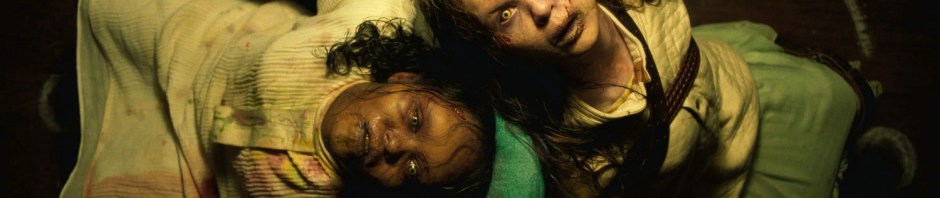
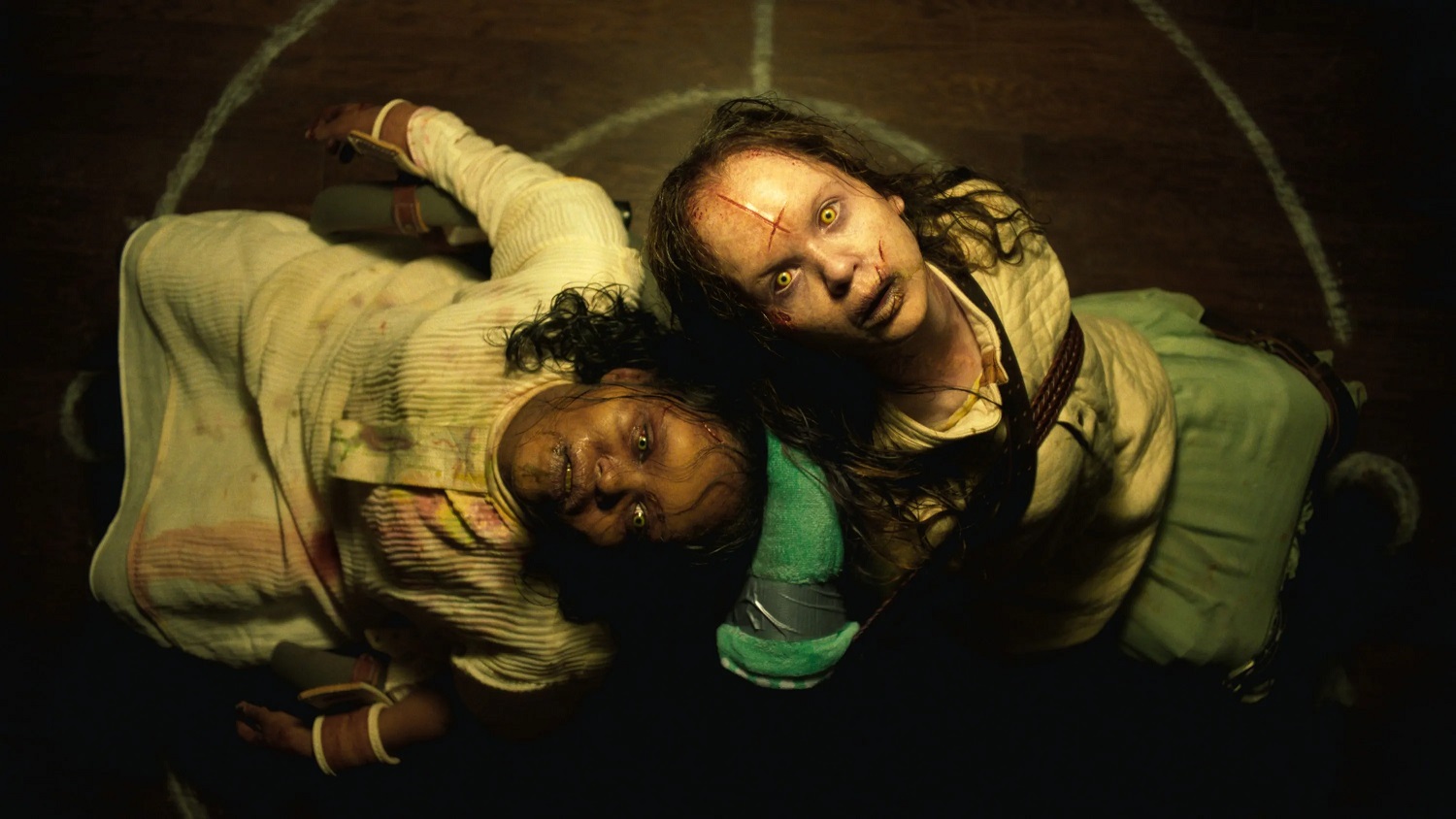
Percy, Georgia, 2023- Angela Fielding and her friend Katherine (Lidya Jewett and Olivia O’Neill) disappear into the woods outside their middle school for three days, and when they return, something is very wrong. Katherine’s parents, who appear to be high in the social order at the local megachurch, are eager to leap to demonic possession, but Victor Fielding (Leslie Odom Jr.), who was forced to choose between his wife’s life and Angela’s at the end of a disastrous pregnancy, has a very different relationship with God.
The Exorcist: Believer finds horror in the honking of car horns in the school parking lot, the sharp yell of a single father trying to convince his child to get dressed and the screech of the wind against the window at night. It is by far at its best in its mundane opening act and throughout the second act, which follows Victor Fielding trying to navigate daily life as his daughter’s condition deteriorates. Family arguments and tension as violence, all that snapping at the start of a school day, is the main theme the film will fail to follow through with.
Photography director Michael Simmonds is still attached from the Halloween team, and it’s pretty clear at this point that Simmonds is the straw that stirs this drink. The unique, dark visual texture he developed for their Halloween series immediately set the films apart, making them unique and instantly recognizable even among a sea of peers, and the compositional quality of Halloween Ends showed a marked improvement even from what he’d already done. The rich, textured photography continues to be the best part of The Exorcist: Believer, both before and after the midpoint dropoff in overall quality.
Believer sets up an intriguing racial dynamic. In the fictional town of Percy, but the non-fictional state of Georgia, the public middle school appears to be the only real mixed-race setting, everywhere else is either white or non-white. This is most obvious in Katherine’s megachurch, which she desecrates in a major set piece, but it’s maybe more noticeable in the hospital after the girls turn up, when Angela Fielding is surrounded by minority doctors while everyone treating Katherine is white.
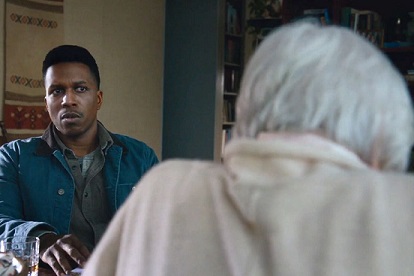
Victor Fielding, the film’s protagonist and biggest role, is a black professional photographer, and both characteristics help him blend in, both in Port-au-Prince during a prologue – the 7.0 Haiti earthquake in 2010 is what leads to his eight-month pregnant wife’s emergency C-section and death – and the Percy homeless population, who is at first vaguely suspected in the girls’ disappearance.
Like the original, the main body of The Exorcist: Believer is spent searching for an explanation as the girls’ condition steadily worsens, but where the original started searching for medical explanations before giving way to Catholicism in desperation, Believer lacks that degree of focus. Victor Fielding looks for sources of trauma, but is confronted at every turn with different potential religious explanations.
Doctors say their vaginas are undamaged, explicitly dismissing the possibility that their symptoms are in response to a sexual attack, though it seems to stick in the back of Victor Fielding’s mind. It seems like the script wants viewers to not focus on the obvious, but this is a 2023-set movie about parents worrying about their middle-school daughters on the cusp of puberty. The ever-present fear of sexual violence is inherent, not something you handwave away to think about religion more, and there are a lot of ways it could have been incorporated as subtext or a more plausible explanation – look no further than the original Exorcist for a great example. It feels like another dropped theme, especially as a follow-up to the film that gave us “Let Jesus fuck you.” This is what The Exorcist: Believer, releasing now that the Catholic church is primarily associated with sexual predation of minors, should be focusing on and updating, not steering away from.
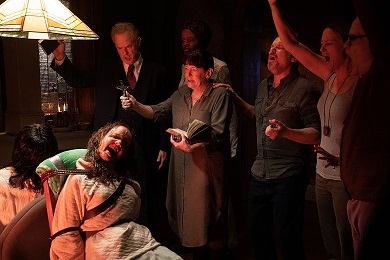
Then, somebody says “we’re going to need all of them,” leading into a bizarre climactic scene in which every character we’ve encountered gathers in the Fielding home to perform what appears to be exorcism by way of improvisational jazz. The girls are surrounded by a Catholic priest, a would-be nun who left seminary, Katherine’s minister, a Haitian Vodou practitioner Fielding knows from the prologue and their parents, all standing separately, each doing their own thing in their own shot, creating their own vibes in the hopes that the general positive energy will result in the demons being cast out.
The crucial thing to understanding Christianity, and especially Catholicism, in mass media is that pretty much everything you’ve ever heard about hell and the devil is made-up, even in a Christian context. Fan-favorite concepts like the seven deadly sins have no biblical basis whatsoever, but stick around because they help the dominant religion stay hip and popular. The Exorcist may be the most important example – the concept of exorcism was barely in the zeitgeist when it released in 1973.
The subgenre of Exorcist ripoffs over the past 50 years, each hoping to up the ante on each other leading to a rapid expansion of this branch of Catholic fan fiction, has burrowed into its conservative-skewing target audience with apologetics and jingoism, resulting in recent films like The Pope’s Exorcist, which presents the idea that the Spanish Inquisition was the work of Satan possessing a high-ranking exorcist and not something the church needs to take responsibility for, or Prey for the Devil, which imagines a secret Hogwarts-style exorcism school in the heart of Boston with its own dungeon and medical floor. Those both released this year!
So the idea for this baffling scene is that The Exorcist: Believer is escalating the genre in the opposite direction, bringing in other religions instead of expanding the virtues of Catholicism, and it just doesn’t make any visual sense. It looks like band practice than any kind of religious ritual. The idea that this disjointed scatting of nulti-flavored religious nonsense, none of which is given any weight over the others, would have any kind of organized effect feels very silly. The film denies authority to any of the presented religions or explanations for what’s happening, and not in the fun way that the original film denies answers – Believer seems almost like it’s afraid to be seen as taking a viewpoint.
The idea of picking between two lives as Victor Fielding is forced to do in the prologue is the one them Believer seems to think it’s following through on, but one choice at the beginning and a near-identical choice at the end does not a theme make. Angela Fielding has a lot of questions about her mother and it’s clearly a source of tension in their relationship, but to really execute on this, the film would need to put Victor Fielding in more of these situations, and much more importantly, it would need to relate other characters to this theme. Katherine’s parents and most of the exorcists are all completely off in their own worlds, not just in the scene but from the moment they’re introduced, and when the possessed girls start taunting Victor Fielding about what happened in Haiti, nobody else even knows what they’re talking about. If this is the main thrust of the film, why are they even here?
I want to like The Exorcist: Believer for the photography, the editing and the performances, but the truth is the rest of the film is just as disorganized and afraid to say anything in particular as its climax.
Leopold Knopp is a UNT graduate. If you liked this post, you can donate to Reel Entropy here. Like Reel Entropy on Facebook and reach out to me at reelentropy@gmail.com.
 Reel Entropy