

7/10 After the breakout success of 2018’s multidimensional animated adventure Spider-Man: Into the Spider-Verse, its sequel was lined up as one of the most hotly anticipated films of 2023, and boy does Sony know it.
New York City- Gwen Stacy (Hailee Steinfeld), tired of secretly fighting her police captain father as Spider-Woman and hearing constant abuse from him within the home, runs off to join a society of multi-dimensional spider-people. For months, she’s told to avoid Miles Morales (Shameik Moore), who is similarly isolated as his school and puberty ramp up, but he remains isolated from Stacy and their spider-friends from the prior adventure. When a dimension-hopper native to Morales’ own universe, a villain calling himself The Spot (Jason Schwartzman), begins moving through other dimensions to consolidate his power source, Morales gets sucked into the spider-society himself, where he’s faced with more experienced spider-people bent on enforcing the tragic spider-narrative.
Obviously the animation is excellent. I love animation for this concept of a multiverse, and I love how far the Spider-Verse movies push everything. Everything Everywhere all at Once, Dr. Strange in the Multiverse of Madness and the other Marvel movies that are dicking around in the multiverse usually feel like they don’t push the concept far enough, and there’s going to be plenty of movies like Spider-Man: No Way Home and The Flash where it’s all just an exhausting load of jargon to get legacy actors back onscreen. These movies push the concept almost too far, which is how it should feel. This should be overwhelming and kind of hard to keep track of.
On the other hand, it’s overwhelming and kind of hard to keep track of. As much as I love the idea of this movie, I find myself checking out as it wears on, especially as we stay in some settings too long and as the plot becomes more self-referential and predictable.
There’s not a whole lot of the “five movies at once” animation explosion that we saw in Into the Spider-Verse. Hobie Brown (Daniel Kaluuya) is the only character we see who’s the type of wild departure from everyone he’s sharing the screen with that characterized the first film. We spend a lot of time in Stacy’s dimension, where the backgrounds all seem to be progressively abstract watercolor paintings.
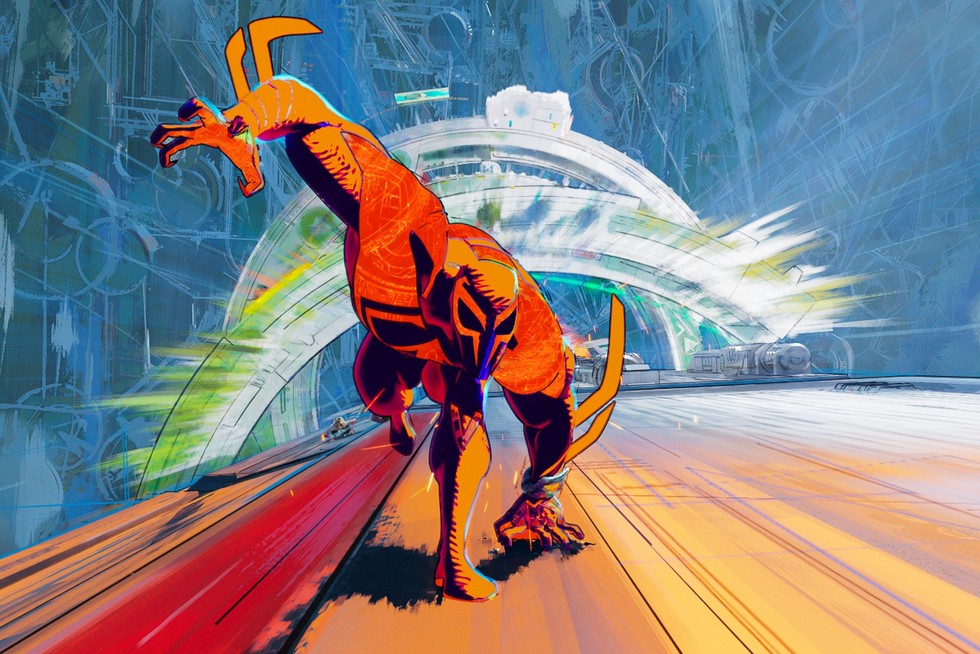
Spending the first 20 minutes or so with Stacy and those watercolors feels like a bad omen, but really it was an extended prologue before we get into the dimensions that have real backgrounds. I see it now as a terrific expression of her particular setting, but the real problem it reveals is pacing. Between her opening act and Morales’ opening act that immediately follows, it feels like the movie has about 40 minutes of prologue, and then we spend what feels like another 40 minutes past its obvious cliffhanger ending setting up the next movie.
Two sequels to Into the Spider-Verse were greenlit at the same time and look like they shared a production schedule – they were initially announced as Spider-Man: Across the Spider-Verse part I and part II, though the third movie has been retitled Spider-Man: Beyond the Spider-Verse – so everyone should have been prepared for a cliffhanger here. There was a great deal of vocal dissatisfaction about that, but again, the real culprit is pace. A 140-minute runtime is fine, but not when you spend the first 40 waiting for it to get started and the last 40 waiting for it to wrap up.
There’s plenty of applause breaks a-la No Way Home, with footage from live-action installments and meme moments. Footage from the exact same live-action movies and references to the exact same memes as No Way Home, actually. It’s a very shallow pool, and Sony, responsible for the Amazing Spider-Man debacle and still clearly expecting every spider-movie to be its last, has dove all the way into it twice in a row now.
The Spider-Man meta-narrative and the way viewers have seen it repeat across multiple interpretations in quick succession is the film’s main subject – Miguel O’Hara (Oscar Isaac), who organized and leads the spider-society, sees the narrative as holy, believing that the specific Spider-Man process of losing at least one father figure is necessary for every spider-person to become a hero, and his organization enforces those losses “for the greater good.” The idea that heroism requires tragedy is nextdoor neighbors with ideas like “morality comes from God” and that all artists must be depressed because that aligns with the trope, and I’m sure Beyond the Spider-Verse will get into how flawed the thinking is, but it’s strange and a little alarming to look back on the past 20 years and see what was once a simple story about a guy doing his best even though things didn’t always work out for him so compounded and compacted into this meta-narrative that O’Hara wields like a cudgel.
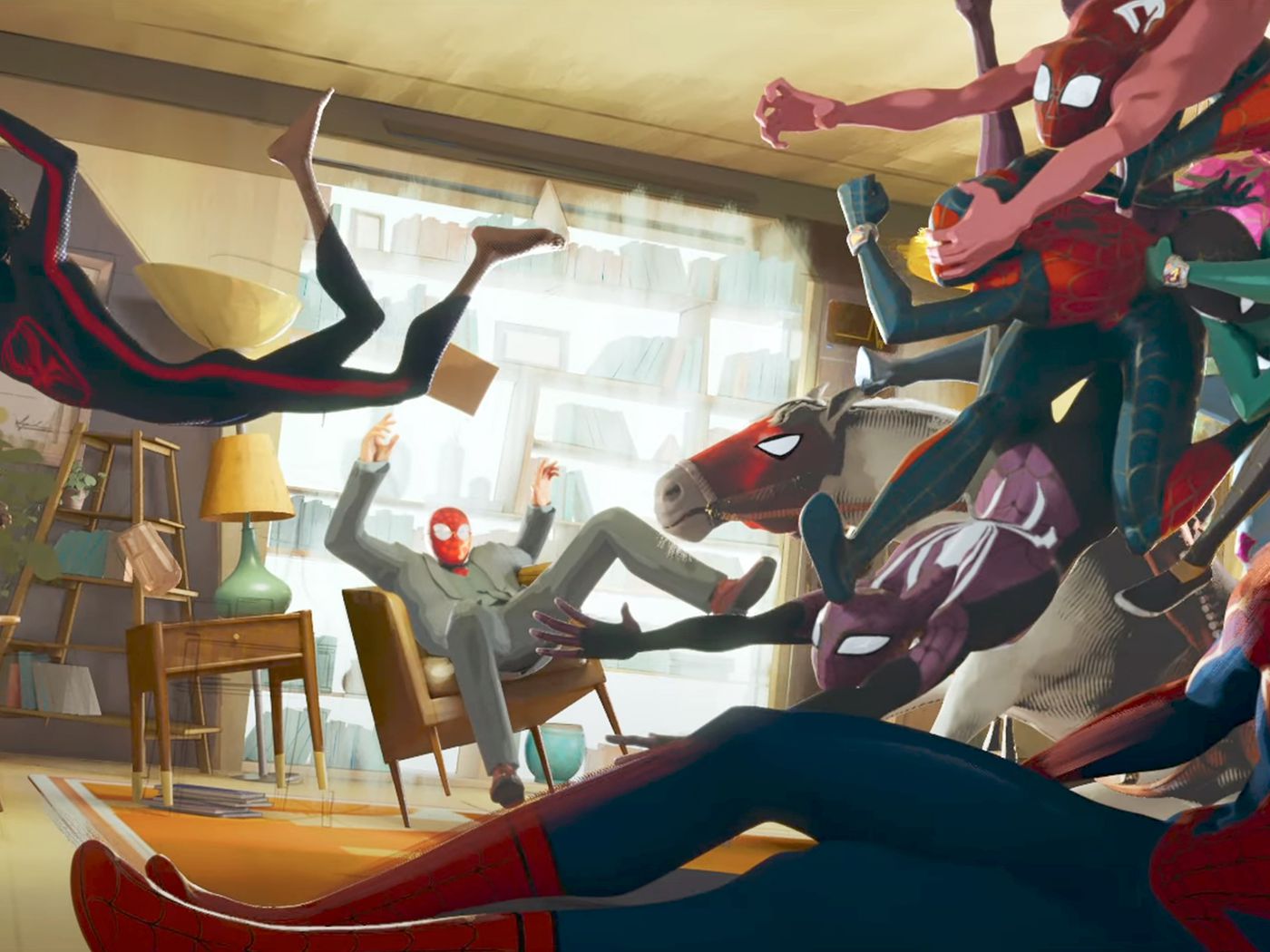
These Spider-Verse movies focus heavily on identity, with Morales doubting that he is capable of being Spider-Man and also resisting all the prescribed narratives of his life as a black teenager in America. Now in Across the Spider-Verse, he finds that not only does he have a tragic destiny, there’s an asshole sitting in another dimension fighting to enforce that tragedy and the prescribed life of a Spider-Man upon him. This manifests in just about every climactic moment when Morales uses his camouflage and “venom strike” abilities, which are unique to him among all spider-people, to get the best of his peers.
The film released with plenty of noise about how its 140 minute runtime made it the longest animated movie from a, I don’t remember but there must be some lawyer-speak caveat to that given that it’s shorter than both Avatar movies and plenty of mainline Marvel offerings, which are mostly animated at this point. That circulating bit of public relations is the real indicator about the film – it’s obvious self-aggrandizing bullshit, and as fun and high-quality as Across the Spider-Verse is, that’s the throughline of all the differences between it and its predecessor.
Ever since the MCU got rolling, Sony has been clutching the Spider-Man property it maintains from purchasing the film rights in the ‘90s like stolen diamonds trying to spin it into a comparable cinematic machine, and with these Spider-Verse movies, they know they have a winner, a real winner with critical acclaim coming off a Best Animated Feature Oscar, not like the trashy anti-hero movies that feel like they may drop off a cliff at any moment, so they’re preening. They’re bragging about the scale of the film, even when the scale is obviously a problem.
Across the Spider-Verse and the behind-the-scenes behavior it entailed test the patience, and Beyond the Spider-Verse is in danger of breaking it if it has the same problem.
Leopold Knopp is a UNT graduate. If you liked this post, you can donate to Reel Entropy here. Like Reel Entropy on Facebook and reach out to me at reelentropy@gmail.com.
 Reel Entropy