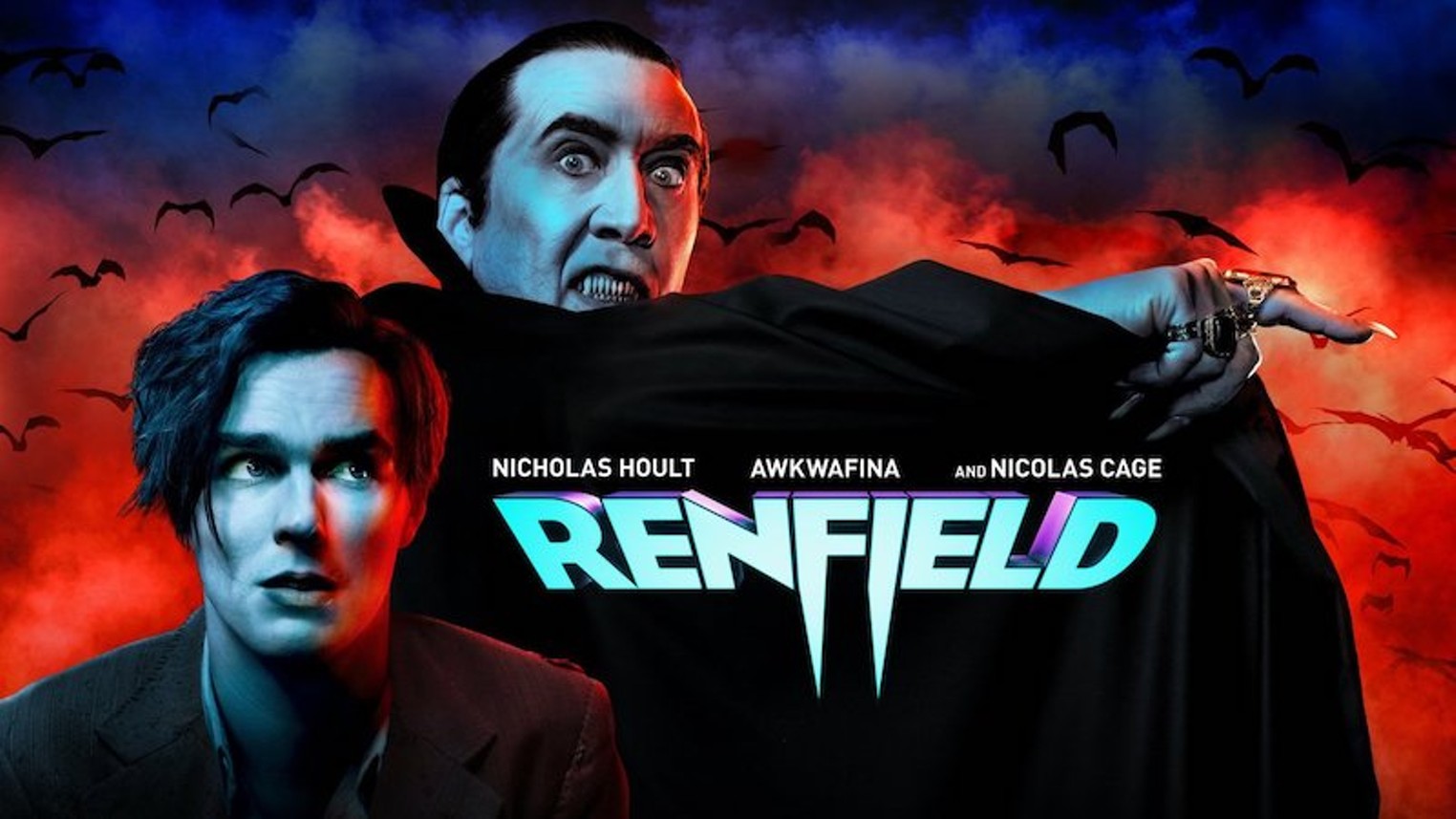
2/10 Renfield ranges from boring to completely unwatchable aesthetically, and it expresses an incredible hatred of its own characters that’s deeply angering to watch play out.
New Orleans, present day- After traveling the world, sucking as much as he can out of every city until he’s finally driven out, Count Dracula (Nicolas Cage) has settled in the Charity Hospital that was abandoned after Hurricane Katrina in New Orleans with his familiar, R.M. Renfield (Nicolas Hoult). Renfield has also been sucked dry and is looking for a way out, but he keeps using the powers granted to him by Dracula to bring Dracula people to eat due to a combination of his own inertia, apathy and lack of self-respect and active manipulation by the vampire.
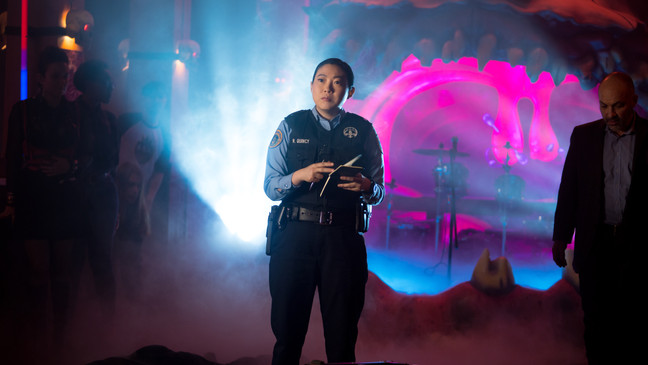
Also, a significant amount of the scant 93-minute runtime is dedicated to the Lobo crime family, and the mother and son play out a similar relationship to Dracula and Renfield’s, and also there’s a traffic cop whose father was killed by the Lobos because he was the only honest cop on the force, and she’s got a grudge, and, what? We’ve got a vampire, not just any vampire but Dracula himself played the greatest actor who ever lived, and we need this drug dealer plot, why? The way Tedward Lobo (Ben Schwartz) is used as a foil for Renfield turns out to be one of the better parts of the movie, and that’s not a compliment.
The movie filters the drama of leaving a toxic relationship through several shorthand lenses, but mostly the lens of a shitty Marvel movie – which is what Renfield is. Everything is blasted with teal and orange light, the antagonist is a costumed supervillain, thugs in Chuck E. Cheese masks try to knock over Mulate’s at one point segueing into one of the film’s signature terrible action scenes, which also take their cues from superhero movies. It’s gross. It’s an off-brand Marvel movie, which is to say it’s an off-brand version of a product that’s sold entirely on brand recognition and it takes aesthetic cues from a series that’s designed to have as little aesthetic as possible. It sucks. I hate it. Boooo!
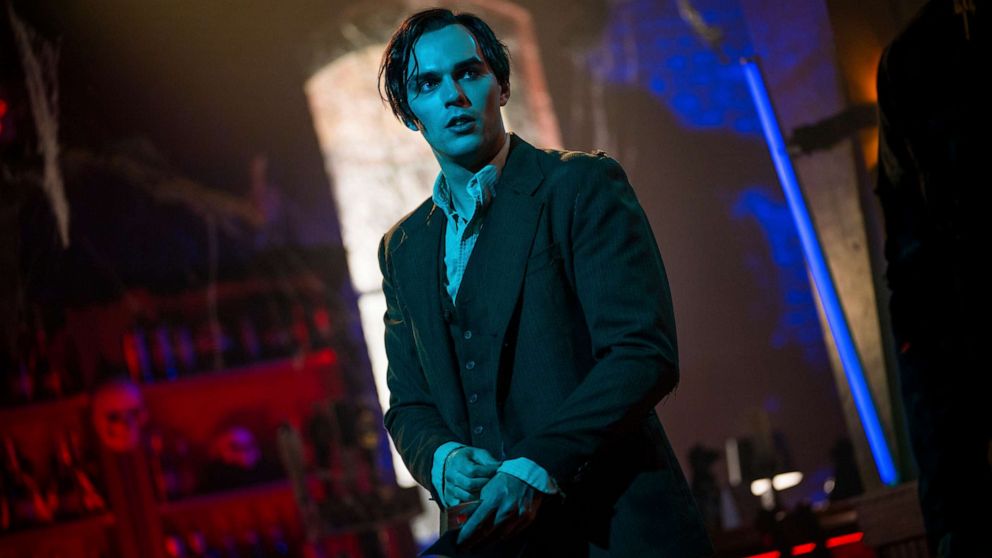
Other aesthetics at this strange party include addiction imagery, as Renfield spends time at Co-Dependents Anonymous meetings, and professional wrestling. There are so many dramatic power reversals – Renfield’s on the mat, then he’s on top, then he’s down for the count again, then he’s mugging for a Hallmark movie montage and getting new clothes and his own place to start a new life as a strong independent woman, that it starts to take on that phony WWE structure, where every moment is peak drama and I lose all interest in who might win. Even watching the struggle is boring because the blow-by-blow feels so scripted.
Part of the reason the Lobos are here is so Renfield can break into some of the worst action scenes ever put to film. How Dracula’s boon works is, every time Renfield needs to kill someone, he eats a bug and becomes Neo for a short period of time. Instead of creating this effect by hiring talented choreographers, grips and martial artists to work out something amazing, it is simulated with a suddenly hyperactive camera that barely captures Hoult’s stunt double doing a long sequence of flips that appear to do nothing, but result in the death of his enemies.
It’s completely unwatchable. Every time Renfield drops into this camerawork, it’s like the movie has hit an “eject” button and sent me flying out of the theater so suddenly I’m too surprised to scream. If everything else about the movie were perfect, the action would still hold it down in F- territory. It’s that bad.
Hollywood is a copycat industry, and Renfield certainly isn’t the only movie aping Marvel, but it does so extremely poorly in a way that betrays how delicate that aesthetic really is. It starts to remind me of Sony’s imitation Marvel products, the Venom movies and Morbius, which attempt to heighten MCU hallmarks and get really goofy really quickly in the process.
I’m not thinking of a specific individual Marvel movie that directly eclipses Renfield, but they all have elements of toxicity, including Iron Man’s early-series alcohol abuse and the combination of love and distrust Thor and Captain America feel toward Loki and Bucky Barnes. Captain Marvel addresses abusive relationships though the lenses of sexism and gaslighting, but that may be too narrow to overlap.
Renfield was intended to be even more of a Marvel knock-off than it ended up being. The film is recycled from Universal’s ill-conceived “Dark Universe” series, which aspired to make an MCU-style crossover series with Universal-owned Golden Age movie monsters before it fell flat on its face with 2017’s The Mummy. It would be the only film to release under the “Dark Universe” banner, but work on other legs of the project have been recycled in to 2020’s spectacular The Invisible Man and the much less spectacular Renfield. We’re not sure if that Bride of Frankenstein remake is ever going to happen or not.
As a piece of shrapnel from this series, it’s hard to point the finger at anyone in particular for how awful the movie ends up being, but that’s also because it’s hard to find anyone who was really pushing this through. Director/producer Chris McKay, the second director attached to the project, is executing Ryan Ridley’s screenplay that was ready three years before production, and Ridley was executing a pitch made by comic book writer Robert Kirkman that was made a couple of years before that. Renfield wasn’t pushed through development hell by dedicated artists who loved it, it was shelved for years at a time and picked up again whenever money came free after whoever was last working on it had already moved on, and it feels exactly like a product that slipped and fell through several different hired hands onto the screen.
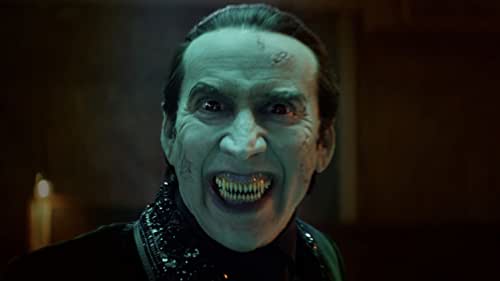
The aspect of vampire mythology that Dracula requires explicit invitation to cross any threshold is emphasized as Renfield pauses to wonder how he arrives in every scene. It nicely echoes the notion of abusers needing invitation to enter a victim’s life and the guilt that engenders, and it also forces Dracula to be a charmer. We’re introduced to him through Renfield’s description of him as a parasitic monster, and we first see the character covered in burn scars from a recent slaying attempt, but this element of his curse forces him to show us how he gets people to let him in.
Nicholas Cage is giving 120%, as always. I’d prefer to see him without the hunched back and toothy accent that he’s trying to do, but he does what he wants. Schwarz is loving life as the young Lobo, subtly giving the second-best performance in the movie walking his character’s inferiority complex all the way from constant fear to a boiling insecurity in his role as Dracula’s new familiar. Schwarz is able to put these layers into his character without any narrating or Hallmark movie montages, just precise choices with his face and line delivery. Good old-fashioned acting!
I want to come down on Renfield for being a fundamentally weak person and trading his principles for power, but that’s not fair – in fact, it’s so unfair that Dracula uses this argument as a tactic to get Renfield back under his sway. Renfield’s real failing is his inability to accept responsibility for his choices, which stops him from exiting the relationship because he can’t sort out where Dracula’s culpability stops and his own starts, and this is what Dracula is preying on directly in the scene. He relies on Dracula for power and immortality, but also as someone he can blame for his circumstances, his crimes and his shitty attitude. In his introductory narration, Renfield describes his hobby of going to CoDA meetings and using his powers to hunt the people attendees identify as their abusers, something he does explicitly to assuage his guilt without having to acknowledge that what he’s doing is wrong or that he has the power to stop doing it.
In this way, Renfield takes a nuanced and incisive approach to both abusive relationships and why they’re so hard to leave and to co-dependent people and why they fail to leave such relationships, and it does this entirely by accident. This interplay of shortcomings is framed as entirely Dracula’s fault. Renfield’s character arc is to simply start telling himself he deserves more, as demonstrated by treating himself to a Hallmark movie shopping montage. In its climactic moments, we get so far as “there are more Renfields in the world than Draculas” as if people with co-dependent tendencies are a proletariat of perpetual victims who must rise up against the narcissist class – no war but the toxicity war! It’s an absolutely ludicrous salad of psychological concepts that demonstrates an active lack of understanding of the film’s own characters.
It feels like the point is to preen for an audience of “Renfields,” people who feel like they can put themselves into this relationship, which is a cute trick given how important framing oneself as a victim has become in the era of social media. Just about everyone who’s had a relationship of any kind end in the past 15 years carries with them a list of reasons why the other party is solely to blame – “more Renfields in the world than Draculas,” indeed. In Renfield, this is not a horrifying result of technology allowing everyone in the world to cast themselves as the main character of a self-curated drama, but as aspirational. Renfield’s allergy to accountability and self-improvement isn’t a personal failing that damns him to service, it’s a truism about humans that everyone in the audience can sympathize with, and every negative consequence that comes from it is completely Dracula’s fault.
Watching the film aim itself directly at this complex relationship only to handwave it away feels like not just a personal insult, but an insult to everyone watching it, but that’s nothing new for Renfield – from the first few frames, it already felt like an insult to everyone watching it.
Leopold Knopp is a UNT graduate. If you liked this post, you can donate to Reel Entropy here. Like Reel Entropy on Facebook and reach out to me at reelentropy@gmail.com.
 Reel Entropy