
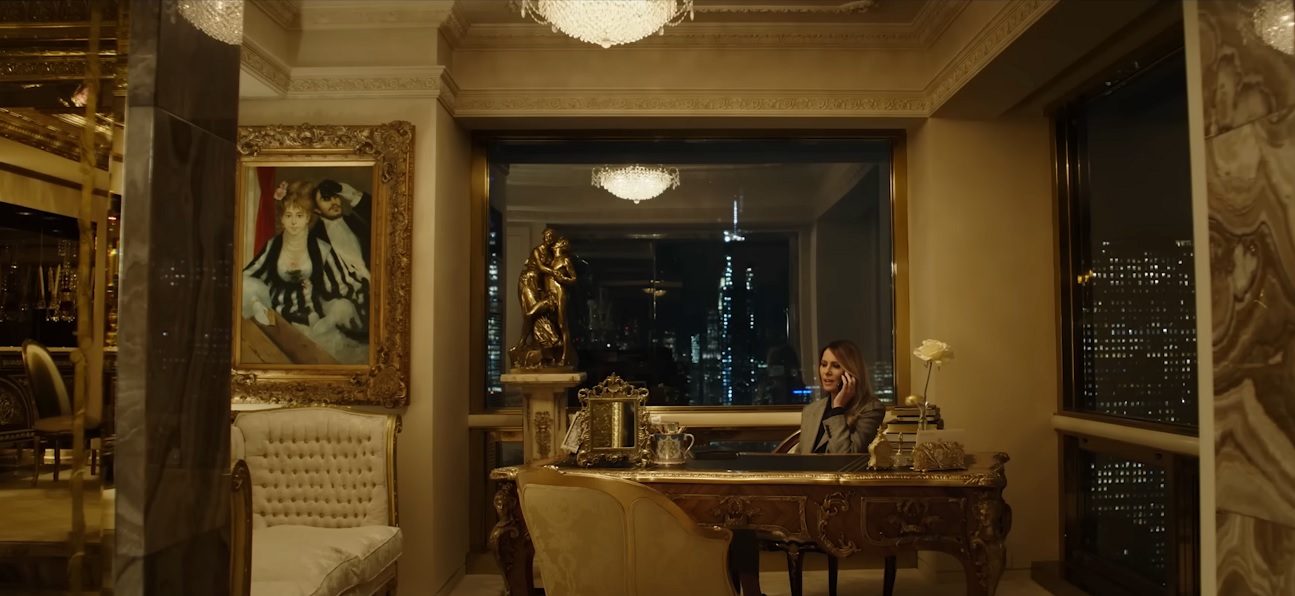
The only sequence in Melania that threatens to expand into a watchable narrative with conflict and stakes appears suddenly through the morass of extended scenes of nothing happening. Former president Jimmy Carter has died, and Melania Trump, credited as star and producer in a documentary named after herself, faces a personal crisis. His funeral, which Trump must upend her schedule to attend, falls on a painful anniversary for her, and she must publicly grieve for this stranger while privately facing her own demons.
The film is referring, of course, to Jan. 9, the anniversary of her mother’s death. What? Did anything else happen in early January in recent history that might be an uncomfortable memory for Trump?
Melania is an expansion on Trump’s October 2024 memoir, also titled “Melania,” which was, reportedly, in line with how the First Lady is often perceived – self-sheltering and selectively empathetic to the extreme that she can guiltlessly coexist with her husband. Caught between the apparent desperation for usable footage and the multiple pairs of blinders the film must keep strapped to its face, Melania raises itself to the level of a new form of cinema – the cinema of omission.
The documentary follows Trump as she flies back and forth between Palm Beach, Florida, New York City and Washington D.C. in the 20 days leading up to inauguration, opening a window into her stress-filled fairytale life of trying on clothes and picking out furniture surrounded by old, flamboyantly queer New York men – such as her husband, President Donald Trump.
“Follows” is a painfully literal descriptor. Melania was shot over 20 days on two months’ notice, and many of its funniest moments come from the obvious fact that they didn’t get enough footage. The documentary opens with a tracking sequence following Trump from Mar-a-Lago all the way to Trump Tower in New York through various private cars and planes. There are more sequences like this throughout as we get closer to inauguration, and even when the scene isn’t shifting, what you’re watching is someone following her around with a camera.
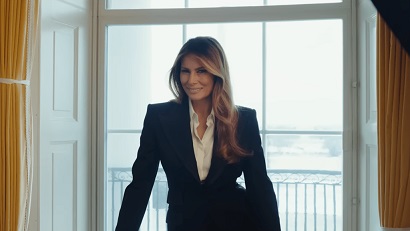
Get ready for a whole lot of B roll.
Melania is likely the most obvious example of state propaganda in U.S. history, but that isn’t so simple to assess. When you think about a propaganda film meant as a direct message from government to population, it’s usually something like Triumph of the Will, which was conceived and funded entirely by the Nazi government. This is convenient for most other countries with film industries that are already heavily nationalized before taking an authoritarian turn, as opposed to the American film industry, which is driven by private venture. Similar elements in American cinema like tax incentives for shooting in a particular state or military input in exchange for military participation mostly take the form of public-private partnerships, not a from-the-ground-up government initiative.
In Melania, money flows in the opposite direction. After publishing “Melania” and her husband’s reelection in quick succession, Trump started a bidding war for the rights to make this. Disney, Netflix and Paramount Pictures, all of whom have offered transparent bribes to Donald Trump in other ways so he’ll approve various mergers and acquisitions, all bid, but lost out to Amazon’s offer of $40 million, $28 million of which reportedly went straight into Melania Trump’s pocket. The film has been described as another big fat bribe.
Melania is an ambitious and often snazzy filmmaking exercise, but not an impressive one. Everyone involved is used to being surrounded by cameras, and though cinematographers Barry Peterson, Dante Spinotti and Jeff Cronenweth frequently find terrific compositions, there’s a whole lot of scenes of nothing happening and just as many awkwardly composed shots of stammering and poorly scripted dialogue.
Melania is remarkable not in how sanitized it is, but in how many things it is obviously sanitizing. The documentary constantly bumps up against the realities of everything Trump must studiously look away from and how deeply unpopular she and everyone around her are. The Zone of Interest, Jonathan Glazer’s fly-on-the-wall masterpiece about the wife of Auschwitz commandant Rudolf Höss’ idyllic life on the corner of the concentration camp, is a decent comparison, as the documentary-style film delves into the evil that Melania can’t help but display in passing.
Scenes in this narrative with a foregone conclusion and no real conflict include Trump trying on clothes, talking about who introduced her to whom and singing along to “Billie Jean,” all scenes that last some minutes in this hollow experience. In one scene, Trump coordinates White House interior decorating with a Laotian immigrant, who describes the moment as her realizing the American Dream. Trump echoes this thought as she becomes First Lady for the second time, urging viewers in voiceover to fight for our rights.
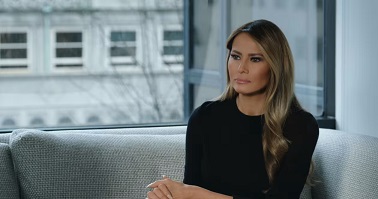
The biggest thing we learn from Melania is how significantly her poor English contributes to her quiet reputation. She’s reputedly fluent in five or six languages, but after 30 years in the U.S. surrounded by her English-speaking family, she still struggles to find words, often appearing to sound sentences out in real time. Spouse of the President of France Brigitte Macron and Queen Rania of Jordan both quickly speak circles around her as soon as they appear onscreen.
Learning a new language is an immense task, and immigrants can often appear less intelligent due to discomfort with their new country’s tongue. This can lead to avoiding social interactions, limiting themselves to only communicating simple ideas and generally letting it ruin their confidence, all symptoms we’ve seen from Trump during her time in the spotlight. Her thick accent and sometimes shaky grammar makes a documentary that she narrates rough to watch, but it’s no reason to think less of her or snatch her into an unmarked van.
Just about everything weird about Melania screams that they don’t have enough footage, and the depths to which the documentary sinks to drag itself to 104 minutes make it frequently hilarious. The most surreal technical tell is covering shots of people talking with Trump’s narration – shots in which other people are speaking and framed as though we should be listening, but Trump’s disembodied voice telling you how she feels while she’s listening to them plays instead. This only happens a couple of times, but they’re shocking moments, putting us directly in Trump’s head so we can experience first-hand how little regard she has for anyone else. Given the shot choice, it seems less like the intent and more like something was wrong with the audio and they couldn’t cut around it because they don’t have enough footage. There are several sudden ugly compositions early in the film, and closer to inauguration, someone gets a hold of a Super-8 and they jam that in, also presumably because they don’t have enough footage.
All of the documentary’s lacks come together for its funniest moment, when Trump interviews two candidates to join her staff. This is edited right after the trying-on-clothes and talking-about-furniture sequences as the last part of a busy day, though they all explicitly take place days apart. Trump says in voiceover that she must interview multiple candidates as the footage cuts rapidly between two women, neither of whom get significant dialogue, for some minutes, as if trying to convince viewers through sheer force of cutting that this day consisted of several interviews.
This is immediately followed by a scene of her telling her husband, months earlier, that she didn’t watch his electoral victory because she “had meetings all day.”
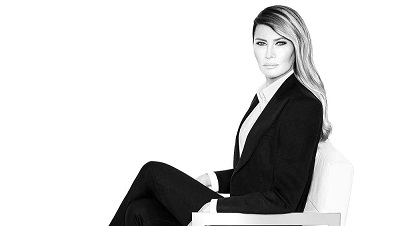
Trump’s husband, Donald, becomes more of a character as the film nears its climax, and I’m glad I got to see this in a theater, because a packed house of who I assume to be Trump supporters bursts into uncontrollable laughter every time he’s onscreen. The Donald has been mocked mercilessly since entering politics, and though he’s a bumbling comic relief character who can’t stop talking about himself in Melania, the film is less mocking and more humanizing, an oafish but affable and presumably loving husband. His obvious selfishness softens Melania Trump’s implicit selfishness, and he steals every scene in that special way that he does.
The commonality of Trump supporters is not just ignorance, but a virulent anti-intellectualism. Be it the realities of climate change, Palestinian genocide or the contents of the Epstein files, they desire to not only be empty of information, but for the information to no longer exist. They want people to stop telling them about it. Melania sells the simplistic reality they wish they were living in back to them, proactively presenting a world where only the things in your line of sight matter.
The documentary is profoundly self-centered, which is OK to a certain extent – we all have the interior life that Trump describes – but it becomes shocking contrasted against the brutal violence and brazen corruption, corruption this very film is a part of, of the second Trump administration. In Melania, it’s even more shocking when that contrast is meticulously omitted.
It is the cinema of someone who knows she profits from the suffering of millions at the center of a global fascist movement that is scrambling to burn through as much of a dying planet as it can before it fades out, but who powers through that background noise to focus on her prescribed role – trying on clothes, meeting other powerful men’s wives and being photographed next to her husband.
It is the cinema of someone who doesn’t really care.
Leopold Knopp is a UNT graduate. If you liked this post, you can donate to Reel Entropy here. Like Reel Entropy on Facebook and reach out to me at reelentropy@gmail.com.
 Reel Entropy