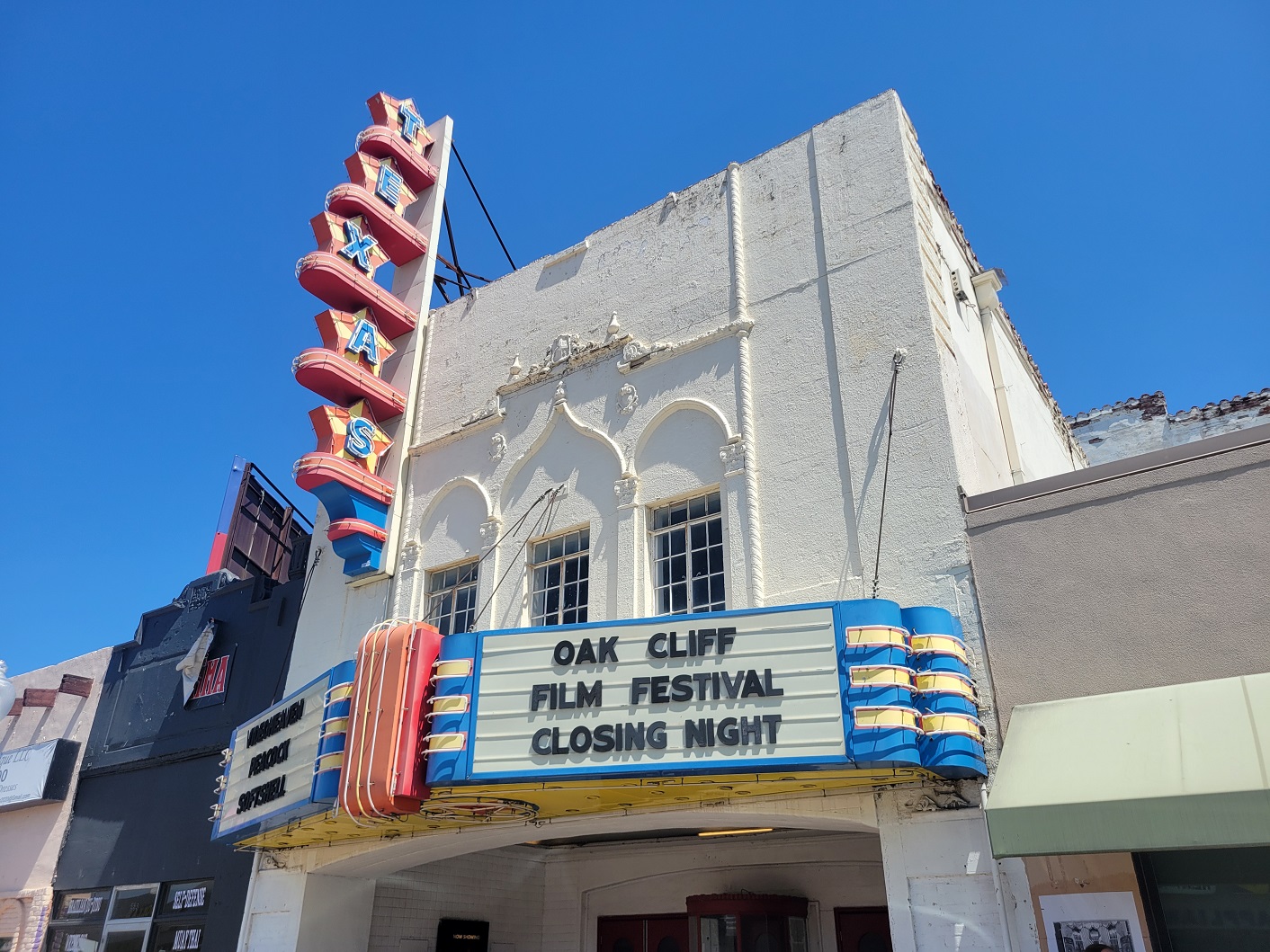
I wouldn’t get up early yesterday for morning yoga – the correct choice, I only got halfway through the session I attended – but I delayed publishing, which is dangerous, so I could make the 11:45 curtain of Videoheaven. This was also the correct choice. David Lowery, Green Knight and Ghost Story director and the most prominent Dallas filmmaker of the past several years, comes out to introduce the documentary. He’s on the Oak Cliff Film Society Board of Directors and has hosted events at the Texas before. It’s the only time I spot him all weekend, and he’s already out of the spotlight before I can get my phone turned back on for a picture.
The theme of the fest this year, “real movies for real movie people,” seems random at first – these things usually do – but after slamming several consecutive lower-budget riffs on Uncut Gems, the selection has morphed into a meditation on what real movies and real movie people are. It’s been a weekend full of films with emotional depth, exploration, charm and artistry that look extremely simple to make, many of them man-with-camera style films carried by shock value and madcap central performances. Several all-time classics can be described that simply.
When David Lynch died in January, the Texas Theatre went into mourning, with tribute screenings lasting well into the summer, elevated with dusted off material from the Lynch retrospective they held two years back now. One of the Lynchisms that rose to prominence around that time, “Translate those ideas to cinema, or a painting, or whatever, and figure out a way to get it done,” rings true. Movies are just a medium. It’s people who have ideas, and who have the need for those ideas to take the form of a film specifically.
Nothing makes this more clear than Videoheaven, the haunting documentary of cobbled-together movie scenes set in video rental stores, charting the 30-year course from centers of counterculture to corporate domination to living relics of a technological era that raced right by them. Through Maya Hawke’s gripping narration, writer/director/producer Alex Ross Perry charts their cultural impact through mass representation, bending the barrel of mass media back on itself. It’s a brilliant conceit, a vector of study that ought to be applied to almost any space, but would likely never be as mesmeric and tearjerking as applied to video stores. As Videoheaven documents what the public thinks of these spaces, it quickly pivots to document portrayals of the cinephiles inside them. They’re all exactly who you would expect to find behind the desk of a video store, people who think movies are important, and who know how to read the human truths they reveal.

That’s me. That’s us, everyone in the theater, everyone reading this now. Cinephelia exists on a broad spectrum – the film highlights Quinten Tarantino, the very model of a video desk guy-turned filmmaker, screening his debut masterpiece Reservoir Dogs at the Kentucky store he ran off to Hollywood from. Watching movies, recommending movies, making movies, writing about movies – Tarantino himself has turned to writing as he contemplates his next project – they’re all different levels of expression and dedication from the same archetype of person. That’s why I’m still down here at the Texas Theatre. Even if you walk in, speak to no one, and walk out, you’re still here. You’re still in this grand tradition of people who asserted, with their time and money and often much more, that this matters. You’re part of a community, whether you want to be or not.
It’s the first three of 12 solid hours in the main theater. It’s a very easy place to sit down in, but I’m emotionally exhausted for most of the rest of the day. Age of Audio is next, a documentary about Ira Glass and the pioneering of the podcast format, a new word 20 short years ago. This is followed by Messy, another low-budget screwball that feels heavily inspired by Uncut Gems, this one with a love-addicted lead character played by writer/director Alexi Wasser.
I’m being reductive. Messy has much more overlap with a contemporary, feature-length “Sex and the City,” an aspiring sex columnist navigating Manhattan infested with dating apps and the kinds of people you meet on dating apps, complete with her catty confidants. It’s a courageous film primarily set in Stella Fox’ (Wasser) bedroom, which serves as its shock value while also creating a much more honest and courageous film. Contrary to the clean romances of the ‘90s usually set in public, the most dramatic moments in a love story, especially a brief one, tend to be in the bedroom. Messy correctly frames this.
It’s another well-acted, beautifully composed film about real people who feel like they belong in 2025. That’s rare. Pop-culture shifted away from everyday life in New York in the early ‘00s – can’t imagine why that happened – and we shifted fully into this long superhero fantasy around the time the first smartphones were released. Market forces rewarding centralization into large-scale blockbusters, pushing movies about everyday life to the very perimeter of the national scene, and the adaptations this technology forced on the everyday routine existed only in tabloids and articles about those slutty millennials. If films like Messy, Uncut Gems, last month’s Materialists and reigning Best Picture Anora can lead a wave of movies about the absurdities of the here-and-now, the world will be a better place.

My senses have recovered in time for the closing night film, Gypsy 83. It’s the world premier of a 4k restoration and director’s cut with writer/director/producer Todd Stephens in attendance, along with many of the cast and crew. I’ve never heard of this 2001 film, but the theater is suddenly full of people in Stevie Nicks costumes who haven’t been around all weekend, and the excitement is palpable. It’s easy to believe Stephens when he says the original cut was ruined in the edit – a glance at Wikipedia confirms the director’s cut is almost a full hour longer. Entire plotlines must have been shredded. It’s a queer, coming-of-age road movie about the feeling of being stuck in rural Ohio, and it captures that beautifully, but it calls for long, slow stretches feel ripe for lobbing off. Sadly, the scenes that would be the easiest to remove are what give the director’s cut its texture.
It’s an emotional experience I’m not fully prepared for, a film about an undefined longing for which broken families and traditional gender dynamics provide no framework, the entire courses of relationships altered by tiny moments because direct communication is too risky. It takes me back to 2001, when the viciously heteronormative teen films of the ‘80s had gone into a bust cycle, and the genre would mainly see ironic deconstructions like Mean Girls and Napoleon Dynamite for the next several years. For all the anxieties about not fitting in that these films address, they usually brush off any subcultures that would clash with the fires of young attraction – Mean Girls, which thoroughly catalogues a rich environment of lunchroom cliques before spending the entire runtime lodged in the Plastics and their tiny, straight world, is a terrific example. Gypsy 83 would have been an extremely important film back then about the internal lives of the people who don’t fit these structures, who view things like fraternities and prom night as permanent fads they interact with as little as possible.
It was the correct choice to delay publishing, but I’ve taken far too long to write this. The transitions between movies and real life have become foggy and can stretch for days now. I can feel the pins aligning, though. It’ll be all right.
And if you can believe it, it’s Friday once again.
 Reel Entropy