

I won’t log any time at the Texas Theatre today. Over time, as the festival gets more jam-packed, they’ve had to expand venues and put up temporary screens at other venues around Oak Cliff. Tonight’s features are at the Bishop Arts Theatre Center down Jefferson Boulevard and the Oak Cliff Assembly on the other side of the highway, both of which are primarily for stage productions.
Electric Child, another major score for the festival that premiered at Locarno, is our second feature in a row in which the main character spends half the film in a computer. In the film, Sonny (Elliott Crosset Hove) learns that his newborn child has a genetic disorder and will likely die before his first birthday. While his wife wants to focus on the time they have left, Jason pours all his energy into his other, electric child – he’s a programmer developing generalized artificial intelligence with simulations of an adolescent child dropped on a deserted island, tweaking his programming to increase his survival skills with every iteration. The film alternates between scenes in the real world and the simulation, which Jason begins to enter in an attempt to accelerate the tool’s learning in the hopes that it will find a cure for his baby.
I don’t have production dates, but Electric Child must have been shot after the popularization of large language models in early 2023, because it nails them in a way that I haven’t seen elsewhere, both the physical reality and the paranoid God complex mentality. Sonny works in a massive software development office with great lighting, an open concept with cool-looking computers everywhere and a massive, underground data center, a much cooler but realistic representation of the data centers we’re seeing power crypto mining and large-scale computing, complete with the unbearable whir of all the fans required to keep these things running. Despite the immense scale, there only seem to be three employees, and security is a constant point of discussion.
When Sonny is told of the odds that his child will die, he immediately questions the data behind the study and requests it so he can feed it into his model, as if finding inconsistencies in the underlying data will change his individual child’s fate. When he communes with the electric child, it’s from within the racks of this data center, as if he’s hiding in a glowing, unbearably hot cave.
Remember the name Elliott Crosset Hove. This guy is a star. He came to international attention starring in the 2022 masterpiece Godland directed by his buddy Hlynur Pálmason. He has this incredibly authentic way of slowly going feral over the course of a film that puts you in the mind of someone who’s losing control of himself. I didn’t recognize it, or him, from one film to the other – in Godland, he plays a missionary going crazy because the reality of pre-industrial Iceland doesn’t suit his entitlement, but in Electric Child, his reaction to tragedy seems completely reasonable, even if it’s essentially the same performance. He carries long stretches of the film by himself as cinematographer Gabriel Sandru holds tight on him in handheld close-ups.
This is the kind of film you may not see outside of a festival. It’s an extremely hard sell just because of the subject matter, not only the dying baby but the electric child running around naked inside the simulation for several stretches. He dies several gruesome deaths, as well. It’s also brutally slow, twisting its 118 minutes to such torturous length that I question if I’ll make my next curtain several times during the movie even though I’ve seen the schedule. Making time move differently is one of the highest executions of filmmaking, even if it’s to move slower.
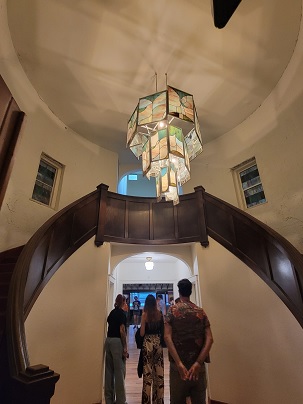
Next on the docket is a shorts block that I opted for instead of a narrative that looked like it may have been more teen-focused. A seven-film block, the late-night block with the queer film tag, seems more appropriate for the exploratory nature of a festival. It’s my first ever shorts block, and my first journey to the Oak Cliff Assembly. It’s a magnificent, building straight out of an Ari Aster film, opening up into a grand double staircase that’s sadly not for customers. They don’t appear to have permanent seats in the auditorium,
There’s a certain frenetic energy that’s inherent to short blocks as a format. You don’t set out to make a film unless you have a full-intensity climax in mind – real movie people don’t, at least – and when you commit to a final product of only 15-20 minutes, you commit to getting there almost immediately. In a feature film, typically built around three keynote high-intensity sequences, the tension rises and falls as the story moves forward. Not so in a shorts block. Here, the story is constantly changing, but everything goes from zero to 60 as fast as possible and stays there for as long as they can. You love to see it.
What’s in the box is seven shorts, most of them around 15 minutes. It feels like a giant Youtube party, but curated for only the most artistically ambitious entries. It’s also much more casual than a feature film, with several intermissions built-in. Chatting, in-and-outs and bringing in more chairs for the overflowing audience is common and doesn’t take away from the experience.
That’s handy, because it’s the second night in a row multiple people assume I’m in charge of the place mid-runtime. The dialogue for Rat! was silent, which seemed to be an artistic choice because the short worked so well without it, and another audience member walks up to me during the short and tells me she thinks the sound is off, as if I haven’t been watching the thing with her for five minutes. I tell her I think it was a deliberate choice, but I don’t really know. I head to the bathroom during the next block and overhear what sounds like a production person on the phone explaining how they couldn’t have known there’d be a problem. Next thing I know, someone’s asking me where the bathroom is again in a building I’m in for the first time, while I’m mid-conversation with the woman who’s actually in charge of the place.
I don’t know why this is a running theme for me. I’ll be back at the Texas Theatre all day tomorrow, so I can make sure I have a drink in my hand the entire time.
The block does not disappoint on that queer tag, with Are You Fucking Kidding Me!? and ¡Beso de Lengua! coming right out of the gate with explicit gay sex scenes, but the heaviest hitters come in at the end of the night, Cherry Colored Funk and The Fatal Egg, both hinging on completely deranged lead performances. It feels like its own, miniature two-hour festival.
Electric Child does not yet have a release date.
 Reel Entropy