The Zone of Interest is a soul-shaking historical document, closer to a docudrama or recreation than a traditional film.
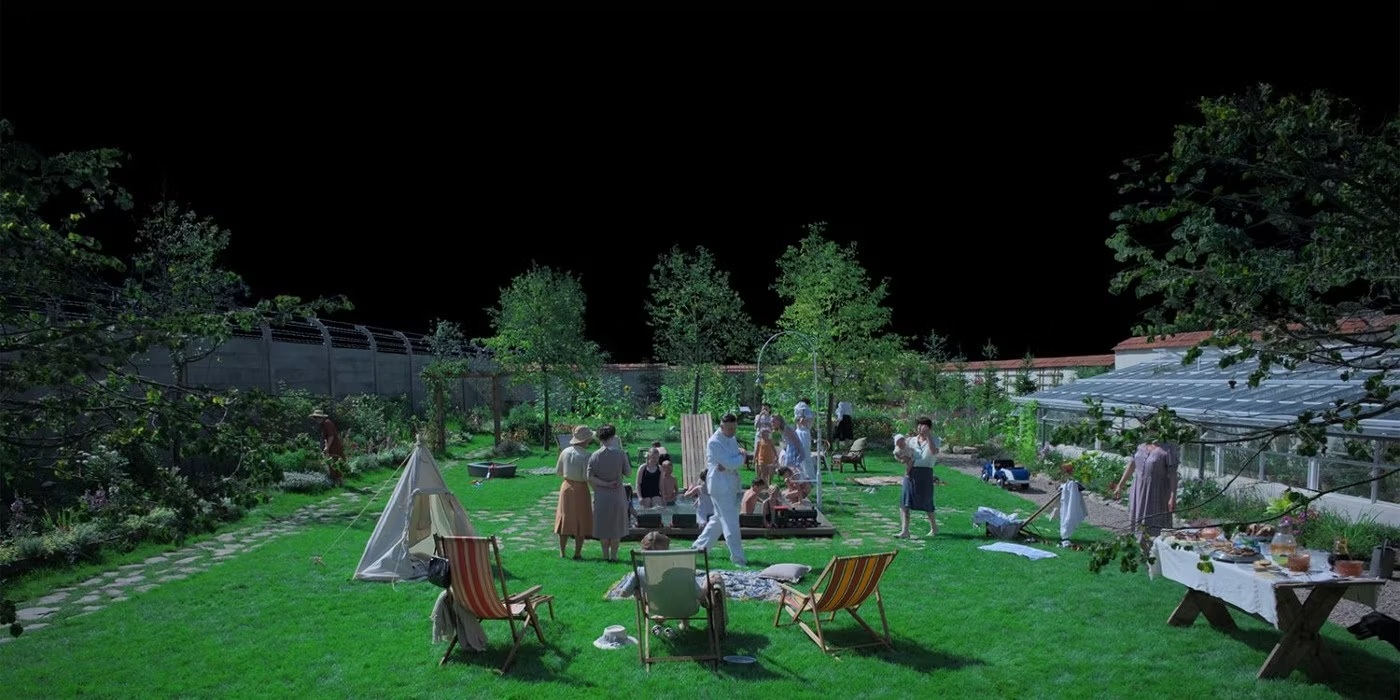
Auschwitz concentration camp in Oświęcim, Nazi-occupied Poland, summer, 1943- Auschwitz commandant Rudolf Höss and his wife, Hedwig (Christian Friedel and Sandra Hüller), live a quiet, idyllic life in their residence bordering the northwest wall of the infamous Nazi killing center. Every day, Rudolf Höss goes to work, where he experiments with gasses and approves funding for new crematoriums to make sure the largest mass murder in human history continues smoothly, and Hedwig Höss keeps their five children and the servants while tending the enormous garden that borders the prison wall. On weekends, they play in the Soła and host parties with other Nazis.
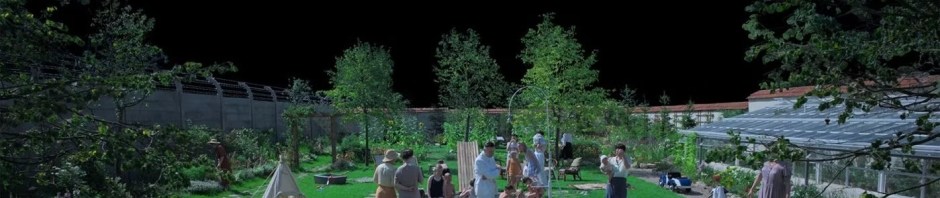
The Zone of Interest is designed to tell two stories at once, one to your eyes and the other to your ears. Visually, in the foreground, the family is threatened by the possibility of Rudolf Höss being transferred back to Oranianburg, Germany for a promotion to head of all concentration camps, but in the background of most shots, Auschwitz looms over the residence, and smoke from the crematoriums or trains bringing in new prisoners frequently blot out the sky.
The soundscape, on the other hand, is dominated the constant grind of this industrial machine of murder. Instead of birdsong and cicadas, the roar of furnaces and trains and the screams of desperate human beings are the white noise for the Höss household.
The film was shot on location in a detailed recreation of the commandant’s residence mere yards from the original building against the real walls of Auschwitz, including a recreation of their expansive garden cultivated months in advance of shooting. Writer/director Jonathan Glazer worked on the film for 10 years, most that time spent researching the Höss family, and the central tension of the foreground narrative, Hedwig Höss’ view of this as a dream life and her desperation to stay in the residence, is completely accurate. Glazer and cinematographer Łukasz Żal shot it documentary-style, with cameras set up around the residence running all day as the actors played out their daily tasks. There’s almost no camera movement in the film, and most of the dialogue is improvised.
Sound designer Johnnie Burn, who worked on Glazer’s last two films, compiled a 600-page document on the sounds of Auschwitz, and what we hear in The Zone of Interest is as close as could possibly be recorded to what the place actually sounded like. Concentration camps were partially designed to obscure what was going on inside them, and sound was a major consideration. SS officers were issued smaller-caliber pistols, when possible, to make less noise when they murdered the prisoners, but gunshots are a regular sound this close to the camp. In some cases, specific, historically accurate sequences of murder are recreated as background noise for the film.
Oscar-season movies about the Holocaust seem cliché in 2024, but the big ones like Schindler’s List and The Pianist absolutely weren’t. The subject matter was heavily taboo and not approached in media for decades after discovering the extent of the Nazi’s crimes, in contrast to something like the Vietnam War that was covered in high-profile films like The Deer Hunter and Apocalypse Now! almost immediately. Schindler’s List in particular, which was also shot with a documentary mentality and also went to the actual grounds of Auschwitz for shooting, released into an atmosphere of growing Holocaust denial.
The Zone of Interest could be considered a counterpart, or even a completion, of the work of Schindler’s List. The 1993 film was made to wrench viewers back to the reality that this happened, because it released in a world where that was starting to be subject to debate. The Zone of Interest was made to screw viewers further into the reality that this was government-subsidized and functioned as the perpetrators’ nine-to-five jobs, complete with efficiency analysis, logistics, budgeting, target metrics, merit-based promotions and a wife and kids back at home.
Marketing for The Zone of Interest was opaque enough that I’d researched beforehand, so I’d known going in what it was about and how it was going to approach the material. This is another Holocaust movie that approaches the banality of the Nazis, contrasting the family life against the business of the Holocaust – to be clear, there has never, ever been a film like The Zone of Interest before, but after dozens of articles during the Trump Administration about how easily fascism might take hold in the U.S., the concept is familiar.
Can we appreciate Rudolf Höss’ concern for his children when he sees the runoff of human remains from the deathcamp he commands coming down the creek toward them? Can we sympathize with Hedwig Höss’ love for the home she has worked on, the beautiful garden she built that shares a wall with Auschwitz? Small-caliber gunshots ring out in the background.
It affects me anyway, of course, in some of the ways it’s supposed to. I find myself getting used to the industrial grind of the camp, not looking away from the film, but taking it in more passively than I might otherwise. Popcorn helps, and we never go inside the camp, so there’s little explicit to turn you off a theater snack, at least on the visual side. That’s a catch-22 – watching a film about creature comforts during the Holocaust, you implicate yourself with anything you do for comfort while watching.
I’m also implicated, of course. I’m dutifully reporting back to my white-collar job, now in-office three days a week, while Israel uses weapons paid for with my tax dollars to murder Palestinians thousands at a time. The urgency hasn’t been lost on Glazer, either. This genocide is much less hidden or deniable than the Holocaust was, relying instead on the right people towing party lines as hard as they’ve been trained to by the sharp political divisions of the past several years.
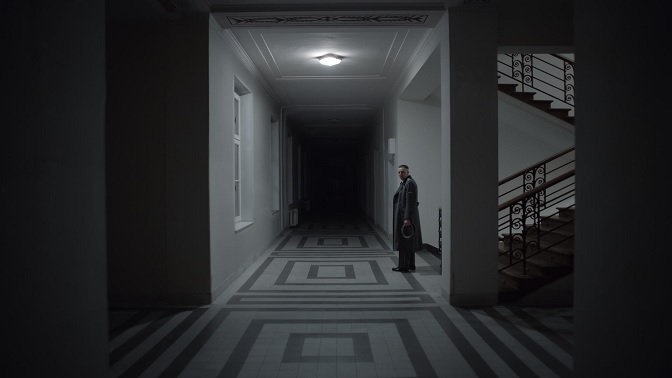
It isn’t until the final shots, when Rudolf Höss descends the staircase into darkness, that something snaps in my chest and I have to get out of there. It’s as if the film will get me too, somehow, not pull me into Auschwitz but pull me into this casual acceptance of it, acceptance passive enough that I could actively contribute to it and feel nothing. Just keep walking down those stairs, no matter how dark it gets.
Maybe I’m already there.
Leopold Knopp is a UNT graduate. If you liked this post, you can donate to Reel Entropy here. Like Reel Entropy on Facebook and reach out to me at reelentropy@gmail.com.
 Reel Entropy