

I thought it would be disingenuous of me to see and write about The Boy and the Heron because just about anyone who knew about the film would know more about it than me. Writer/director Hayao Miyazaki is a titan of animation, of course, but I’d never seen any of his films, and this one was noted even in Japan for its lack of promotional material. The Boy and the Heron is an encore after a decade of retirement, and only the people who were already at the show would have known about it. This post is by reader request.
March, 1945- School-aged Mahito Maki (Soma Santoki) loses his mother in the Tokyo bombings. His father promptly marries his late wife’s sister and whisks Maki to her rural estate, far from the war. Isolated, dejected and angry, Maki encounters a grey heron (Masaki Suda) in the backyard, who taunts him with the possibility of seeing his mother again. Their conflict takes them into the hidden world in the abandoned watchtower behind the estate.
I was familiar with Miyazaki by reputation and still imagery, and The Boy and the Heron is everything I expected and more – I’ve been assured it’s one of his better efforts.
The Boy and the Heron is astonishingly good. It’s absolutely everything I’d expected and much more. Experiencing it with such a weight of reputation, you’re just counting the things you were told are great about these films – lavish animation that is at once detailed and aloof, a child exploring a hidden world, an entire menagerie of bizarre creatures that each seem like they could be the center of their own story, a fervently hopeful sense of magical realism and reverence for nature and, of course, food. I have never wanted toast with jam more in my entire life.
Films are an expression of dreams, and animation is in some ways a more perfect format to express them than photography, offering absolute control over everything in the frame – we’re directed to think about live-action film this way, to start with a base assumption that everything in the frame is meant to be there even when that obviously isn’t the case, but in animated films, that’s completely true. Nothing in the frame exists at all until it is drawn for the film’s purposes.
The Boy and the Heron is animation used to an extent that I’ve never seen before. It isn’t just that nothing in the frame existed before being drawn, they hadn’t even been thought up before being drawn. The movie is filled with all sorts of creatures and spaces that I never could have thought up, like a two-hour freakshow that’s extremely quaint and charming, with never a hint of anxiety from these bizarre settings and mutant creatures.
Designs are credible and solid, but can casually stretch and break in ways that look physically impossible. Creatures melt, bigger objects emerge out of smaller ones, all of this seems normal in this animated world. It’s like a subtle study in depth perception, because the realistic images look like a representation of the real world, but then they shift in impossible ways to reveal that these are shapes on a flat surface that only looks like it has depth to hijack and break your human brain.
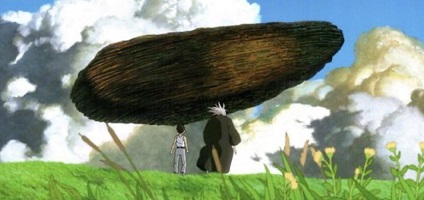
Highlights include Maki himself, a tough, no-nonsense kid who takes no guff, the heron that seems to subtly change size to make visual jokes work, the Parrot King and Maki’s uncle, who is also God. He sits in a field observing what appears to be a giant turd floating in the air, which he refers to as the world.
This makes complete sense when you’re actually watching it.
My overwhelming instinct is to compare The Boy and the Heron to the director’s prior work, but I can’t! I don’t know it! The idea that films, which are inherently collaborative projects, can or should all be traced back to the director is not neutral – it’s called “auteur theory,” it’s a whole can of worms. I want to know more about the director not as a fallback, not from a film theory perspective and not because the film is obviously autobiographical, but because it’s an incredible work of art and I want to know more about the person who made it.
My understanding is The Boy and the Heron makes several callbacks to Miyazaki’s career, and it’s obvious watching it that the film is deeply personal, probably semi-autobiographical and heavily symbolic. Unraveling the specific meanings is impossible, but also a poor way to consume a film – whatever it’s supposed to mean, the emotion is obviously there, and that translates. So much about a film’s context can be lost or regained in hindsight, but the level of emotion is what makes it special to revisit, and that’s undeniable here.
I wouldn’t have seen another Miyazaki without deliberately seeking out his work. His only film during my time reviewing, The Wind Rises, peaked in a grand total of 496 American theaters in 2014, bringing in $5.2 million over a 13-week domestic run. His widest American release, 2009’s Ponyo, opened in 927 theaters and brought in $15.1 million over its run.
The Boy and the Heron made $5.6 million its first day and just over $13 million its first weekend. It’s Miyazaki’s first film to spend a weekend at no. 1 in America and his widest release by an order of magnitude, peaking at 2,325 theaters. It is also his first IMAX release, apparently at the request and coaxing of the IMAX company itself.
Miyazaki celebrated his 83rd birthday Jan. 5, and due to his age, the personal nature of The Boy and the Heron and its release that feels like such a climax in context, it’s set up as the perfect swansong for the filmmaker, but it won’t be. In late 2023, Miyazaki was already hard at work on his next film.
Leopold Knopp is a UNT graduate. If you liked this post, you can donate to Reel Entropy here. Like Reel Entropy on Facebook and reach out to me at reelentropy@gmail.com.
 Reel Entropy