
9/10 Palme d’Or-winning Anatomy of a Fall is another film that captivates by being a lot of different things at once. The evolving blend of personal and legal and of fact and fiction paint a complex portrait of human life, how it’s perceived and how it’s processed in hindsight.
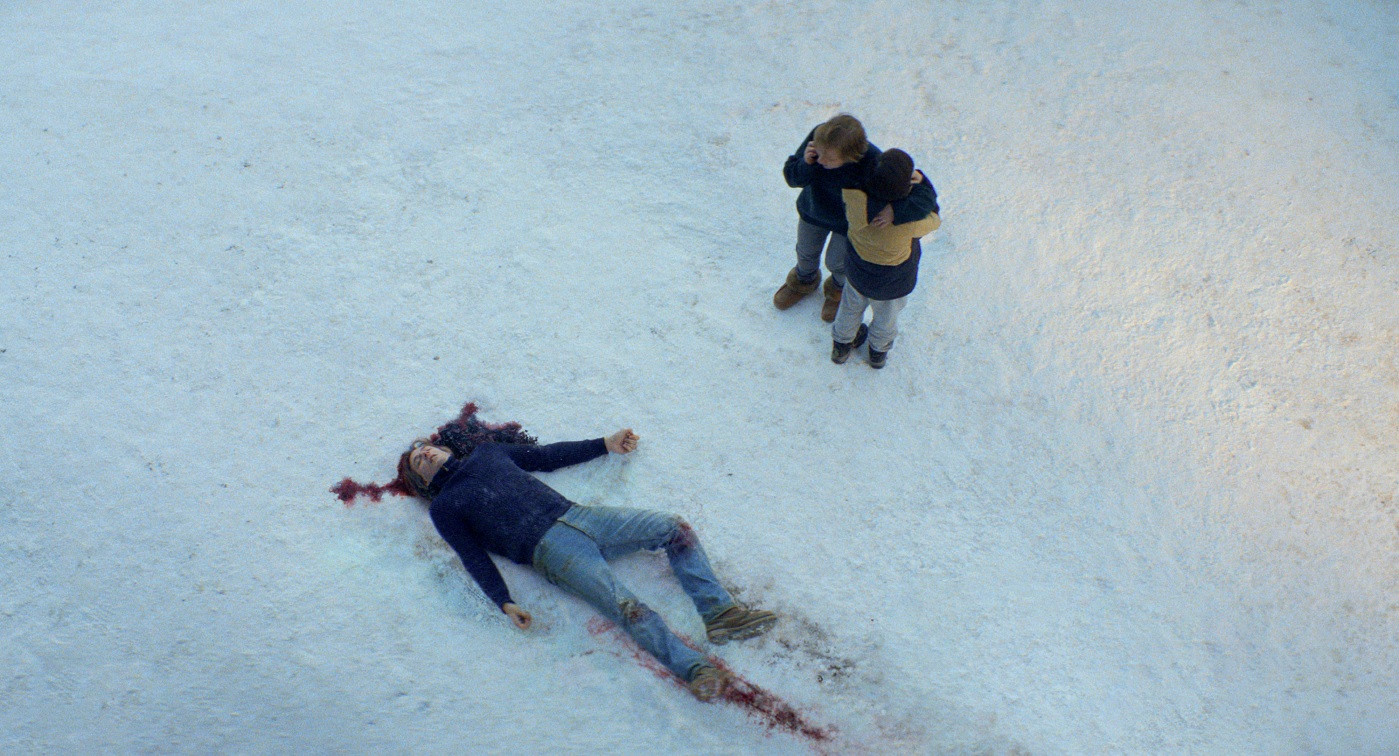
Grenoble, France- writing professor Samuel Maleski (Samuel Theis) has fallen to his death in a suspicious manner, and his wife, novelist Sandra Voyter (Sandra Hüller), was the only other person in the house at the time. She falls under an aggressive, speculative murder prosecution that never has any evidence, but interrogates Voyter’s marriage and art for possible motives. This is accompanied by a media frenzy that is mostly offscreen, but hangs over the film.
Voyter is German and Maleski was French – they met and married in London and spoke English in the home, but had moved back to Maleski’s hometown as the marriage spiraled downward. Voyter’s French isn’t strong enough for a trial or daily interactions with government officials. Additionally, because the couple’s young son, Daniel Maleski (Milo Machado-Graner), is considered a key witness and the defendant is going home with him every night, court officer Marge Berger (Jehnny Beth) is assigned to basically move in with them and make sure they’re never alone together, and they also have to explain all this to Daniel as it’s all happening.
The appeal of Anatomy of a Fall is its passion and intensity. It’s a high-quality courtroom drama with a perfect central performance from Hüller squirming against the high-energy accusations of Theis and Antoine Reinartz. High-stakes, high-minded themes and high-messiness, this film delivers it all.
Anatomy of a Fall is primarily an examination of narrative and how fact and fiction start to weave into each other when drawn together into a linear story. In a short prologue before Maleski’s death, Voyter’s books are specified to be a semiautobiographical mix of truth and fiction, and that’s essentially what we see play out in court. The prosecutor (Reinartz) puts together a story of marital strife and, essentially, tries to fantasize a murder into existence as the natural ending of this story, while Voyter, her lawyer, Vincent Renzi (Swann Arlaud), and Daniel Maleski piece together a story of professional failure and suicide. The narrative created by Voyter’s and Daniel Maleski’s combined memory is another way the film approaches its theme. Each counselor complains loudly about the other’s speculation before stretching even further, to the point that the prosecutor submits passages of Voyter’s books into evidence.
It is narrative that animates the case from without, as well. TV news hungers after the narrative of a German black widow killing a hometown boy, which we can assume puts pressure on prosecutors to move forward with this bubblegum case. Narrative is what makes Maleski’s death suspicious in the first place – when breaking down the anatomy of his fall, the narrative it created didn’t add up for the investigators.
Like any mystery film, what is shown onscreen and what is only talked about is hugely important, and Anatomy of a Fall sticks mostly to what the facts support and within what characters can actually see, but one theory of Voyter murdering Samuel Maleski does play out onscreen eventually. The media frenzy surrounding the case is shown as cameras and microphones shoved in Renzi’s face, not something we get to see onscreen, though again, there’s a late exception.
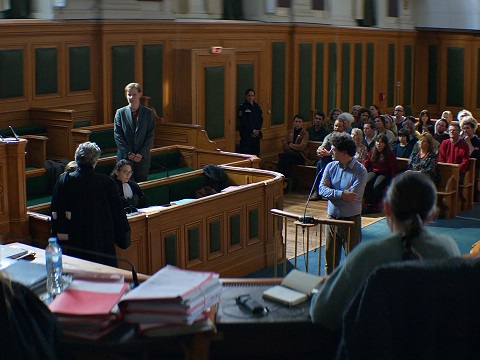
Another key strength of the film is that the narratives they’re arguing over are so compelling they don’t need to be onscreen to be effective.
The complicating factors, like Voyter’s weak French and Daniel Maleski’s partial blindness, ratchet up the tension, but don’t really pay off in any kind of symbolic or story sense. This, along with its roomy but realistic sets, is how Anatomy of a Fall realizes itself. The story we’re watching seems like a smaller part of these characters’ life stories, because those life stories are present in the courtroom serving as procedural obstacles – or new vectors for the prosecutor to harass Voyter as he tries to criminalize any and all of her life choices and even her bisexuality.
The film opens by plugging didshedoit.com, a tie-in website where viewers can weigh in on whether or not they think Voyter is guilty. I find the prosecution’s complete lack of evidence distressing as I’m watching the film, and it only gets worse when I check out the website and see not only support for her guilt, but even more fantasized scenarios created wholly by viewers.
Maybe I’m too level-headed for this – I hate procedurals and I don’t get sucked into true crime media or news coverage, but I know narrative hijacks a lot of people’s opinions about high-profile crimes. Again, there is absolutely no positive evidence at any point in the film that Voyter murdered her husband, no reason to even suspect her, let alone prosecute her, other than narrative momentum, but we’ve seen that result in a full conviction in plenty of real-world instances.
Writer/director Justine Triet based the film on one such trial trial, this one a pair of American defendants in Italy that caused a similar media storm, saw prosecutors similarly submitting wild, unsubstantiated fantasies into evidence and that resulted in a conviction that was overturned four years later. Hüller reportedly asked Triet over and over again whether or not her character is guilty, and Triet refused to answer. The film, the post-film discussion and even the production process is more concerned with the narrative than the facts here.
Leopold Knopp is a UNT graduate. If you liked this post, you can donate to Reel Entropy here. Like Reel Entropy on Facebook and reach out to me at reelentropy@gmail.com.
 Reel Entropy