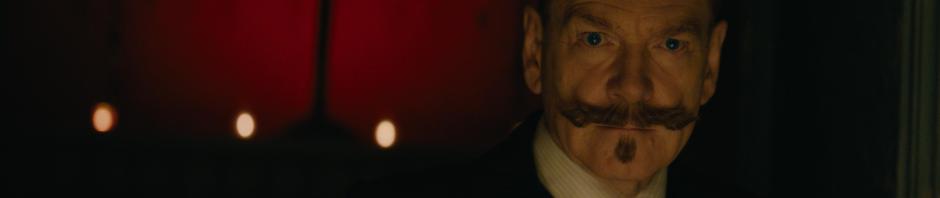

8/10 A Haunting in Venice is less a whodunnit and more a chilly, visually driven moodpiece about crisis of faith in the midst of an apocalypse. I don’t engage with films by trying to guess where they’re going, especially not when they’re based on books that are more than 50 years old, so a stylized telling is the only way to make it a rewarding viewing experience.
Venice, Halloween night, 1947- Retired detective Hercule Poirot (Kenneth Branagh, who also directs and produces), retired and secluded, is sought out by an old friend, mystery writer Ariadne Oliver (Tina Fey), for a Halloween party. The hostess, retired opera singer Rowena Drake (Kelly Reilly), has hired purported medium Joyce Reynolds (Michelle Yeoh) to hold a séance so Drake can speak with her recently dead daughter, and Oliver wants to see Poirot expose Reynolds’ routine. Immediately after he does, Reynolds is pushed from the balcony and impaled on a gate. Poirot locks all the other guests in the palazzo to solve the murder.
Poirot is now certain there is no god after fighting one world war and living through a second, and he plays out his crisis of faith through the case. The palazzo is purported to be an old orphanage haunted by children who died there during the plague – after the prior installment, Death on the Nile, saw its release delayed two and a half years by the COVID-19 crisis, A Haunting in Venice is sharply focused on pandemic despair – and Reynolds’ death is initially blamed on them. For Poirot, solving the case means proving the power of fact over superstition. It’s an opportunity for him to directly fight against the existence of an afterlife, which has become a painful and frightening concept for him after seeing so much death.
The film posits proof of an afterlife as proof of Christianity specifically and everything associated with it, echoing the concept of “Christian atheism” – that is, a person who doesn’t believe in God, but Jehovah is the only god he thinks of himself as not believing in. The core of the idea is that Christianity is the default and other religions exist in relationship to it, and that atheism the cosmic opposite of Christianity, not an entirely separate philosophy. It’s but it is an appropriate mindset for a character who is struggling with his decision to leave the faith. Also, they’re in Italy, there’s crosses everywhere.
A Haunting in Venice’s strength is its photography, starting from the opening credits set over several seemingly haphazard Dutch angles of Venice pigeons, foreshadowing the harsh angles and flurry of bird imagery that will hold sway inside the palazzo, which seems more like a mausoleum. It’s filled with dark, low-contrast images of characters taken at strange angles, frequently static images in which the subject isn’t, sometimes deliberately to emphasize the fact that the subject isn’t moving – this is, after all, a haunted house movie, in which things often move when they shouldn’t.
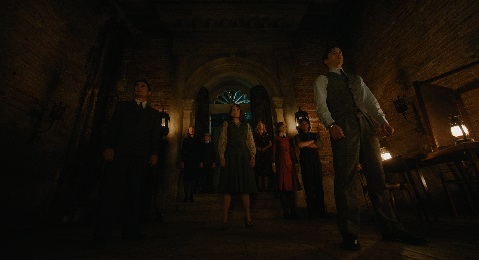
The mansion is made to look extremely claustrophobic and isolating, with characters rarely sharing the frame in a wide shot or even a two-shot, and the camera usually as close as a coffin lid. It’s often the exact same shot, a close-up with the character looking offscreen, their face taking up half the frame with the other half darkness extending out of the back of their head. The visual cue is that everyone is keeping a secret. The intimate, echoing dialogue and general lack of music helps the place feel more like a tomb as well.
The dialogue is short and fast, and unfortunately, the editing and acting aren’t a good match for the visuals – the film always flips to the speaker’s shot as an ironclad rule, creating a flip-book effect between two static shots that gets dizzying pretty quickly. There either need to be more shots to work with, or the edit needs to cure its allergy to offscreen dialogue. The tight, single frames also don’t give the actors enough room to get animated, which they frequently need.
Some performances are strong in spite of itself. Yeoh is a livewire in her short appearance, and Branagh starts to get into it as Poirot invests his belief system into the case and starts getting angry and flustered.
Branagh is an actor/director who I always want more out of, but his feelings about whatever material he’s working with always overshadow what he’s actually doing with it. His career as a director is mostly binary between overindulgent, way-too-excited adaptations of Shakespeare, or now Agatha Christie, in which he’s also usually overacting the lead role, or uninspired corporate projects like Thor or Cinderella that he doesn’t appear in as an actor and you can tell by watching he didn’t care much about. It’s his talent and he should use it how he wants, but when other directors bring such wonderful performances out of him, I can’t help but want to see more from his own work.
At the very least, we see a direct improvement in his third Christie adaptation, A Haunting in Venice.
Leopold Knopp is a UNT graduate. If you liked this post, you can donate to Reel Entropy here. Like Reel Entropy on Facebook and reach out to me at reelentropy@gmail.com.
 Reel Entropy