
Warner Bros. began development on Blue Beetle in November 2018 after Black Panther and Crazy Rich Asians had spent eight collective weeks at the top of the box office, each accompanied by weeks on end of stories about how the market of non-white American filmgoers remains largely untapped. By my counting, that made it the 17th movie “in development” at the time for the DCEU, which was arguably already dead by this point, and it’s a small miracle that it’s the eighth of that group that made it to theaters. The film adapted for several company-wide changes in direction, most notably being greenlit as a direct-to-streaming project and then being reassigned for theatrical release, the same change that famously killed Batgirl.
It’s the saddest thing that underneath all the ambition that does shine through, the film still falters under the weight of the DCEU’s history. It wants to be something new and exciting, but it can’t, because it’s buried under Warner Bros.’ battered, terrified-to-fail understanding of a 2023 superhero movie, a skittish attempt to be completely unobjectionable.
Well, it’s not like it was some kind of masterpiece anyway.
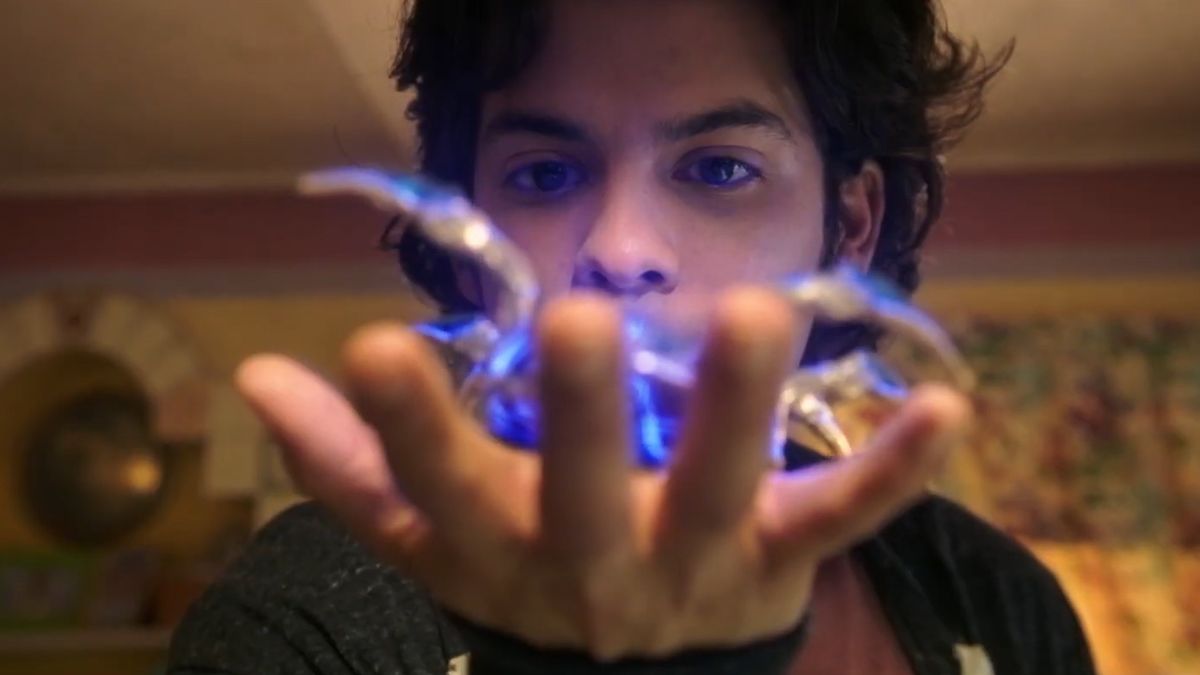
3/10 Palerma City- Jaime Reyes (Xolo Maridueña) returns home to discover his family is facing eviction, and the high-power job they think he can get with his brand new pre-law degree is their only hope. He desperately secures an internship with Kord Industries. CEO Victoria Kord (Susan Sarandon), who saw Robocop as aspirational instead of as a satire, is using an alien artifact called the scarab to create powered exoskeletons for military and police work, an artifact which Reyes ends up walking out of the office with. The scarab bonds with Reyes and he becomes Iron Man the third Blue Beetle, granting him incredible cosmic power, but putting him and his family permanently in the crosshairs of Kord and her enforcers.

A lot of Blue Beetle’s survival can probably be credited to enthusiastic and ambitious work from screenwriter Gareth Dunnet-Alcocer and director Ángel Manuel Soto, who saw opportunity in the DCEU’s instability – Shazam!, the first unambiguous success for the series that would release the April after Blue Beetle was greenlit and rearranged Warner’s priorities for the next few years, proves merit to the idea. Dunnet-Alcocer and Soto approached the material like it could be the next breakout hit, most notably by placing Reyes in the fictional metropolis Palmera City, asserting him as the level of media icon as heroes whose aesthetics are so dominant they spread over an entire city like Batman or Superman.
Blue Beetle is the first appearance of Palmera City in any media, and introducing the city is part of the film’s function. It’s a not-quite neon megalopolis that seems mostly based on Miami crossed with an overcrowded business-district skyline, an upsized version the Financial District crowded beyond the limits of physical infrastructure, and overhead shots of the Reyes’ slums appear distinctly modeled on the artificial Venetian Islands between mainland Miami and the beach – this might be a very thoughtful reversal. In real life, those islands are upper-class enclaves, but in Blue Beetle, they are ghettos that seem to have been built specifically to pile non-white workers within driving distance of medial labor jobs in the city, where they can be out of upper-class sight both at work and at home.
Greenlit while staring bug-eyed at Black Panther’s $700 million domestic take, Blue Beetle is made to draw in Hispanic viewers the way Black Panther drew in African-American ones. It doesn’t succeed for reasons well beyond the filmmakers’ control, and though the effort is clear, it wouldn’t have anyway. The film features “Spanglish” dialogue, gets a ton of mileage from George Lopez as Reyes’ kooky uncle and is grounded in the Reyes family dynamic, but that family dynamic is nothing unique – it’s the classic immigrant tale. An extended minority family is stuffed into a too-small house in a decaying neighborhood. Blue-collar parents have paved the way for the main character, the first-generation college graduate on whom they’ve pinned all their hopes, but rent is rising too fast in 2023 for this intergenerational American Dream to take form, and everyone’s stuck.
The story of Jaime Reyes in Blue Beetle is the story of Hank Hill in Goodfellas is the story of Mario and Luigi in The Super Mario Bros. Movie. In terms of appeal to a minority target audience, it’s always great to see yourself onscreen, but there’s no comparison whatsoever to Black Panther’s shining fantasy of an Africa that was not colonized.
The unique circumstances of Hispanic Americans relating to how the U.S. both drives immigration by destabilizing Latin American countries and then exploits that immigration for often unregulated manual labor is mostly relegated to Kord’s bodyguard, the deliciously named Ignacio Carapex (Raoul Max Trujillo), who is implied through vague flashbacks to have been crippled in a covert war in Central America. Kord’s powered armor suits, which Carapex is the main test subject for, have both feet in the world of prosthetics – again, just like Robocop and Iron Man.
The much more frightening real-world internment faced by Latinos at the U.S. border is sharply avoided – in fact, this may be part of the reason the Reyes was lifted to Palerma City from El Paso, Texas, where he is based in the comics.
For all the details and lore that are supposed to set this movie apart, no matter how ambitious the movie is supposed to be, the vast majority of the film is spent going through the same motions as Black Adam or Shazam! Fury of the Gods. Even the formula for timid, off-brand superhero movie is sleepily forgettable at this point, and everything that should be an artistic choice is tainted.
Blue Beetle opens with a slow, boring expository scene setting up backstory, a cold bucket of water dumped on the audience, but no one can complain that they’re lost. Every plot point is emphasized through dialogue, including every moment of action explained in voiceover arguments between Reyes and the scarab. The action is meant to be crowd-pleasing, but comes across as dumbed-down, going only for laughs in early scenes where the scarab hijacks Reyes’ body, only for drama in the obligatory doppelganger fight at the end and only for coolness, or whatever passes as coolness on TikTok, in scenes with Reyes posing with his cleaver.
Is Blue Beetle a jukebox musical as an imitation of the more successful Marvel movies, or a continuing insistence that Suicide Squad was good, and you enjoyed it? There’s no good answer. Is Blue Beetle too oversaturated because of the DCEU’s history of complaints about undersaturation, or was it a genuine decision? It looks great, with a heavy emphasis on the blues, but there’s still no good answer. Even when I know this movie was made by bright new faces looking to fill a power vacuum, the history is too poisonous.
It does look great! Well, it looks OK, specifically in scenes set in the Reyes household. The higher-tech sets are passable, if a bit “Power Rangers.” The blue light of the scarab plays well against the orange walls, and some of the lights were actually onset and reflect against characters’ skin, you don’t usually see that these days. In CGI-heavy films, one of the common problems that make the whole thing look off is characters and backgrounds will appear to be lit by different sources. It’s gotten to the point that seeing lighting change on a character in a shot is rare and noticeable. That’s how low the bar is!
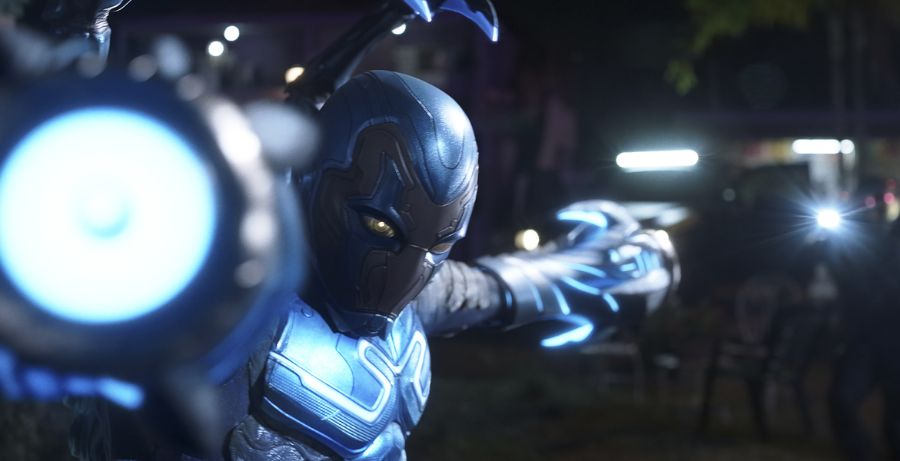
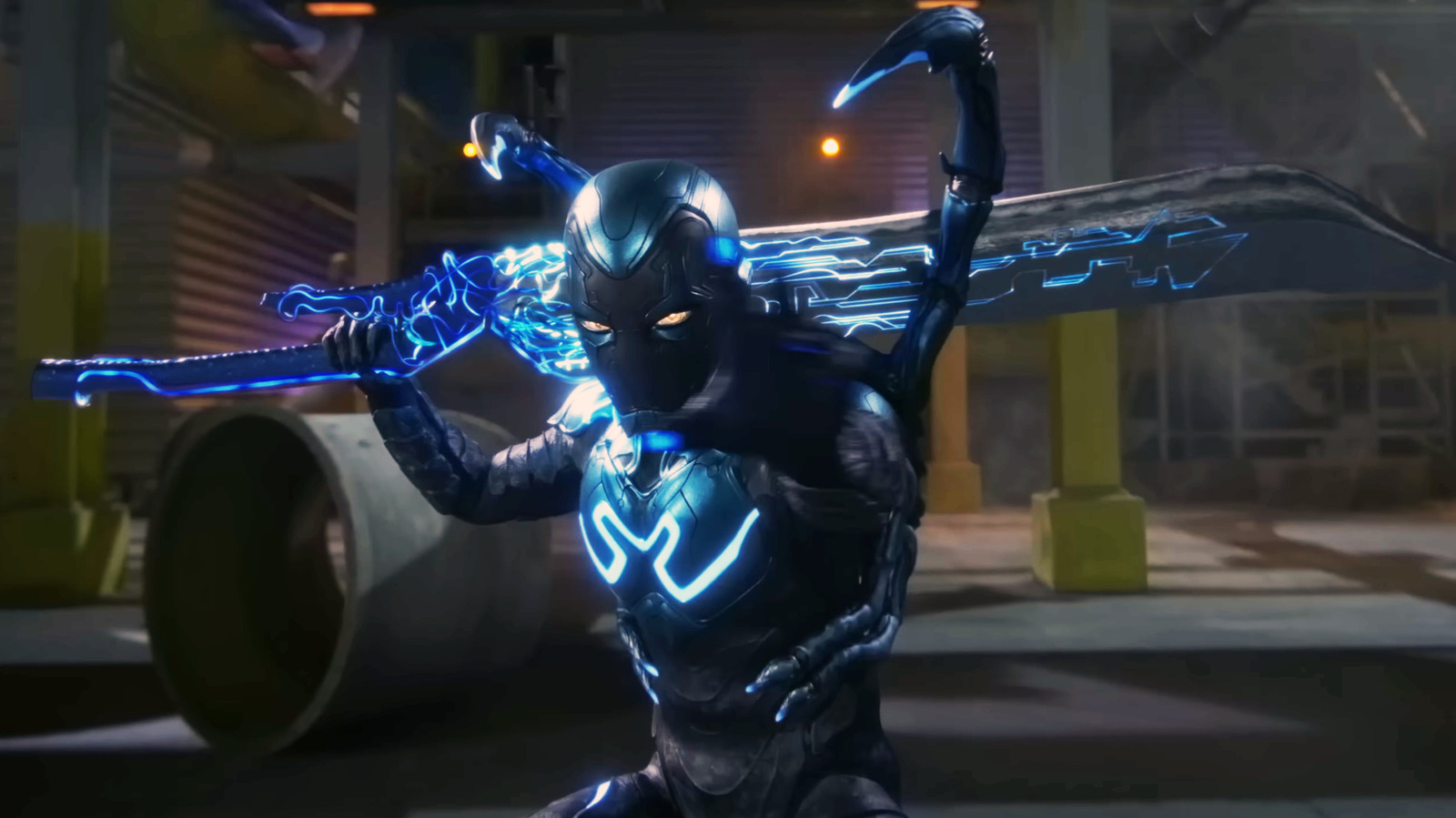
The broader action of the film is, well I guess I’m just numb to this type of behavior at this point. Computer animation looks smoother than it used to and the blue energy effects aren’t as hyperactive as they might be, but it’s still a horrifying half-cartoon thing. At this point, I’d almost prefer CGI that stands out as badly as early attempts like T2: Judgment Day, where there’s still a heavy reliance on physical set design and computers are only tasked with physical impossibilities. Blue Beetle’s most consistent problem detail is the difference between Reyes’ two suits – one is entirely drawn for action scenes, and the other is spandex for scenes when his helmet retracts for some facetime. It’s the same design, but too easy to tell the difference between real fabric and animated steel.
The fear that pervaded Blue Beetle’s making and seems to be baked into the film is best observable in the film’s breathtakingly passive protagonist, Reyes himself. He’s a complete passenger in his own movie. He enters the film already locked out of action, supposed to save his family with a pre-law degree that he doesn’t have the time or resources to pursue further. The reasons the scarab chooses him remain unclear, and he’s even shown lucking into the job in which he encounters it.
Maridueña, who senses his career breakthrough and brings all the energy he can muster to the role, mostly has to spend that energy to protest that he doesn’t know what’s going on, even in his first major fight sequences, because his character is so impotent. It doesn’t even matter that he doesn’t know what’s going on, because almost every decision is out of his hands anyway.
By the time Blue Beetle made it to theaters, Dunnet-Alcocer and Soto seem to have the same impotence. The DCEU was initially built a decade ago on the assumption that these movies would be popular, that it would be easy to put in the same kind of money and get the same kind of results with a similar base property to the competing MCU, and the creative team here represents the last, dying breath of that assumption.
Production had wrapped months before the balance of power shifted in the DCEU for the final time, and Blue Beetle releases into the world as a lame duck on film. The jobs everyone thought they were auditioning for were closed before it ever released.
Leopold Knopp is a UNT graduate. If you liked this post, you can donate to Reel Entropy here. Like Reel Entropy on Facebook and reach out to me at reelentropy@gmail.com.
 Reel Entropy