

2/10 Gran Turismo is a screaming torrent of baffling filmmaking decisions that seem half-thought out at best, but more like they weren’t actual filmmaking decisions. It’s bizarre plot points that screech by, not cars – the cameramen seem almost to not know where the cars are in many racing shots – so don’t expect even that level of basic entertainment value from it. Most of its intrigue is for the odd version of history it presents, like Sony shouting out a non-sequitor about its own standing into the mid-August void.
The film is based on the true story of Welsh race car driver Jann Mardenborough – so based on this true story that, in some markets, it’s been released with a full title Gran Turismo: Based on a True Story. In practice, this has lead to a mixture of media with both titles, making it seem like the movie doesn’t care about its own title.
In Gran Turismo (Based on a True Story), Nissan marketing executive Danny Moore (Orlando Bloom) pitches to Sony an idea to fund a competition in which best players of its racing game “Gran Turismo” are pitted against each other in real Formula One vehicles, with the winner being awarded a contract to compete for the Nissan team on the international circuit. Moore speaks reverently about the accuracy of “Gran Turismo’s” tracks and realizing the vision of game designer Kazunori Yamauchi, who makes several cameos in the film, that “Gran Turismo” could be just as real as the F1 tracks it simulates, that, with a little help, gamers can rise up to overthrow the professional athletes who drive in F1, those posh, entitled rich kids and their lifetime of work to reach the height of their sport. Moore does not specify how either company might profit from this arrangement.
Movies should never be rated against their source material no matter how hard the marketing effort ties itself to it, but I spent more than two hours screaming silently to myself “Who is insuring this?” at a movie that may or may not have “Based on a True Story” in its title, so the background is necessary here. In real life, Nissan executive Darren Cox – they changed his name in the movie for some reason, I really don’t even have a guess – brokered a partnership between Nissan and Sony to put on a reality show called GT Academy. Part of this pitch’s success was that it is immediately clear how both companies would profit from this arrangement.
The show ran for eight series, and some of the winners were remarkably successful – in Gran Turismo’s climactic moment when Mardenborough places third at the 24 Hours of Le Mans in 2013, second place on the same podium is actually occupied by Lucas Ordóñez, GT Academy’s first winner from the 2008 series. There’s a legitimate story here about the success of competitors from this show, a story that starts with Ordóñez, and it’s weird that Sony isn’t interested in telling it.
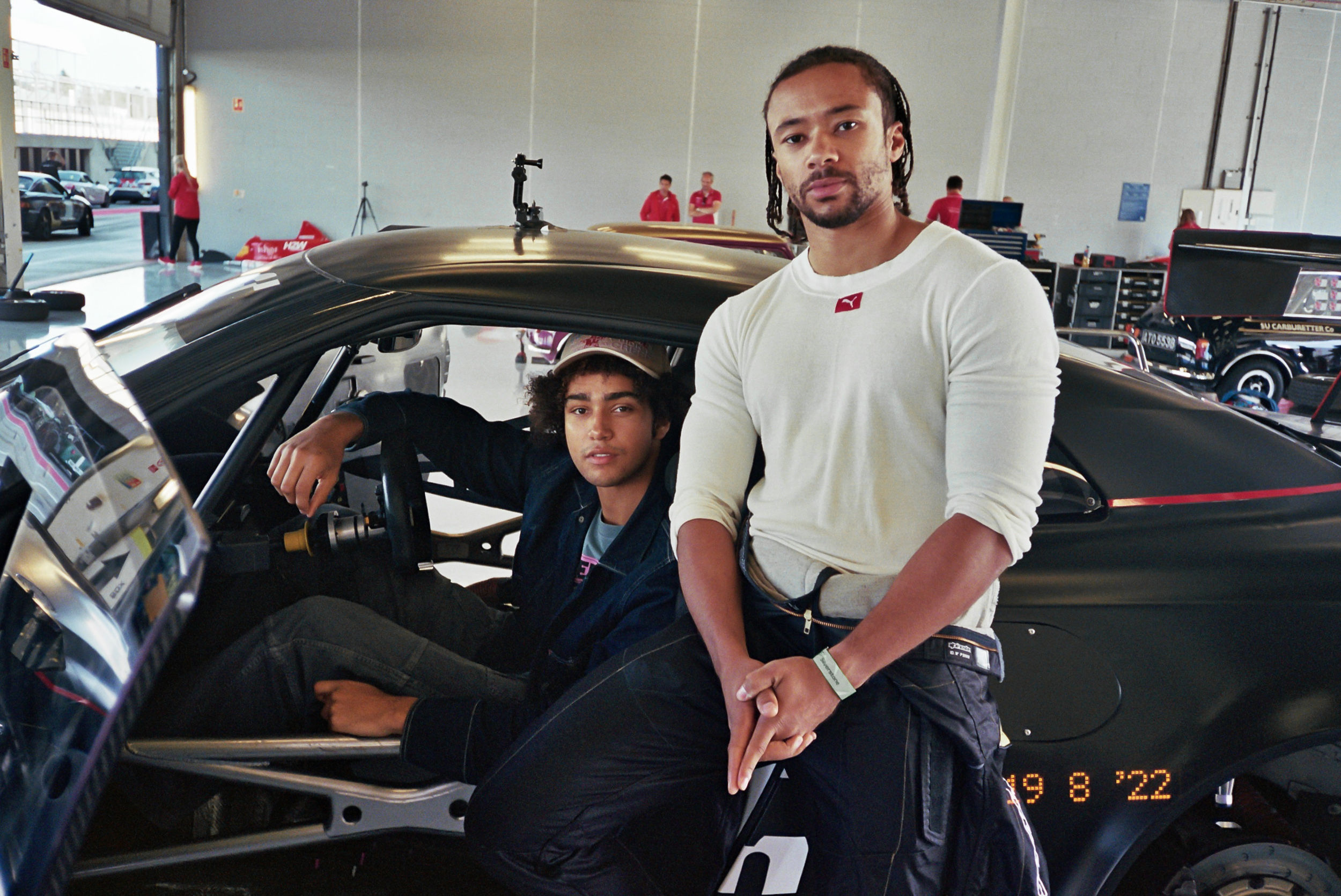
Mardenborough (Archie Madekwe), then a teenage engineering school dropout living with his parents in Cardiff, is plucked from obscurity to star in a bracingly paced sequence of vague gestures at the tropes of a sports drama that doesn’t have the common decency to last less than two hours, much less entertain for that duration. It has the shape of a linear arc with several metaphors and plot threads that could have lead into each other nicely, so my instinct is to point the blame more at editors Colby Parker, Jr. and Austyn Daines and less a screenwriters Jason Hall and Zach Baylin, but it also looks like they didn’t have enough footage to work with.
The subplots, which range from a teenage romance to the tragic – and highly fictionalized – backstory of trainer Jack Salter (David Harbour), also renamed for the film for reasons that are unclear, all track with the primary story’s shape, but not its time or its tone. The love interest, Audrey (Maeve Courtier-Lilley), will jarringly reinsert herself after a half-hour’s absence. Salter will pull Mardenborough aside at seemingly random moments to somberly hint at his big dark secret, a secret which would have been public knowledge anyway if it weren’t, again, completely made up.
The moment finally comes after Mardenborough’s accident at the Nürburgring Nordschleife, in which he lost control of his vehicle and careened off-track, killing a spectator. The accident was in 2015, two years after Mardenborough’s podium at Le Mans, and is pulled back in time to serve as a “lowest point” on his hero’s journey that centers Mardenborough’s pain and doubt. The crass use of this scene has become a point of controversy for the people who remember, but again, the movie betrays itself – Salter insists to Mardenborough that it isn’t his fault so forcefully and repeatedly that you can tell this scene has ulterior motives without knowing what they are.
This is director Neill Blomkamp’s first movie that he did not write, and many of his other signatures, such as the dust of his native South Africa and powered exoskeletons that seem to be transplanted joint-for-joint between his early movies, are absent. He and cinematographer Jacques Jouffret seem to not know what they were shooting from time to time, especially in the plentiful drone shots that breathlessly race over tracks with no cars on them.
Their failure to shoot good racing action is the primary problem with Gran Turismo. There are several decent ideas, such as animating Mardenborough’s line to make clear the thought process of how he gets around other drivers and incorporating video game graphics into the footage, but none are used consistently enough to make the race clear or even emerge as a clear shooting strategy, to the extent that, when the film shows current racing positions, it alternates between two different graphics to display the information. In what ought to be a racing movie, you rarely get a solid sense of what’s happening in an individual moment, more of a lazily assembled barrage of dramatic shots and noises that last several more minutes than they need. The scenes all slow down at the end for the critical moments of Mardenborough’s career, but those are about the only moments of actual clarity.

When the movie finally lets out, I race back home and immediately pull up Martin Scorsese’s Raging Bull. I’m thinking of the boxing biopic constantly during Gran Turismo for a lot of reasons, but mainly for its attention to detail in the boxing sequences, with the wild animal noises and the purpose-built rings and de Niro training with la Motta to get the body language right. Is it fair to compare a Playstation-brand movie-product, commissioned to tap into a market just like the series it’s based on, to one of the greatest movies ever made? It may feel unfair, but any given screen can only play one of them at a time. I have a finite amount of time on this beautiful blue world, and every moment I spend watching Gran Turismo (Based on a True Story) is a moment I could have spent watching Raging Bull instead.
The other slow moments are when the action pauses to pan around Mardenborough in the cockpit as the car explodes out, all the panels and engineering drawn falling away from Mardenborough to show him as simply the same gamer in a slightly different chair. The main point of the film is to play to this fantasy, that a gamer can become a racer, which is, one, not a fantasy, and two, a fantasy I doubt many gamers have really had – perhaps some racing fans who play “Gran Turismo,” but the emphasis is on “gamers” as an aggrieved class. It’s another bizarre and fairly alarming way Gran Turismo seems to be unaware of its own context.
Like GT Academy, Gran Turismo makes much more sense than Moore’s pitch because it can, at least in theory, make money immediately – though the movie isn’t exactly burning rubber at the box office – but the time spent asserting Mardenborough as a gamer more than an athlete, as well as the always flagrant and often painful departures from history, betrays who Sony expected to come out for this – “Gran Turismo” fans, and not Gran Turismo fans. From the way the film folds Mardenborough’s story to the way it deliberately obfuscates the other successful racers who drove this same track through the academy, there are a lot of reasons anyone who remembers this very recent history might be peeved here.
The film waxes at length about the glorious potential of “gamers,” and I can only suspect there was an insufferable ad blitz via the PlayStation 5, but I do know there’s plenty of cross-promotion at work. Gran Turismo’s trailers advertise its availability as a game, and the movie apparently has a post-credits scene announcing the game will soon be available on the PlayStation VR2.
It makes little sense as a film, seeming to be narrowly aimed at early teenagers who identify as “gamers” without much understanding of the history covered and invoked by the film – maybe, if you squint a little – but it makes perfect sense as a product, a slapdash movie-shaped thing put together to draw in fans of the brand who may be willing to branch out to other media for an afternoon, and at $60 million, it’s budgeted for that use as well.
The gross subtext in many of Sony’s movies is an 18-point headline in Gran Turismo – this product is an advertisement for other products, which are also advertisements. The money hole is bottomless. The hunger will never be satisfied. The wildfire will burn until it consumes itself. The final “Gran Turismo” product that was a simple purchase, whose only purpose was for your entertainment, whizzed past a long time ago.
Leopold Knopp is a UNT graduate. If you liked this post, you can donate to Reel Entropy here. Like Reel Entropy on Facebook and reach out to me at reelentropy@gmail.com.
 Reel Entropy