

My Barbie review last week ended with several paragraphs on the romantic relationship played out in stereo between the Barbies and the Kens in the final leg of the film, the main argument being it seems like writer/director Greta Gerwig needs to get her love life in order – Gerwig has, quite famously, been with her romantic and creative partner Noah Baumbach since 2011, they have two children, and neither of them can seem to stop making movies about nasty breakups.
I was essentially trying to tip-toe around saying “not all men” because of how poisonous that particular area is. The whole review was stuck in my craw because I’m always self-conscious about doing that, but it can be an important point – most of the time, “all men” actually means straight American men, heavily skewing white, conservative and at least middle class, to behave like the Kens do you’d have to be able to afford a house, a car and some guitar lessons. I’m certainly aware of the systemic power imbalances, how media encourages men to carry ourselves in these ways and how it can seem like this type of guy is universal, but it’s a very specific trope of person who usually can’t survive outside heteronormative spaces.
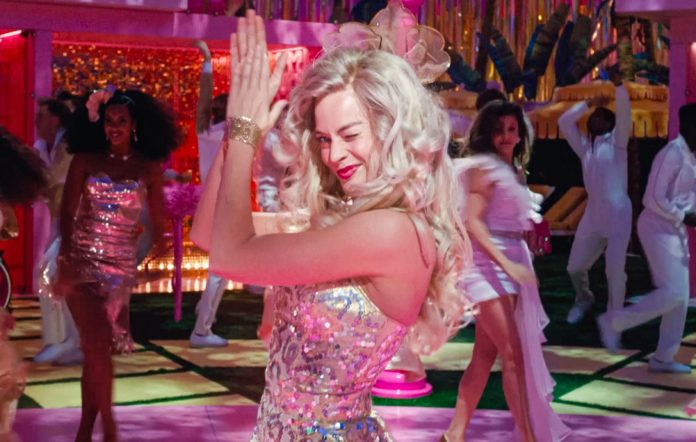
What stuck out for me was the way Barbie undermined itself by showing women who seem to completely forget about their identities once their man comes along. Barbie (Margot Robbie) gets back to Barbieland from the real world later than Ken (Ryan Gosling), and when she arrives, she discovers that Ken has brought what appears to be a very effective form of pick-up artistry back with him, and all the other Barbies have been domesticated, going from the doctor’s office and Supreme Court seats to bringing their Kens a beer and listening to them talk about The Godfather. It didn’t jive for me to see all these women appear to have had their individuality beaten out of them overnight without seeing any of the domestic violence that might cause that sort of thing, or that there appeared to be no queer dolls in the population who wouldn’t fall in line with these dynamics.
But actually, we do see the domestic violence that causes it, and we also see the population of overtly queer characters being squeezed out of Barbieland society once it becomes heteronormative and helping the Barbies break out of it.
The Kens are shown wooing the Barbies en masse with that insufferable Matchbox Twenty song, and the repeated lyrics are all threats of physical violence. It’s the, that’s it. It’s really that simple. The song is really whiny and annoying, so I shut down whenever I hear it and only acknowledged it in Barbie as part of the joke about acoustic guitars, but it’s right there, front-and-center. The Kens threaten the Barbies with violence, they do it in a happy, sing-song way that meshes with the movie’s spectacular Barbie aesthetic, and that’s why the Barbies go from these self-possessed women to housewives.
I wrote about Don’t Worry Darling, another movie that’s overtly about domestic violence toward women who appear to have been hypnotized, that part of the reason it was tough to believe is the abuse is completely limited to gaslighting. The main character contradicts her husband in front of his boss constantly, the kind of thing that would get you punched really quickly in a violent relationship, but that isn’t always how abuse manifests. According to the National Domestic Violence Hotline, 95% of callers are reporting emotional abuse, not physical abuse.
It’s completely unreasonable of me to expect see that kind of darkness in a very soft PG-13 movie about selling toys, but Barbie is very clear about what’s going on – it’s just limited to Barbie’s perspective. Suddenly, all her friends are in completely subservient relationship roles, and we don’t get to see what happened in between, but everyone’s playing that Matchbox Twenty song and it’s also looping on every radio station. The undertone of violence Barbie remarks on as soon as she enters the real world has come back to Barbieland. Any overt abuse is something she doesn’t get to see because, like most domestic violence, it’s happening behind closed doors.

This is a childlike understanding of abuse in a child-friendly movie, and it illustrates one of the core problems how abuse continues to cycle – we don’t talk about it, and we don’t educate our children on how to identify it in their own relationships.
While I focused on the explicit intersex and transness that Barbie doesn’t really delve into, the implicit queerness, exactly the type of implicit queerness that most movies rely on, slid past without my notice. Weird Barbie (Kate McKinnon, who has been an out lesbian since before she became famous) and her crew of discontinued Barbies and Kens are all obviously queer in the context of Barbieland, where everything is a little bit coded, and Allan (Michael Cera) is nonbinary – even if he’s listed as male, the binary in Barbieland isn’t between men and women, it’s between Barbies and Kens, and Allan talks specifically about his resentment for being created outside of that binary. The group pulls the hypnotized Barbies out from under the Kens’ sway by kidnapping them and gently reminding them of their individualities.
Gerwig was making the exact point I wanted her to make here about how the cure for a world crippled by the gender binary is people who exist outside that binary, and I just completely fucking spaced on it.
Barbie’s experience of suddenly realizing all her friends have paired off and can’t really hang out anymore doesn’t have to be so sinister – it also distinctly mirrors what it can feel like to turn 30 and suddenly realize that all of your friends are married, often with children, and the dreams you had together are on indefinite hold. It could even mirror what it feels like to turn 15, and suddenly all your friends are dating and not playing with Barbies anymore.
This is a borrowed observation, but it could also reflect the Fall of Man. Vox’ Alissa Wilkinson asserts that Barbie and Ken are an inversion of Adam and Eve, right down to one being made in their creator’s image and the other an opposite-gender partner derived from the original. In the film, they leave their idyllic birthplace, Ken acquires forbidden knowledge, and when Barbie returns, the paradise has been lost.
There’s a lot going on. It’s a very good movie.
This is another borrowed observation, but Barbie is explicitly about abortion access and how the Trump presidency was experienced by women. Ken’s sudden political rise is a gender-swapped version of the 2016 election – a member of the excluded gender is almost elected president and allowed to remake the Supreme Court, two positions Barbie mentions by name, but a leader from the dominant gender is able to psychologically abuse their way back into the driver’s seat at the last second.
The film opens on an extended and loving homage to 2001: A Space Odyssey with Barbie herself standing in for the monolith. In the opening act of 2001, maybe the most famous sequence in film history pointedly titled “The Dawn of Man,” the monolith teaches prehistoric primates to use weapons. The film forcefully posits that technology, and this specific use of technology, is the decisive incident that allowed these baboon-like creatures to evolve into a dominant, spacefaring species.
Barbie uses the cinematic grammar, supported by narration from Helen Mirren describing the actual events, to make a similar and similarly forceful point. She describes Barbie as the first doll that was not aimed at teaching girls to play as mothers, and young girls are shown smashing their baby dolls in time with the famous music.
In the last sentence of the film, Barbie says “I’m here to see my gynecologist.” It registers as a punchline, but the sentence stands out for a lot of reasons. “Gynecologist” is a powerful word – a lot of people are still raised without comprehensive sex education, and because most media is made for men, even a basic understanding of how vaginas work can be shockingly rare. Technical terms relating to female anatomy like “menstruation,” “fallopian tubes” and “hysterectomy” are still taboo for a mainstream film, and ending the film by jamming one of them in there is a very sharp point.
It contradicts earlier statements that the Barbie and Ken dolls have no sex organs. Barbie, who introduces herself in the scene as Barbara Handler, is now a full woman and has a vagina that needs to be taken care of.
This is also an overt political point. One of the principal fears in the wake of Roe v Wade being repealed in the U.S. is abortion is part of routine gynecological care, and many of the laws that have been passed in the ruling’s wake are to make physicians liable for executing an inaccurate, anti-abortion understanding of medicine. For many OB-GYNs, the solution has been to get out of town.
***
These all represent pretty major oversights on my part, and they all come back to a failure to see past my own focuses. I saw overt intersex and transness and stopped looking for more implicit queerness, and had a couple of allergic reactions that really hurt my ability to assess the film.

“All men” assessments always bother me because – usually, Barbie clearly doesn’t have either of these problems – they’re so defeatist. That particular language is designed to shut the door on any possible improvement, like a 21st century Meg Ryan character whining that she can’t find a nice guy, but with more awareness of abuse. I think it’s really important to remember that we can be better and we can expect better of our partners. Also, I don’t like being lumped in with rapists! I feel like that’s an OK thing to be sensitive about.
I also didn’t do enough to contexualize Barbie outside of the Barb in Barbenheimer, which has always been more interesting to me than either individual film – though, weirdly, I don’t feel like there’s any glaring subtextual omissions from my Oppenheimer review. Very weird how that’s worked out.
Despite appearances, I am a straight white man. I’ve never held a Barbie doll in my life. Everything I write is from my own perspective, and that’s not something that’s ever going to change. Trying to write from a perspective that’s not my own would be a waste of everyone’s time. But I carry my blindspots with me.
 Reel Entropy
Pingback: Come on ‘Barbie,’ let’s go party with gender theory | Reel Entropy