
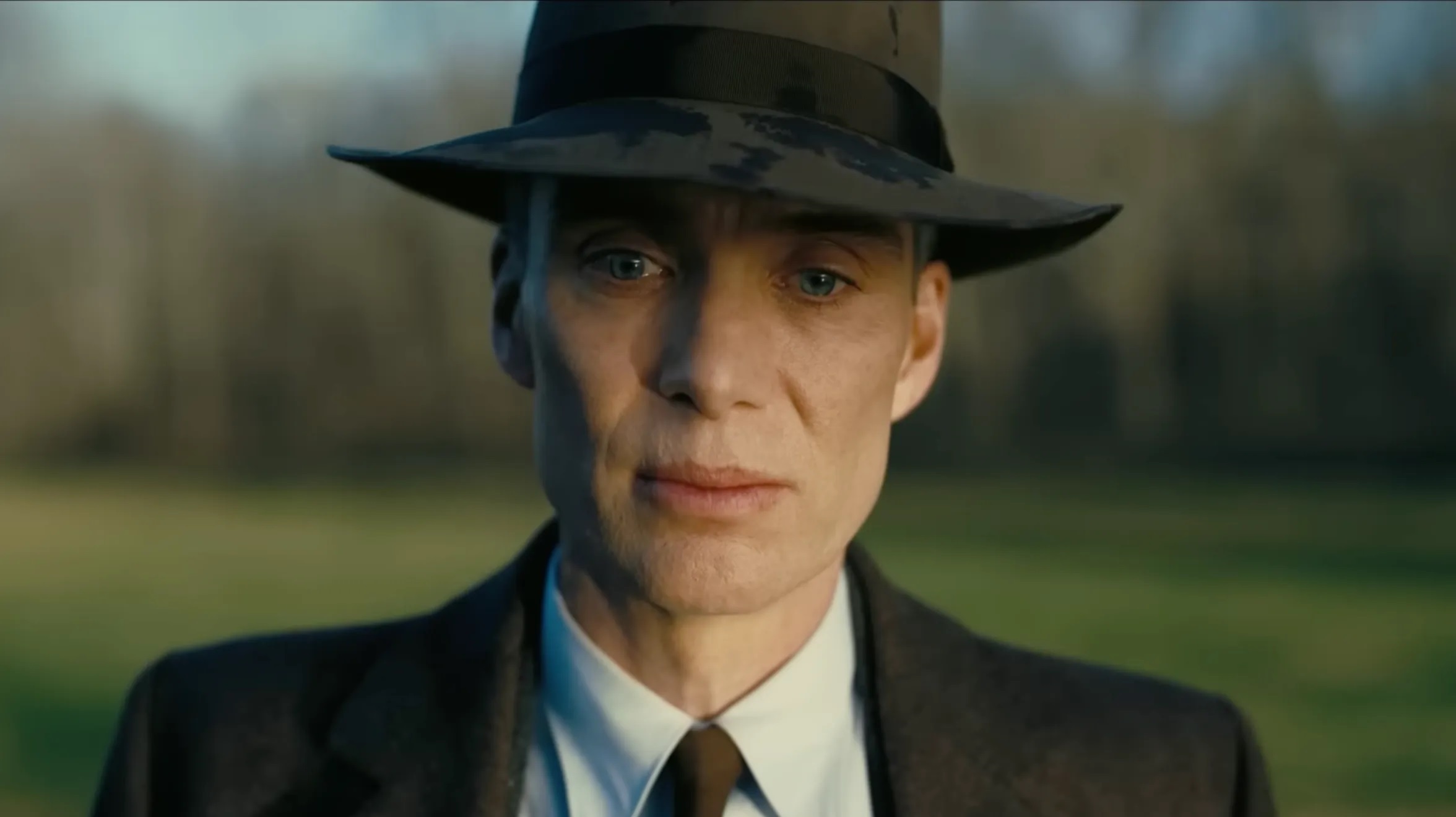
10/10 Los Almos, New Mexico, 1940s- The human instinct toward self-destruction has metastasized and now threatens to consume our entire species. Thirty years after a war to end all wars, many of the people who were hurt the worst by it have started a second, and there can be no victory, as it will certainly be followed by a third, a fourth and a fifth.
As this second world war draws toward its close, J. Robert Oppenheimer (Cillian Murphy) is recruited by Col. Leslie Groves (Matt Damon) to lead a team of scientists in the creation of a bomb to end all bombs, harnessing the power of the sun to annihilate an entire civilization in a single flash of light.
Oppenheimer tells this story in three hours’ worth of detail through the lens of controversial hearings around Oppenheimer’s security clearance renewal in April 1954, followed by Rear Adm. Lewis Strauss’ (Robert Downey Jr.) confirmation hearings as Eisenhower’s Secretary of Commerce in June 1959, both events that were ruled by innuendo about Oppenheimer’s communist associations before joining the Manhattan Project.
Oppenheimer is a brilliant, beautiful and razor-tense mood piece about the paranoia and tensions of an American public caught between Nazi fascism, Soviet communism and the bomb. Everyone knows how the Manhattan Project and World War II ended and anyone can look up how these hearings went, but Oppenheimer makes you feel it, the marathon of politicking, red tape, competing egos and mixed feelings set against the apocalyptic power they were arguing over.
In Batman Begins, his first major studio-backed production in 2005, Oppenheimer writer/director/producer Christopher Nolan single-handedly wrote the superhero origin movie formula that has dominated blockbuster cinema uninterrupted for almost 20 years since. With Oppenheimer, he approaches the biopic formula that has dominated Oscarbate cinema since Citizen Kane and brings together one of the finest ever made, something that feels like it was designed specifically to correct the problems common within biopic movies while also maintaining the grand blockbuster scale he’s made a name for himself with.
Blockbusterbating? I like it. I’m going to leave it in here.
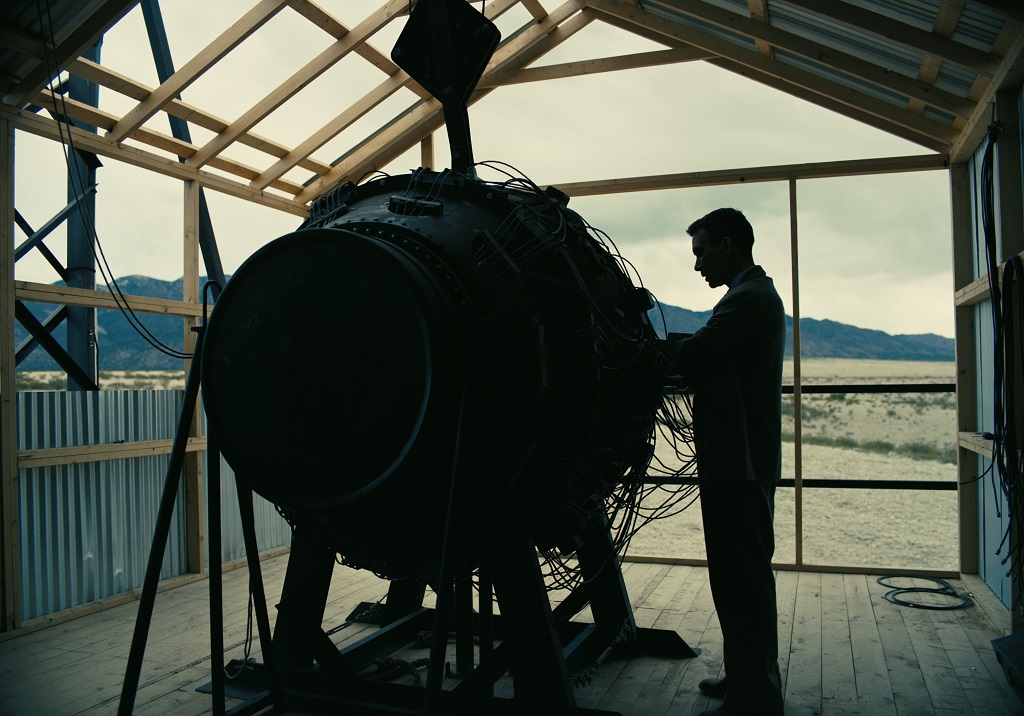
Nolan and Oppenheimer fear the bomb to end all bombs, and he’s used the story of Oppenheimer to create a film that ends with a bang to end all bangs. Nolan has bragged that the film includes no computer-generated effects, and that includes the Trinity Test. The explosion itself was created in miniature, and the awesome power of the atomic bomb, the experience of standing next to the thing, is filmed at length and shown to haunt Oppenheimer as he moves on with his life.
Oppenheimer is an unmistakably Nolan film and will certainly go down as his most definitive work, if not his best. It’s the climax of his career in which he finally confronts the anxiety about nuclear weapons woven throughout his work through the lenses of the man who invented them, the emotions and politics around their existence and the super-long IMAX lenses made specially for this film.
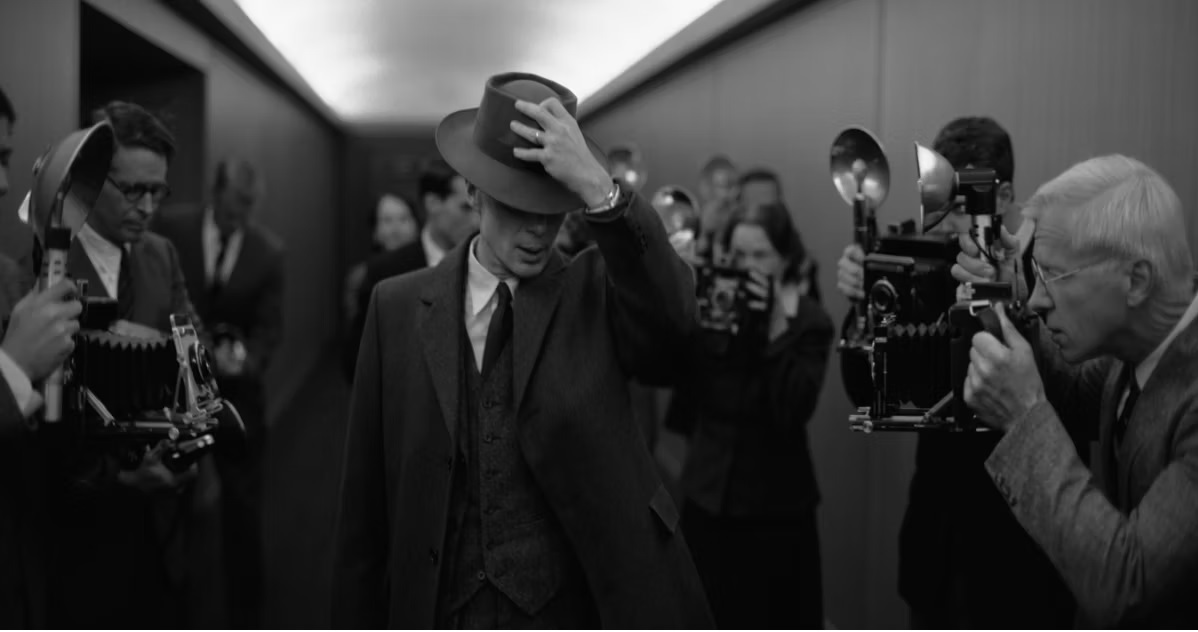
In Tenet, his first film with returning scorer Ludwig Göransson, we see Nolan approach a project more explicitly as a symphony rather than a film, and Oppenheimer stretches this method to a breaking point. The 180-minute film feels like one unbroken string of Proustian memory torrenting through the main character’s mind, the first shot of raindrops exploding onto a pond surface at Princeton University tied directly to the last moments, visualized physics concepts and memories of sexual encounters and the Trinity Test crashing into the hearings. The film is non-linear, as is Nolan’s wont, with the rarely leaned-on visual key stated out loud by Strauss late in the runtime – “Real power stays in the shadows,” and so Strauss’ hearing and other scenes set while he has the upper hand are black and white.
But as an experience, Oppenheimer is a direct line of mood, of rising tension leading up toward the Trinity Test and the climax of each hearing. It’s a master class in managing subjective experience of time from the director who exploded onto the scene with Memento, his second film all the way back in 2000, and Göransson’s relentless score, which recalls Tenet and seems to repeat it at some moments, is the torch that guides viewers through this writhing monstrosity of a film.
And yes, it is a film. What elevates Oppenheimer from just a movie to a piece of history is the choice to film the entire three-hour talkie in IMAX 65mm film – Nolan, already a holdout for film stock, developed a love of IMAX when he used it for some scenes of The Dark Knight, and Oppenheimer is the third straight of his films to be shot completely on 65mm. Its black and white sections are the first ever shot in the format.
Digital images use vast combinations of pixels to approximate color, so where you really notice the difference between celluloid and digital photography is the shadows, both the deep blacks and the transitions. The difference between gradients of megapixels that can get infinitely close to, but never quite reach, real color and light passing through a film reel with a high-contrast image is like the difference between fresh dessert and storebought.
Only 30 theaters in the entire world, a handful of which are actually museums, are equipped to screen Oppenheimer properly as the tiring, soul-shaking physical experience it’s meant to be. I’m lucky one is in Dallas, and I’m also lucky nothing that will demand that IMAX screen is scheduled for at least the next couple of months, because it may take that long for me to get another ticket.
Oppenheimer is a human odyssey that puts most other biopics to shame, exploring the emotions behind the subject matter and drawing a direct line from Oppenheimer’s personality and private life to the events that make him a crucial historical figure.
Of special note are the way Nolan uses the women in his life as driving forces – mistress Jean Tatlock (Florence Pugh), a card-carrying communist, is the source of Oppenheimer’s legal troubles and also gives voice to the communist leanings he may have had, while his alcoholic and combative wife Kitty Oppenheimer (Emily Blunt) puts a face on his fraying nerves and shouts the things he’s afraid to say. Hand-waving wives is a constant, telling problem in biopics when, for all the married people I know, their partners dwarf everyone else in their lives in importance, so it’s always a massive step up when a biopic walks viewers through how the subject’s marriage affects their actions.
Oppenheimer walks viewers all the way through to the other end in Strauss, who sees his interactions with Oppenheimer as a small part of his political career and is increasingly dismissive of them as tensions mount. Oppenheimer fears that his bomb will be nothing more than a the new big stick, and though the film doesn’t dig into the Cold War, in Strauss, we see a man concerned only with his own advancement whose self-absorption is ultimately his undoing using Oppenheimer personally as a big stick.
At the center of this is, of course, Oppenheimer himself, who we see remembering his journey from a believer in the necessity of the bomb to someone who thinks the bomb is powerful enough to finally put an end to war to someone alarmed as Strauss, and many of his own colleagues, treat the whole thing as a means to their own ends, business as usual. Because the film is experienced as his jumbled mess of memory, we see this not as a straight line, but as a jumbled mess of emotions and realizations, the linear arc flattened by editor Jennifer Lame, also in her second collaboration with Nolan following Tenet, into a circular one to make Nolan’s point.
Nolan has brought the film into 2023 by saying he wants Oppenheimer to be a cautionary tale about runaway technology, but the politics the film explores, the frustrating, inconsistent impasse between anti-fascists, the Jews actually doing the work to defeat the Nazis, anti-communists and the Jews who they actually spend all their energy harassing, couldn’t be more contemporary.
Incorporating World War II and anti-semitism is another Oscarbate trope that Nolan incorporates into Oppenheimer, and by “incorporates,” I mean “conquers.” Oppenheimer may or may not be destined for gold, but anything else that comes out this year chasing the trophy with the usual tropes will be blasted away by this film.
Go see Oppenheimer, and squeeze into a 70mm showing if at all possible. See it because it’ll be in Oscar contention, because it puts a still-urgent moment of history in context, because it is a piece of history itself and because it’s a masterpiece from one of the best working directors.
Leopold Knopp is a UNT graduate. If you liked this post, you can donate to Reel Entropy here. Like Reel Entropy on Facebook and reach out to me at reelentropy@gmail.com.
 Reel Entropy
Pingback: ‘Barbie’ is all about queerness and domestic violence and it took my dumb ass a week to fully realize it | Reel Entropy