

9/10 Barbie is an irrepressible explosion of high fashion, joyous and extraordinary set design and deliberately off-kilter dialogue and body language all delivered with a stone-cold straight face from writer/director/executive producer Greta Gerwig. It may be categorically a satire, but none of it is a joke.
Barbie (Margot Robbie, who also produces), an anthropomorphization of the iconic doll, lives an idyllic life in Barbieland, which appears to be a pocket dimension in Venice Beach in Los Angeles, where she relaxes and parties and sings and dances every day and night with all the other Barbies. She imagines herself and the other Barbies as uncontroversial icons of female empowerment, beauty and opportunity.
Suddenly, Barbie appears to start aging, unable to recover from the previous night like she once did, and the plastic, imagination-powered plumbing and kitchen wares of her Dreamhouse begin to malfunction as she is plagued with thoughts of her own mortality. She makes a pilgrimage to Weird Barbie (Kate McKinnon), who tells her that she must go to the real world and solve the existential crisis of her owner, or she will continue to age. She is followed by her faithful but hopeless suitor, Ken (Ryan Gosling).
Gerwig described Barbie as her dream job, one that she poured all of her angst and every idea she could conceive of into, and boy did it ever turn out. This is a wild thing, as awkward and left-field as it is self-assured and distinctive, the type of movie that will last forever as a definitive work for a filmmaker. This is what I’ve always wanted from Gerwig. Coming out of both Lady Bird and Little Women, I thought her best work would come when she left the suspiciously autobiographical coming-of-age stories behind and focused on something more formalist, and Barbie is as formalist as it gets.
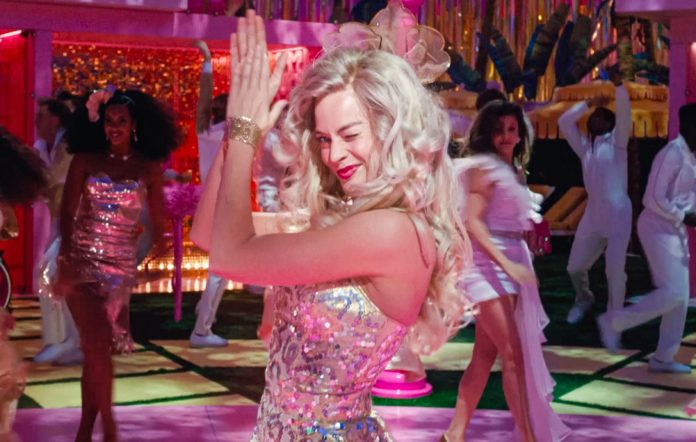
Barbieland is a lush, plastic and pink, almost too pink to be built, realization of the toys and playsets that inspired it – and as literal a realization as possible. Barbie’s shower and car are plastic models that she only imagines work, so we have multiple scenes of Robbie stepping into her shower and reacting to the water that she imagines coming out of it. Barbies don’t walk downstairs, they’re picked up by the child playing with them and set where they next belong, and so Robbie floats gently from the top of her house to the cul-de-sac.
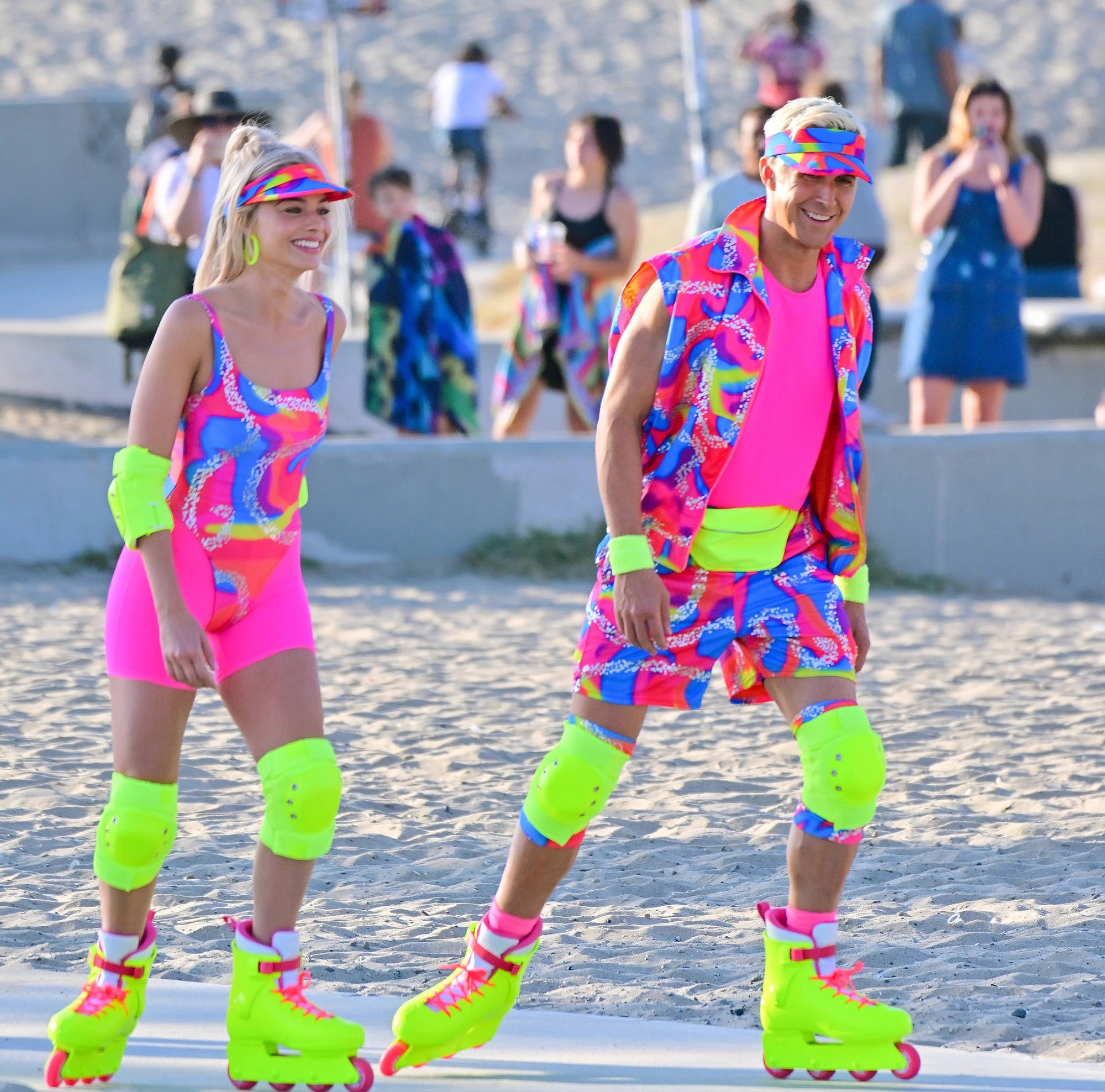
This is powered by spectacular coordinated performances from the perfectly dressed cast, who beam constant smiles, mock-wave and mock-run as dolls being posed, with exaggerated knee raises and arm-pumps but no tilting that would actually propel them forward. When they all meet on the beach, they remain stationary and isolated in their frames, calling to each other from their separate shots the way dolls might.
The most telling choice is how little the aesthetic changes between Barbieland and Los Angeles. It would have been easy to have Barbie suddenly roll directly from her perfect playhouse to Skid Row and play everything for laughs, but the difference is only a slight lighting change and to more realistic exterior design – but not interior design. The Mattel offices are just as expressionistic as Barbieland, from the heart-shaped C-suite table to the lower levels straight out of a Terry Gilliam movie. When the Mattel CEO (Will Ferrell) runs after Barbie, he chases her with the same mock knee-lifts and arm-pumps as the dolls.
Mattel is a major character, and this is where Barbie is its most self-reflective. Mattel executives are the people who could have stayed this madness – when they commissioned a Barbie movie they were probably thinking something along the lines of a feature-length “Monster High” movie – but instead, they’re portrayed in the movie failing to stay the madness caused by a real-life Barbie.

Even in a movie about the concept of Barbie coming to the real world with an underlying personal narrative of discovering her mortality, the movie itself never shatters its illusion. Barbie tackles real subject matter, but its fantasy is end-to-end.
Barbie as a film, and Barbie personally, assumes the attitude and implications of the toy it’s based on, both the aspirational empowerment of women and the impossible, contradictory standards to which they are held, often as the very symbol of those standards and their impossibility. The film inherits the same contradictions it addresses, and Gerwig’s decision to make this with a completely unshakeable straight face was the only way to thread that needle. What she’s correctly identified here is the film is inherently ironic, so it plays better without incorporating any irony.
Barbie does a great job of handling the patriarchy, which is an amorphous concept at the best of times, rolling together heteronormativity, the overwhelming prevalence of male-oriented media, toxic masculinity and lazy boyfriends, but it’s best observed in the way Barbie wilts when ogled. For the first time in her life, she experiences spaces where it’s not safe to be a woman.
Barbie and Ken have very different experiences in the real world, as Barbie encounters street harassment and a pervasive environment of sexual violence and Ken experiences the assumption of competence as a man, each for the first time. The plot completely shifts when they return home as Ken brings heteronormativity to Barbieland, upending its social dynamics.
Editor’s note: Most of the rest of this was basically written in my head during the campfire scene, when seemingly every Ken is wooing every Barbie in a long line of identical beachside campfires playing the same song. I didn’t do a good job of following the rest of the film through, and I ended up missing a lot of the point. I published an addendum here.
The Kens appear to almost hypnotize the Barbies with tropey wooing behavior, a hypnosis that Barbie breaks and then reverses to start a war between the Kens. This sequence, laying out an extremely reductive and narrowly gendered worldview, is where many of the objections to the film are coming from.
The difficulty comes in the form of a chicken-and-egg problem. The film paints a picture of individual Kens creating a system of patriarchy, not an existing patriarchal system creating a mass of individual Kens at scale. In the real world, patriarchal social norms are atmospheric, coming at Barbie from every angle, but once we’re back in Barbieland, everything is expressed at the level of individual relationships. It quickly begins to seem like Gerwig is trying to critique the patriarchy through the lens of a specific ex, and unfortunately, ripping on your shitty ex who likes Matchbox Twenty is never the cool, patriarchy-smashing move you think it is. It comes across the way griping about an ex always comes across – immature, insecure and probably not completely honest.
A much more severe difficulty is how quickly this worldview would break if anyone in it were bisexual. Like Alex Garland’s Men last year, Barbie presents a fantasy that doesn’t seem to be aware other kinds of couples exist. No matter how universal this trope of boyfriend seems to women who have only dated straight men, bi and gay men, assigned-female-at-birth trans men and asexual men aren’t generally inclined to behave the way the Kens do, and Barbie makes an explicit “all men” argument – the plan to save Barbieland hinges on every Ken behaving as predicted according to a bible of toxic masculinity.
In the same breath, no matter how dissatisfied many women who only date straight men may be, not all women are as opposed to traditional gender roles as Barbie is – in fact, many of the other Barbies seem to enjoy performing as housewives. The apparent fragility of female identity in Barbie, the fact that all these decorated, Nobel-prize winning Barbies appear to willingly reduce themselves to these roles the first time they’re exposed to this type of wooing, is a serious unintentional and self-contradictory message of the film. If these women are all so competent and self-possessed, why are their identities so easy to override?

Barbie’s apparent blindspot for queerness is all the more alarming given how ripe the film is for queering – Adrienne Rich’s ideas on compulsory heterosexuality loom large, especially in this last leg. Every Barbie and Ken is explicitly intersex and trans. They describe, but sadly do not show, that they lack reproductive organs, but they are extremely female and male and proudly perform gender roles and show off secondary sexual characteristics that don’t match the plumbing they were born with. This is an extremely gendered film, and every iota of gender coming from the dolls is 100% a performance. Barbie’s disinterest in sex may seem natural, but Ken also lacks sex organs, and he doesn’t lack sex drive at all. Long before he is taught to treat women as possessions, his yearning for Barbie consumes his entire sense of self.
The degree to which Gerwig is telling on herself in this last sequence, delving right back into the suspiciously autobiographical, arguably makes Barbie even more of a masterpiece, given how frequently great directors have told on themselves in their films throughout history, but it’s going to cause less of a crisis if it’s understood as a reflection of her specific experience.
Leopold Knopp is a UNT graduate. If you liked this post, you can donate to Reel Entropy here. Like Reel Entropy on Facebook and reach out to me at reelentropy@gmail.com.
 Reel Entropy
Pingback: ‘Barbie’ is all about queerness and domestic violence and it took my dumb ass a week to fully realize it | Reel Entropy