
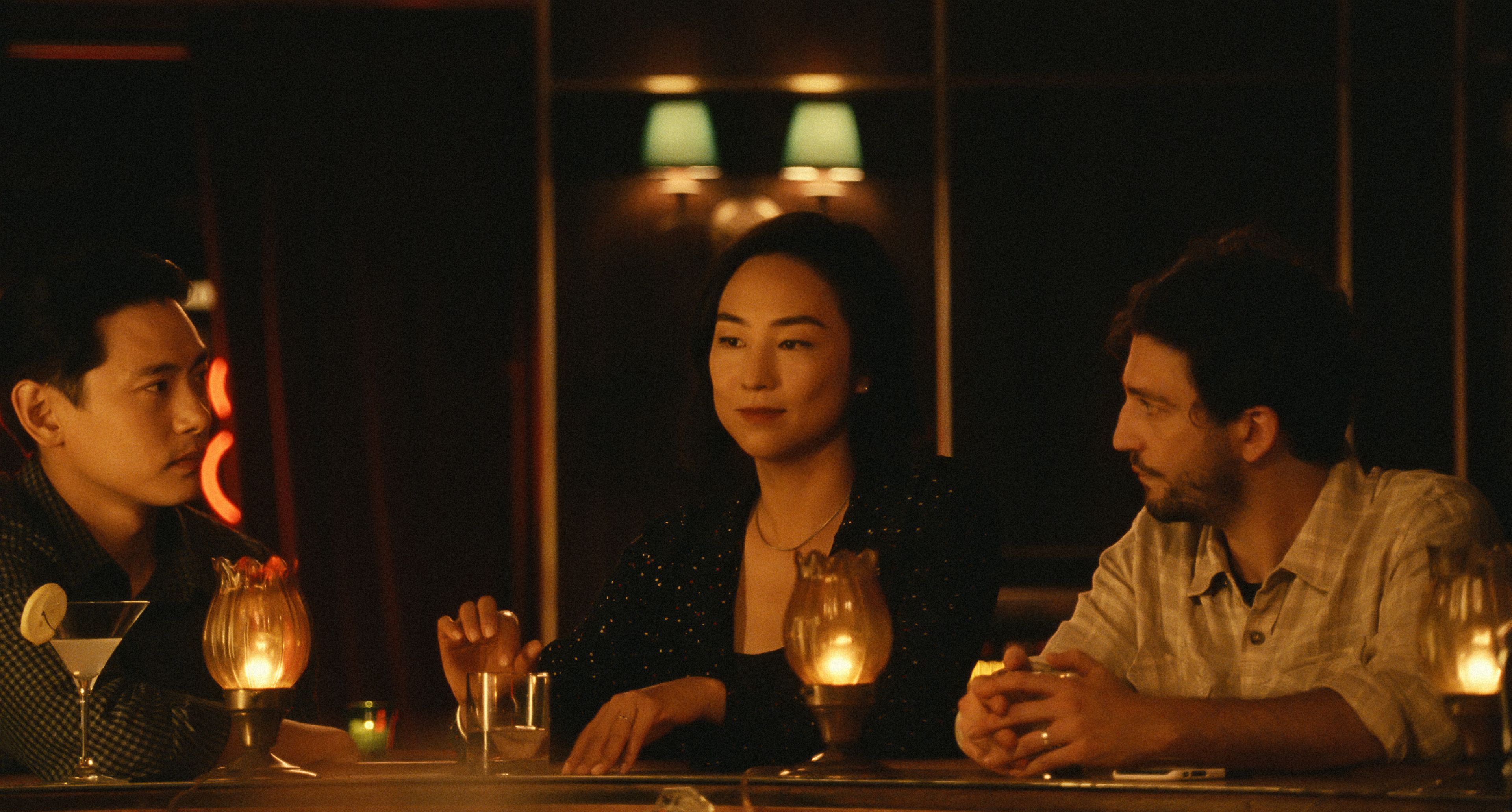
8/10 Past Lives opens with a J cut, transitioning from sound on a black screen to a shot of the love triangle in one of the final scenes at the bar, the only shot in the film from outside the romantic leads’ perspectives. A background character behind the camera, whose point of view we assume we’re seeing, wonders aloud what their story is. Perhaps the entire film is this outside observer’s fantasy? It would certainly fit the airy mood and theme of worrying about multiple possible selves, but it undercuts everything else we see that this framing device, the possibility that not only is the whole thing some fantasy – of course it’s some fantasy, it’s a movie – but someone else’s fantasy, isn’t just included in the movie, it’s the first thing we see.
In South Korea, presumably 12-year-old classmates Na Young (Greta Lee and Seung Ah Moon) and Hae Sung (Teo Yoo and Seung Min Yim) spend their final days together before Na’s family emigrates to Toronto. Twelve years later, Na has Anglicized her name to Nora and is a successful writer in New York City when Hae, still in Seoul, finds her on social media. They enter a de facto romantic relationship, but take a break when neither is willing to visit the other. Twelve years later, Nora is now married, and Hae finally visits New York.
Increasingly over the course of these three legs, the characters worry aloud about inyeon, which is basically the idea that they are each other’s lobster, but the concept is much more complicated in Korean Buddhism, in which reincarnation means that fated romances could stretch across past lives. In this scenario, destiny and choice are no longer mutually exclusive – Nora’s destiny in this life could be the result of choices in her past lives, her natural affinity toward Hae now the result of hard-forged relationships between their souls over the course of centuries.
Nora seems to argue that all love stories are between people who’ve been connected like this, that we’re all the same souls splashing around in the same pool forever, but she left her pool when she was 12. It is in this context that she questions her choice to marry Arthur (John Magaro) and her family’s decision to leave Korea and all the inyeon their souls have forged there. In a format that could easily explore the other lives Nora wishes she had explicit guidance from, the film remains with her and Hae, and her uncertainty hangs.
Past Lives is a romantic odyssey set across time and space about that intrinsic, unbreakable connection certain people have with each other, but much more importantly, it’s set across language. We track Nora’s identity, her name, her language and finally her lover, changing over the course of the film. Hae takes years to find her on Facebook because he’s been looking for Na Young, not Nora. During the long-distance relationship, we see her dust off her Korean. In the last leg, Arthur complains of distance from his wife and says he’s learning Korean so he can understand what she mumbles in her sleep – which becomes important when Hae, who never learned English, visits.
Technically, Past Lives is all about intimacy and putting you as close as possible to the characters, especially through sound design. The camera gives the characters some space to capture a full scene, but the microphone is always doing a close-up. Unfortunately, most of the special details it captures are eating, drinking and breathing noises, so I’m not the biggest fan, but it creates an undeniably unique atmosphere.
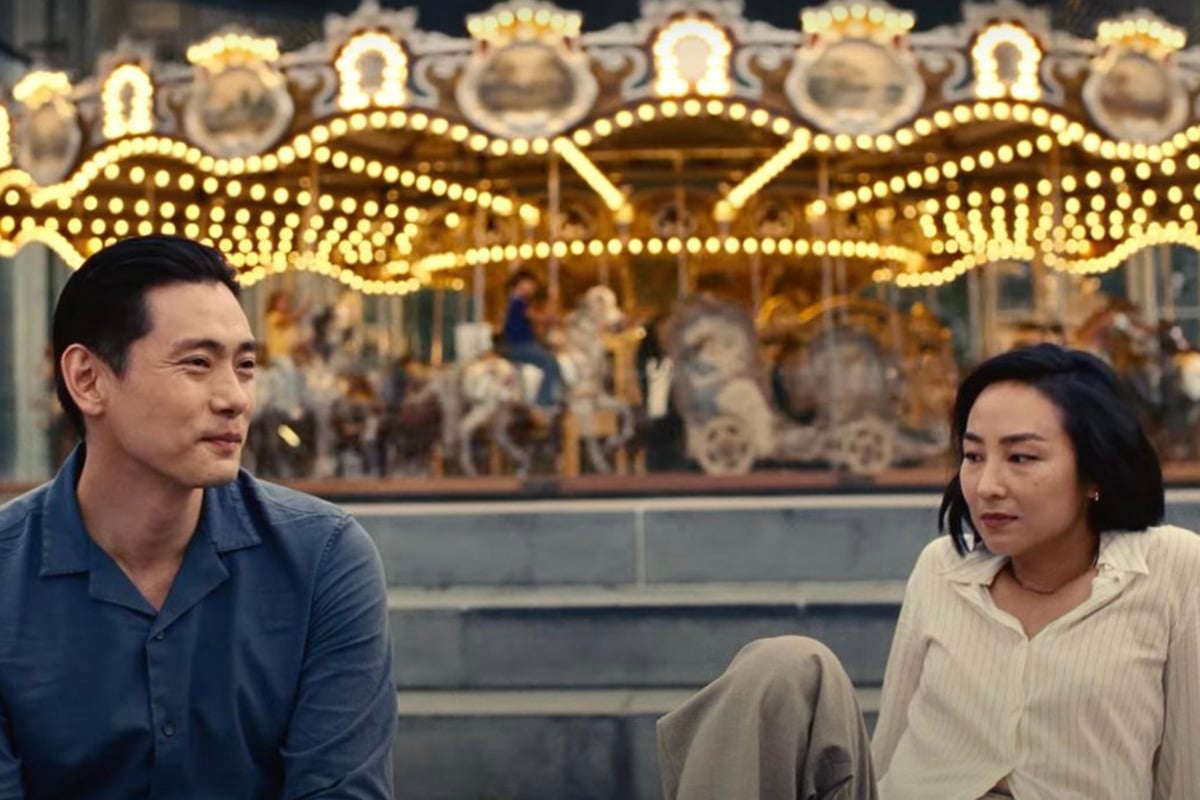
This emphasis is most potent in a shot that tracks Nora and Hae approaching the camera from all the way across Bridge Park, the camera staying still on the shoreline and holding as they walk from distant specs into the foreground, but all the sound is recorded as if from right next to them. The auditory perspective always remains the same.

That isn’t to say the visuals are lacking – they follow all this up. The camera lingers on as many little details as possible to show what characters are thinking about, what they’re feeling and what they’re paying attention to. This is especially prevalent during the second leg, that long “they have a long-distance relationship” montage – set in between two legs that are about specific days, this sequence illustrates why it’s so hard to focus on the day-to-day of a relationship, but all its apparent B-roll is narrowly constructed to bring viewers into Nora’s psyche and how important this relationship becomes to her. Seeing her quickly close other windows on her laptop so Hae can take up the full screen, carefully prepare her appearance for this video chat after a full day at work or wake far too early to account for the 13 hour time difference are examples.
Past Lives is being talked about as one of the best films ever made, and even if some of the details aren’t for me, it’s impossible not to see the level of care, expertise and artistry at work in an explosive film debut for writer/director Celine Song. It’s certainly the only movie of its kind in theaters this summer and I’d expect it to get a lot of noise when Oscar season rolls around.
Leopold Knopp is a UNT graduate. If you liked this post, you can donate to Reel Entropy here. Like Reel Entropy on Facebook and reach out to me at reelentropy@gmail.com.
 Reel Entropy