
9/10 Wes Anderson’s The French Dispatch was the crown jewel of a late-2021 explosion of pandemic-delayed works from name directors, but now at what appears to be the peak of his career, he didn’t stop working during the COVID-19 crisis, and so we have “Asteroid City,” another pandemic movie from the American auteur, this one made during and directly confronting the pandemic.
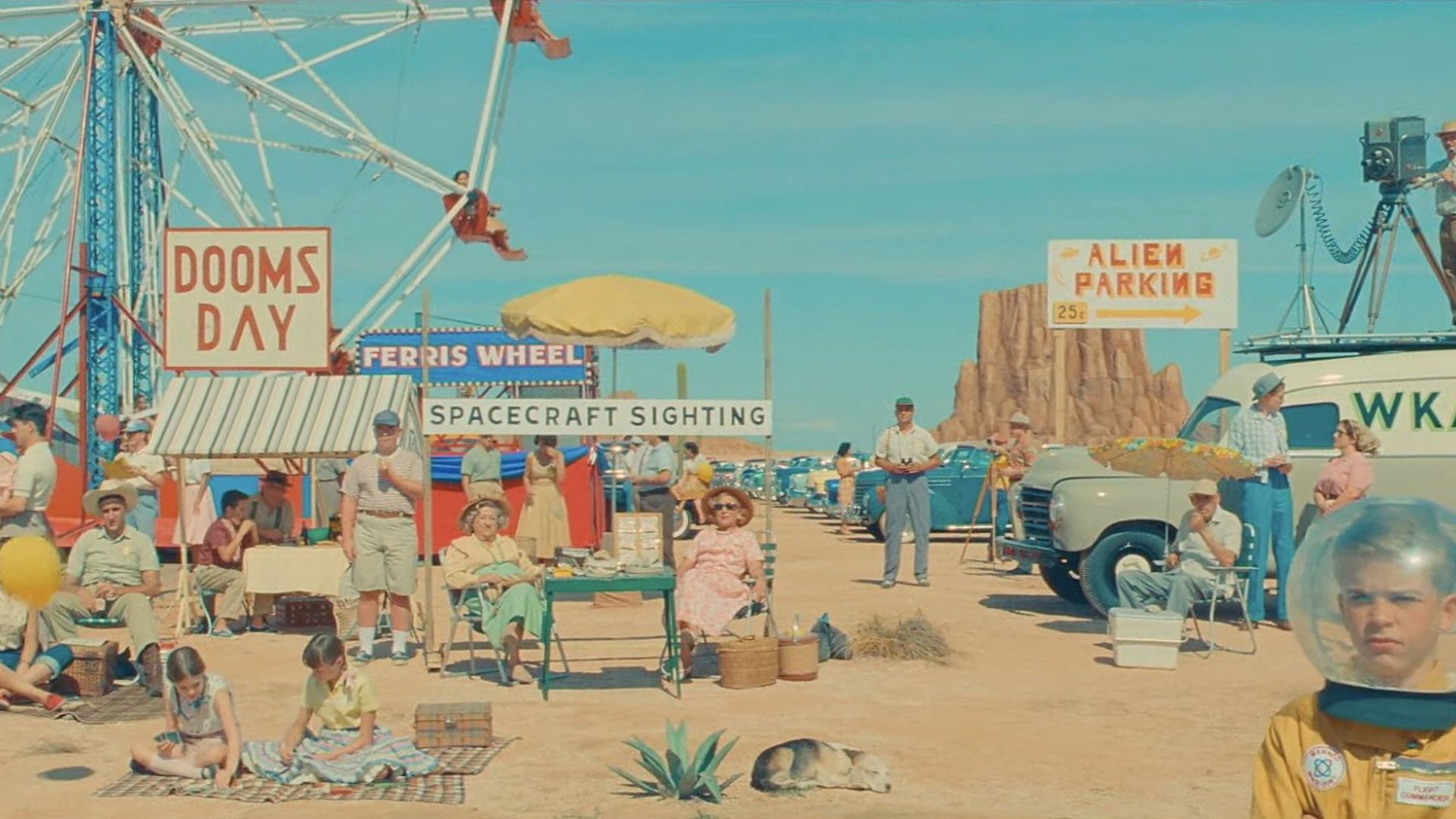
1955- Viewers are treated to a filmed performance of the fictional play “Asteroid City.” In the play, five children and their families descend on Asteroid City, a ghost town near a nuclear testing site in the Mojave Desert known for its meteorite crater, where they are to receive awards from the military for various science projects. The play mostly focuses on war photojournalist Augie Steenbeck [Jones Hall (Jason Schwartzman)], who has not told his children of their mother’s death three weeks prior, who begins a relationship with Hollywood sex symbol Midge Campbell [Mercedes Ford (Scarlett Johansson)]. At the end of Act I, the grand awards ceremony in the crater is crashed by an alien [uncredited (Jeff Goldblum)], who drops in to steal the meteorite and traps everyone there in military quarantine as the U.S. government tries to stop any of this from getting out.
Between acts, a television host (Bryan Cranston) gives us an oral history of the performance and its writer, Conrad Earp (Edward Norton).
Anderson’s past three films have all been intense, personal tributes – The French Dispatch written as a magazine in the style of The New Yorker with every character modeled on specific writers, Isle of Dogs an animated tribute to Japanese filmmakers Akira Kurosawa and Hayao Miyazaki and The Grand Budapest Hotel a fictionalized memory of 20th century writers and the grand spaces in which they did their work.

I can’t help but expect a step down after all this, and “Asteroid City” is distinctly less intense and personal, no longer inspired by specific work and seemingly no longer saying anything specific. Anderson has said the film was written about the improvisation of the writing process and only became a pandemic movie because that’s when the pandemic struck, like an alien crashing an awards ceremony written as a metaphor for grief turning into a metaphor for COVID-19 – which itself primarily elicited grief, albeit a disguised form.
“Asteroid City” is a play within a film, and though there’s almost nothing in it other than the performance, it’s filled with constant reminders of this framing, right down to the quotation marks in the title – this is another distinct similarity to Grand Budapest and French Dispatch, both of which spend the vast majority of their runtimes telling stories within their stories, and again, it seems to have much more of a point in the previous films. The set is designed as a play backdrop, and in many shots, you can see the break between the stage and the background looking like an enclosure around the set, which is exactly what it was. The film’s melancholy, another Anderson signature, also seems aimless in contrast to his previous work.
“Asteroid City” is still a step down. It’s very slow, and not much seems to happen visually. The desert can be very photographically diverse, but not when you’re hanging out in the same place this long. The film marks every handful of scenes, but that mostly seems to be an intrusive reminder that we’re watching a play within a movie. It would have been better to just stick to the act breaks.

A lot of the emotional subject matter is also a retread for Anderson, and was better covered in his early work like The Royal Tenenbaums and Life Aquatic with Steve Zissou, but there’s also plenty that’s specific to this movie. We see much more cross-talking than we’re used to, all just as deliberate as the rest of the film, emphasizing poor communication in a different way.
There’s also a heavy emphasis on religion, with just about every character’s faith background mentioned at some point, and its impact on how characters approach the existential questions posed by the alien. The overarching metaphor is dealing with shattered belief systems, whether it be by an alien disproving various religions or because of the death of a parent, and extends into the beliefs shattered by the pandemic and other catastrophes of the past few years – selling unincorporated desert land outside of Asteroid City out of a vending machine stands out as a particularly keen expression of ‘20s ennui.
Is this what a half-assed Wes Anderson movie looks like? It’s still a Wes Anderson movie, with the pastel colors, themes of grief, distant fathers and overachieving sons, shifting aspect ratios, signature animation and a cast for the ages. He’s been making such distinctive work for so long, maybe he can make something like this seemingly on autopilot.
Leopold Knopp is a UNT graduate. If you liked this post, you can donate to Reel Entropy here. Like Reel Entropy on Facebook and reach out to me at reelentropy@gmail.com.
 Reel Entropy